


 45 / 196

[
] 43
were responsible for their safety, but were nonetheless inadequately
prepared. Different groups require different community education
approaches, which adds complexity as they are not always discrete,
easily identifiable groups. However, the active community involve-
ment in the preparation of the
Tamborine Mountain Escarpment
Management Plan
indicates that the community may be a resource
for fire services, necessitating further education of the fire services
themselves.
Community education: Children’s needs
for Tropical Cyclone Education - Stormwatchers
Effective disaster mitigation requires community education and
awareness. Emergency managers have formerly seen communities
as the adult population of a geographical location, but the most
immediate subgroup of any community is its children. The Centre
for Disaster Studies recognized children as a separate community
group when analysing vulnerability to cyclones in the northern
beaches suburbs of Cairns, in North Queensland during the mid
1990s. Internationally, the significance of children’s involvement in
disasters has been recognized by the United Nations as part of chil-
dren’s rights.
1
In many countries hazard education modules form
part of formal school curricula. The importance of hazard education
for children received further impetus after so many children died in
the Indian Ocean tsunami, and was addressed in the Hyogo
Declaration.
2
Researchers have shared findings of projects aimed at
children’s experiences in disaster and the importance of
educating children for hazard awareness.
3
After Tropical
Cyclone Larry devastated small communities to the south
of Cairns in North Queensland in March 2006, a group
of schoolteachers and mothers gathered children’s stories
of the cyclone and their survival as a means of aiding the
recovery of the children by encouraging communication
and the sharing of experiences. Cyclone Larry crossed
the Coral Sea in mid-March 2006, developing into a
severe category five as it approached the coast south of
Cairns, devastating the small towns of Innisfail and
Babinda and surrounding small rural settlements.
There are distinct phases to each cyclone that engage
the community. The precursor to many cyclones is the
development of the monsoon trough and of tropical low-
pressure systems, frequently bringing rain before the
storm develops. People become aware and once the
cyclone forms and is named, the watch intensifies.
During this period of increasing tension people make
preparations and clear up rubbish, but carry on life as
normal. After Cyclone Larry the Centre for Disaster
Studies carried out a household survey which addressed
this pre-impact period in order to understand prepara-
tory behaviour and the receipt of warning information.
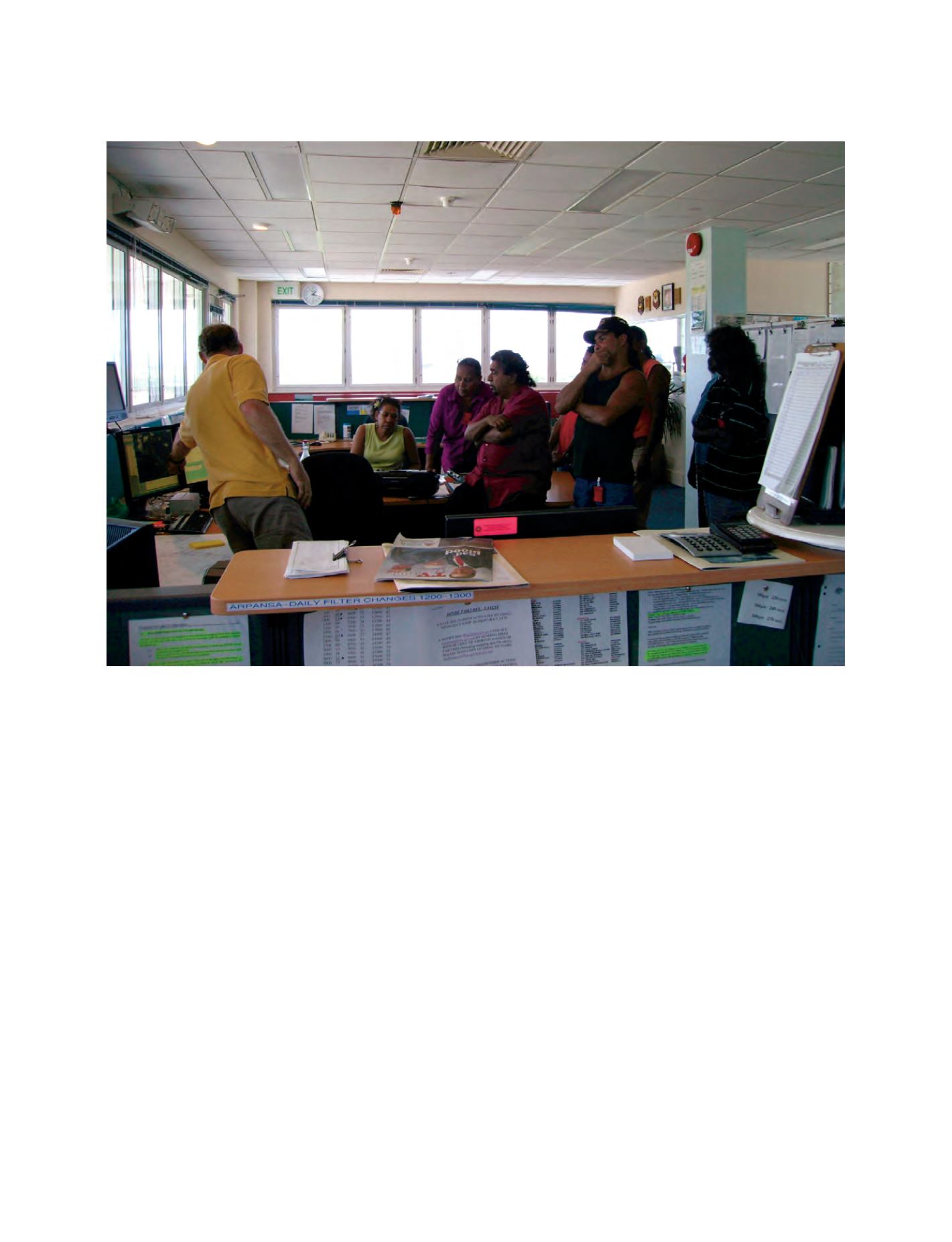
Community engagement: Weather Matters in Indigenous Communities Workshop and Evaluation Report
Image: David Lowe (Cottrell, A., Lowe, D., & Spillman, M. 2008)