


 51 / 196

[
] 49
Safety at sea – building resilience and
capacities of small-scale fishers in South Asia
Yugraj Singh Yadava, Director, Bay of Bengal Programme Inter-Governmental Organisation
T
he Bay of Bengal is a semi-enclosed tropical ocean basin
and forms the north-eastern part of the Indian Ocean. It is
surrounded by India and Sri Lanka to the west, Bangladesh
and the Indian State of West Bengal to the north, and Myanmar,
the southern part of Thailand and the Andaman and Nicobar
Islands of India to the east. The bay is a tropical ecosystem in a
monsoon belt, highly influenced by monsoonal winds and receiv-
ing large volumes of fresh water from both river discharge and
rainfall. It experiences south-west monsoon during June-
September and north-east monsoon during November-February.
This is a region which experiences regular depressions to super
cyclone, making the coastal areas of the countries surrounding it
highly vulnerable to risks and calamities.
The bay also covers some of the most productive waters in the
world, and supports a large population of small-scale fishermen:
some 6-8 million directly and an additional 35-40
million engaged in ancillary activities related to fish-
eries. The contribution of coastal fisheries from the bay
to nutrition and economic well being in the region is
substantial. Marine fisheries are a lifeline in the coastal
areas of the South Asian countries, such as Bangladesh,
India, Maldives and Sri Lanka.
The Bay of Bengal is exploited by 11 major countries:
Myanmar, India, Malaysia, Thailand, Bangladesh,
Indonesia, Sri Lanka, Japan (main islands), Taiwan,
Korea (South) and Australia, as well as some smaller
countries. During the period from 1950 to 2005, fish
landing in this region increased from 0.91 million tonnes
in 1950 to 5.16 million tonnes in 2005, recording a
cumulative annual growth rate of 3.18 per cent. In
recent years, capture fisheries in the region have expe-
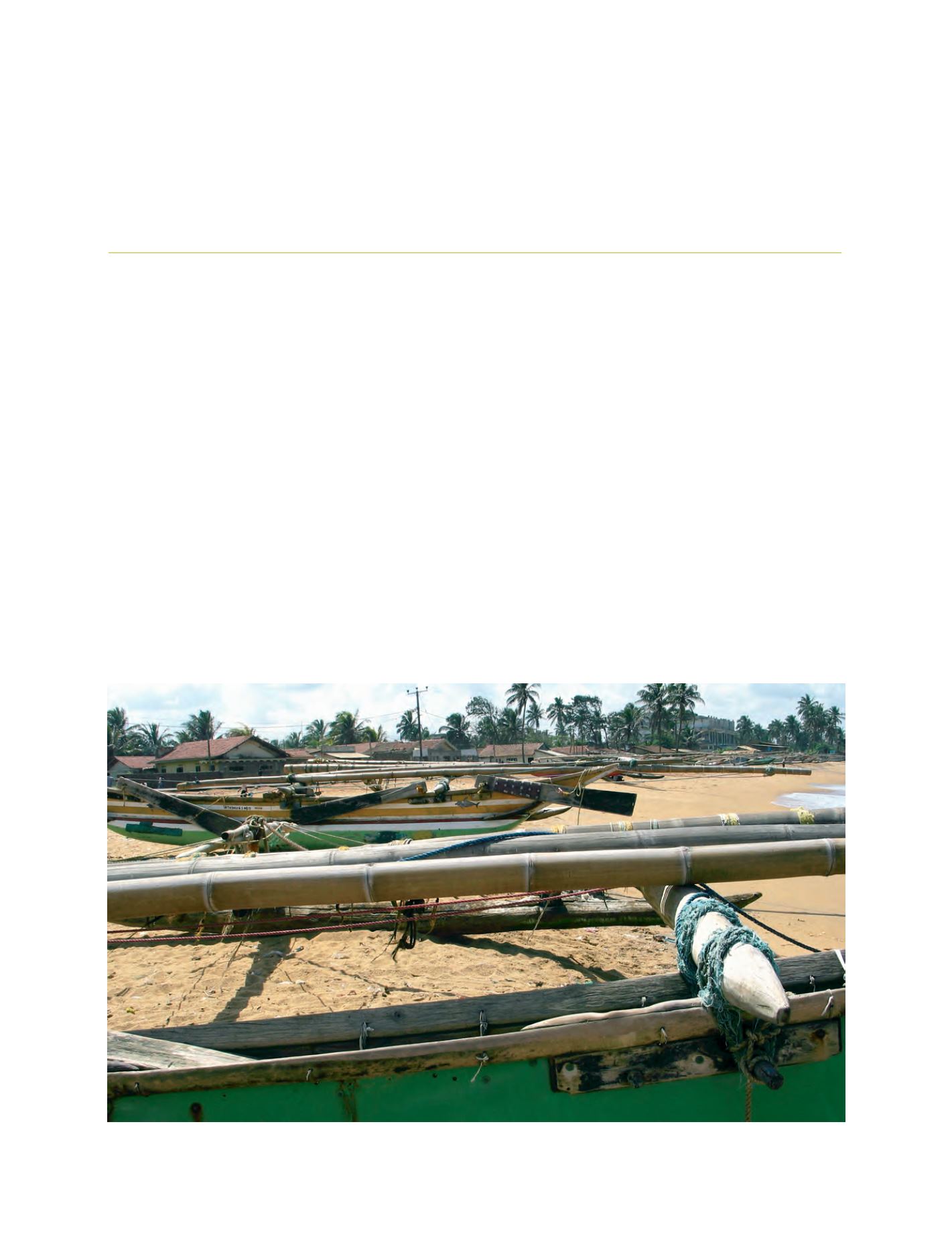
Fishing boats (Orus) idling on a beach in a village in Negombo, Sri Lanka
Image: Yugraj Yadava