


 52 / 196

[
] 50
Programme
1
of the Food and Agriculture Organization
(FAO) of the United Nations in Chennai, India from
8-12 October 2001. This workshop discussed various
issues impacting the safety of small-scale fishers at sea.
The most significant output of this regional initiative
was the ‘Chennai Declaration on Sea safety’, which
resolved to effectively meet the challenges through
holistic fisheries management, adherence to manda-
tory requirements, installation of regulatory
mechanisms, community involvement and education
and training. The full text of the Chennai Declaration
is included in this article.
The Chennai Declaration recommended that the
issues of sea safety be addressed on an urgent basis.
Keeping this in mind, several initiatives have been made
in the BOBP-IGO member-countries in South Asia
(Bangladesh, India, Maldives, Sri Lanka). Based on crit-
ical analyses of the factors that affect the safety of
small-scale fishers, it can be summarized that the most
important factors contributing to increased accidents
and fatalities at sea are: open access to fisheries and
excessive fishing effort; increased competition among
different categories of fishers; reduced profitability;
rienced a slowing growth rate, leading to fishers moving offshore in
search of catch.
Increasing human population and reduced productivity of coastal
fisheries through unsustainable fishing practices, habitat degrada-
tion, post-harvest losses, etc. threaten the livelihood of millions of
small-scale fishers in the Bay. Given that coastal resources, particu-
larly near-shore resources, are exploited close to, if not beyond
sustainable levels, improving the management of fisheries and the
safety and health of fishers is of immediate concern.
Safety at sea of small-scale fishers
Fishing has been recognized as the most dangerous occupation with
more than 24,000 deaths per year. These figures originate from those
countries where a sound database exists on fishing related fatalities
and accidents. If figures were included from those countries where
no surveillance and monitoring, or an inadequate mechanism for
this, is in place, the annual figures of deaths at sea would be much
higher. The large number of fishing-related mortalities, especially in
the developing countries, is attributed to weaknesses in the institu-
tional and regulatory environment, a declining resource base and the
poor socioeconomic condition of the fishers.
A Regional Workshop on ‘Sea Safety for Artisanal and Small-
scale Fishermen’ was organized by the former Bay of Bengal
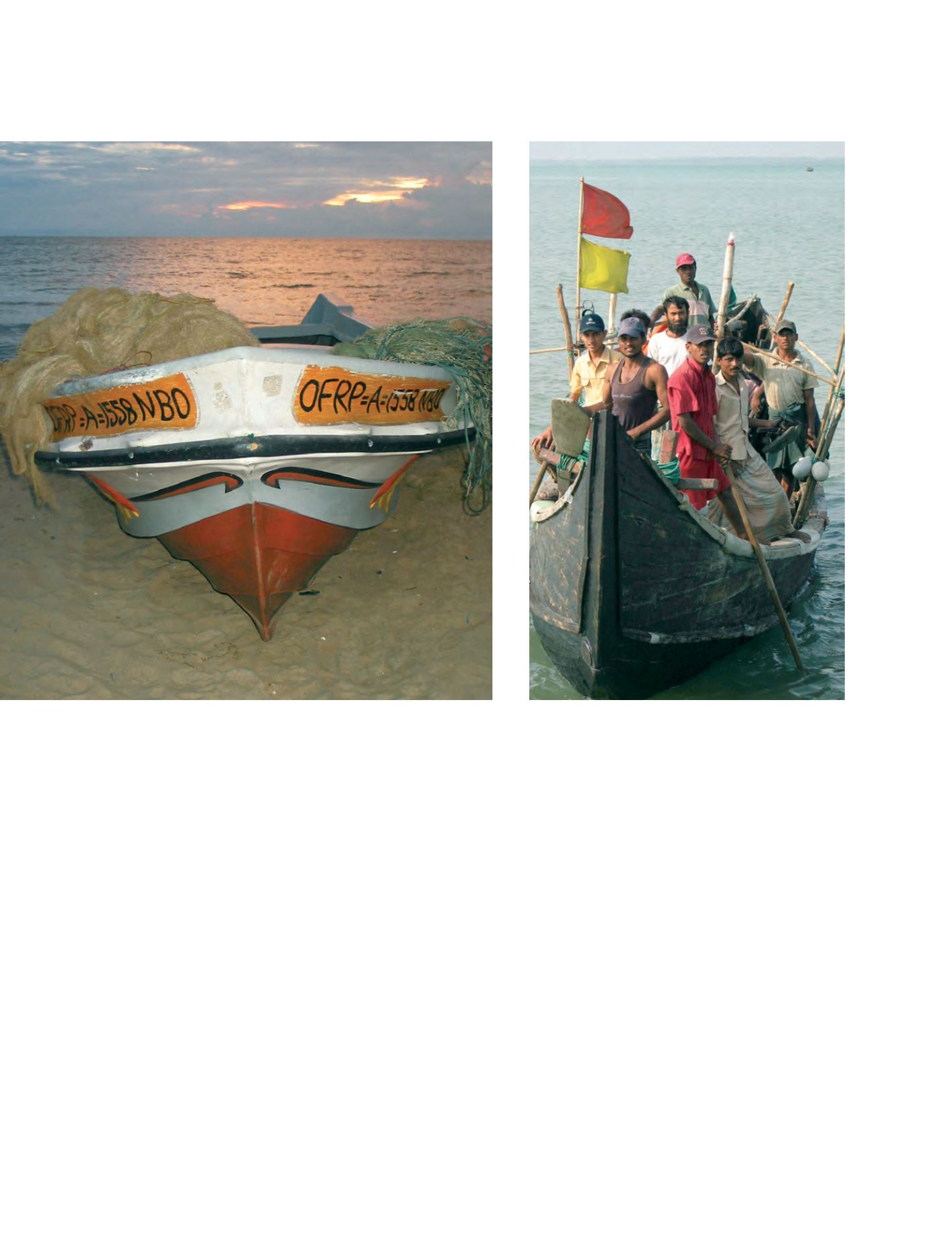
An FRP traditional boat (Oru), Negombo, Sri Lanka
Image: Yugraj Yadava
A wooden boat returning from a fishing trip, Teknaf, Bangladesh
Image: Yugraj Yadava