


 49 / 196

[
] 47
inundation warning’ provide better advice on the level of risk, which
is easier to communicate to the community. The category of no threat
is particularly important, as it eliminates 90 per cent of public
concern that results from international and national media reports
of weak and/or distant seismic events. The Bureau of Meteorology is
utilising public focus groups and media advice to ensure clear and
fast messages are delivered to the public. A science programme and
updated instrumentation now support these stratified warnings.
Australia’s second deep ocean tsunami buoy is located just off an
earthquake fault line to provide maximum warning lead time. This
is one of several different types of detection instrumentation.
Interactions with emergency agencies are a key component
throughout the warning process. Australia has pursued strong inter-
national ties to ensure that other countries in the Southwest Pacific
and Indian Ocean have the capacity to put in place similar systems
and public campaigns.
Indigenous broadcaster training
In remote parts of Australia, particularly in the tropics, there are
many indigenous communities that are isolated from the mainstream
media. The Broadcasting for Remote Aboriginal Communities
Scheme (BRACS), was introduced in the late 1980s, providing
resources that would allow indigenous communities to broadcast
locally produced radio and television as well as managing content
received from the mainstream networks. BRACS stations often
provide a community’s only significant portal to the
world.
One important task these stations perform is broad-
casting the news and local weather, including official
warnings for hazardous conditions. Presenters are drawn
from the local communities and receive limited training
in the basics of broadcast techniques. While this is suffi-
cient for the provision of an adequate broadcast service,
it can be lacking in some of the finer points of broad-
casting – importantly, the process of providing
information on hazards to the community, which relies
on the broadcaster’s understanding of the hazard, the
scope of the risk, and the relevance to the community.
These remote communities are vulnerable to events
like tropical cyclones and severe thunderstorms. When
official weather warnings are issued, these presenters
need to pass the message to the community so they can
take appropriate action. This includes translation of the
warning into the local indigenous dialects. Since the
presenters are from the community, they will generally
know the needs and capabilities of the community. What
may be lacking is knowledge of community vulnerabil-
ities, and understanding of the warning they are
broadcasting.
To address this knowledge shortfall, a workshop was
held in 2007 to determine training requirements. The
following requirements were identified:
• Brief layman’s summary of meteorological phenom-
ena and their causes
• Summary of severe weather phenomena and threat
to the community, along with the provision of
public education materials (posters, brochures,
disaster mitigation checklists etc.)
• Explanation of common terms used in forecasts and
warnings
• Hands-on exercises using synoptic charts, radar and
satellite imagery, and forecasts associated with past
significant events.
Also recognised was the need for the Bureau of
Meteorology to avoid the use of overly technical or
obscure language in its products. A product accurate in
the pure grammatical sense of its construction and word
use may be unintelligible to many users, particularly
those for whom English is a second language.
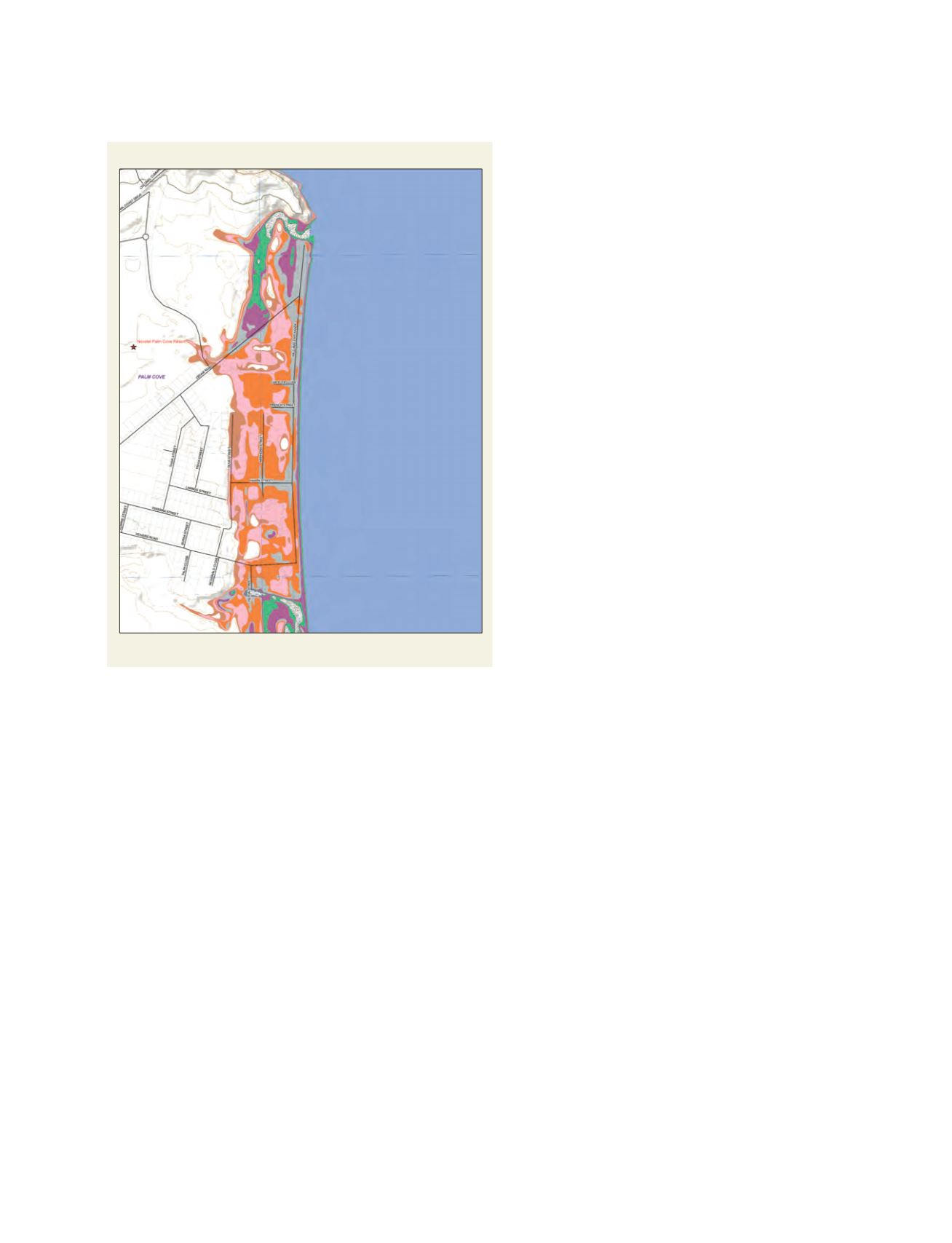
Queensland storm surges under climate change
The Queensland east coast is impacted most years by
tropical cyclones that typically cause severe winds, storm
surge and extreme wave conditions over a wide area. To
better assess the likely impacts, the Queensland Climate
Change and Community Vulnerability to Tropical
Cyclones project updated and extended previous esti-
mates of the storm tide inundation risk in Queensland.
The project scope included the effects of extreme wave
conditions in selected areas, and estimates of potential
enhanced greenhouse climate impacts within the full
context of the naturally complex climatic variability of
tropical cyclones.
Storm tide hazard guide
Cairns emergency zones
Source: © State of Queensland