


 57 / 196

[
] 55
response, injuries, damage and subsequent trauma are
significantly reduced.
Since its establishment in 1999, the fundamental driver
of the New Zealand Ministry of Civil Defence &
Emergency Management has been to work with its stake-
holders to increase the capability of communities and
individuals to prepare for, respond to and recover from
disasters. It does this by working closely with the CDEM
Groups (a consortia of local and regional authorities),
central government, emergency services and lifeline util-
ities involved in civil defence emergency management.
The ministry’s objective is to make New Zealand and
its communities resilient by understanding and manag-
ing their hazards. The overarching strategy for achieving
resilience is through a risk management approach based
on the ‘4 Rs’ – Reduction, Readiness, Response and
Recovery.
This approach starts with recognizing the hazards we
face and the vulnerability of our communities and infra-
structure to those hazards. By addressing what these
hazards could do to us, the focus is on measures for
reducing the risks and for managing the impacts when
they occur.
Get Ready Get Thru
In 2006 the ministry launched its ‘Get Ready Get Thru’
programme, a long-term national public education
programme aimed at increasing individual and commu-
nity preparedness for disasters.
influenza epidemics collectively accounted for more than 12,600
deaths. The 1886 Mount Tarawera eruption and the 1931 Hawke’s
Bay earthquake were the most significant natural events of this period,
with 153 and 256 deaths respectively.
Since the mid-1900s relatively few people have died from natural
hazards, with most hazard deaths attributed to transport accidents
– the 1953 Tangiwai train derailment with 151 deaths, the sinking
of the Wahine in 1968 with 51 deaths, and the Mount Erebus crash
in Antarctica in 1979 with 257 deaths.
In more recent years there have been a number of flood, earth-
quake, volcanic, and severe weather events in New Zealand, which
have caused evacuations of people, disruption to services and damage
to property, but few deaths.
Recent international events, particularly the 2004 Boxing Day
tsunami, have had a significant impact in heightening awareness of
the likelihood and impact of disasters.
The National Civil Defence Emergency Management (CDEM)
strategy for New Zealand identifies four main goals:
• Increase community awareness, understanding, and
participation in civil defence emergency management
• Reduce the risks from hazards to New Zealand
• Enhance New Zealand’s capability to manage emergencies
• Enhance New Zealand’s capability to recover from disasters.
The fundamental principle underlying the strategy is that while disas-
ters cannot be prevented, it is important that those who live in New
Zealand understand the causes and risks, and know the steps to take
to ensure they remain safe. Worldwide experience has shown that
where people are aware of the risks around them and plan their
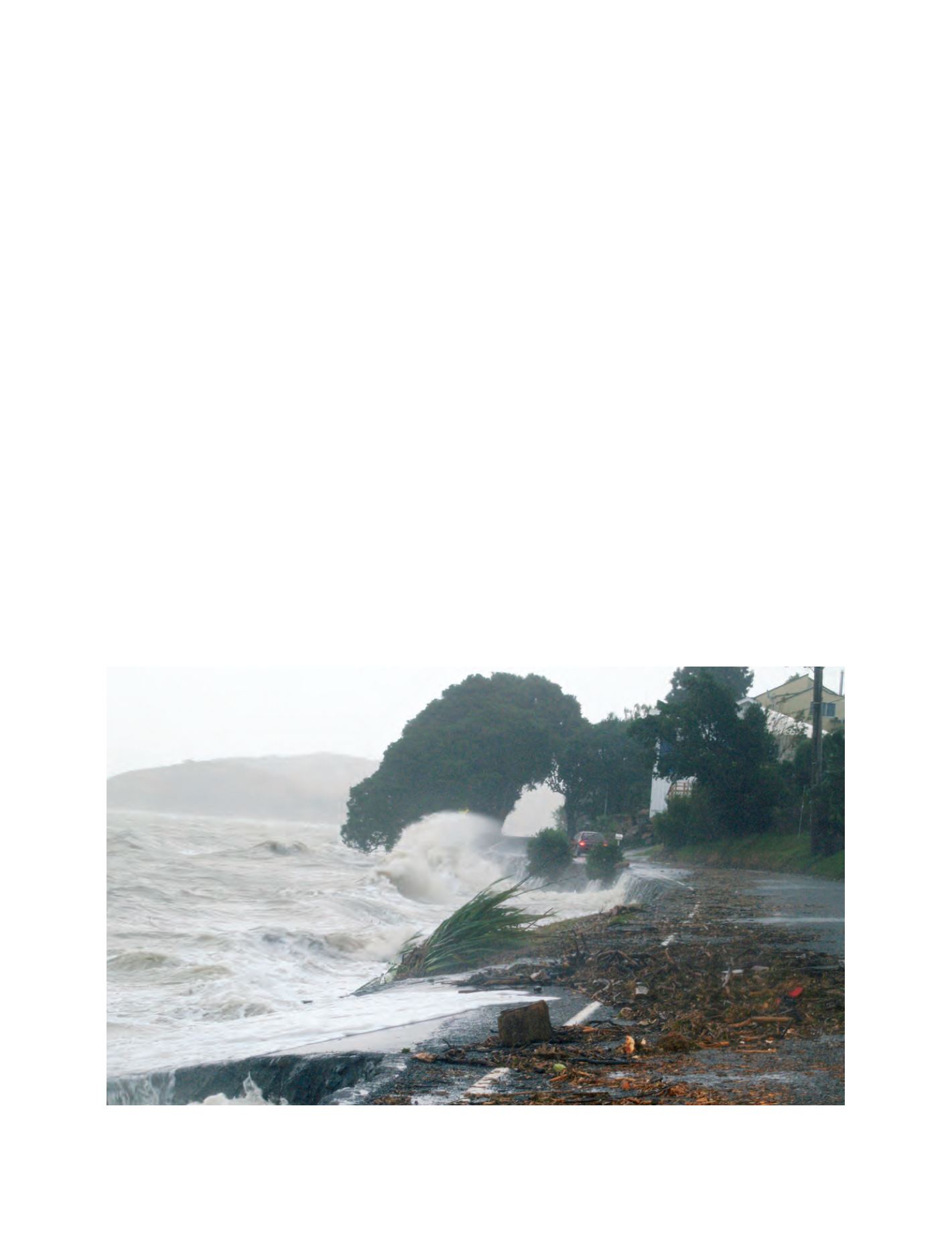
New Zealand’s 18,000km of coastline is constantly changing, shaped by frequent high swells and occasional storm surges.
Photo taken during the 2007 coastal storm in Northland at the top of the North Island
Image: Northland Regional Council