


 60 / 196

[
] 58
Building inherent resilience
Manu Gupta, Sustainable Environment and Ecological Development Society, India
T
he continued high loss of life due to disasters in areas where
disaster reduction practices have been introduced questions
the efficacy of current practice. The paradigm shift towards
community-based disaster management (CBDM) practice, though
rightly intentioned, has to be examined in the light of practical
experiences. Without questioning its purpose, that is, to build
community resilience, it is worth attempting to find an alternative
approach to CBDM. At the core of the proposed alternative
approach is the need to recognize and build on a community’s
own coping skills and practices that are rooted in traditional rela-
tionships with its immediate natural environment.
CBDM is now an accepted and widely practiced strategy in disaster
vulnerable regions. Essentially, it puts community at the forefront of
local disaster management efforts. External agencies then become
facilitators of the process. In developing countries such as in South
Asia, where disasters are recurrent and heavy in impact, such strate-
gies help communities prepare better to respond to disaster
situations.
In recent decades there has been a marked increase in losses due to
natural disasters. Changes in societal living patterns, technological
advancement and increasing pressure on the natural envi-
ronment have made human existence increasingly
unsustainable, often leading to disasters. At the same time,
there is an increasing amount of investment in disaster
reduction interventions. Have these interventions really
been effective? Have they really been successful in reduc-
ing the impact of disasters among vulnerable
communities? Each large-scale disaster exposes the inad-
equacies of interventions so far, and at the same time
questions their basic methodology and approach.
Effectiveness of CBDM
When words are put into action, there is often a wide
gap in the way CBDM is understood on the ground. An
overview of CBDM strategies implemented around the
world clearly suggests that while communities at risk
are put at the centre, the solutions are often imposed
from outside.
Moreover, as pointed out during a recent national
meeting of community representatives on disaster risk
reduction in India,
1
communities become vulnerable
because:
• An overemphasis on technology masks social, polit-
ical and economic issues that underline
vulnerabilities
• Many development policies and programmes create
or increase vulnerability
• Reconstruction and development policies sometimes
increase vulnerability which leaves disaster struck
communities worse off
• Community knowledge and solutions are getting
lost due to non-recognition.
Every individual is endowed with an inherent capacity
to overcome any extreme adversity in his life. The inher-
ent capacity, if properly recognized, honed and
sustained, can lead to fewer lives lost due to natural
disasters.
Several methods used in CBDM – that is,
Participatory Rapid Appraisal from group discussions,
such as disaster mapping – are aimed at identifying root
causes of vulnerability; but solutions do not always
appreciate the existing coping practices of the commu-
nities. Traditional systems are often discarded, as they
are considered ‘obsolete’ and therefore cannot be repli-
cated in the contemporary context.
It is important to define here the scope of the commu-
nity’s own coping capacity. While most communities are
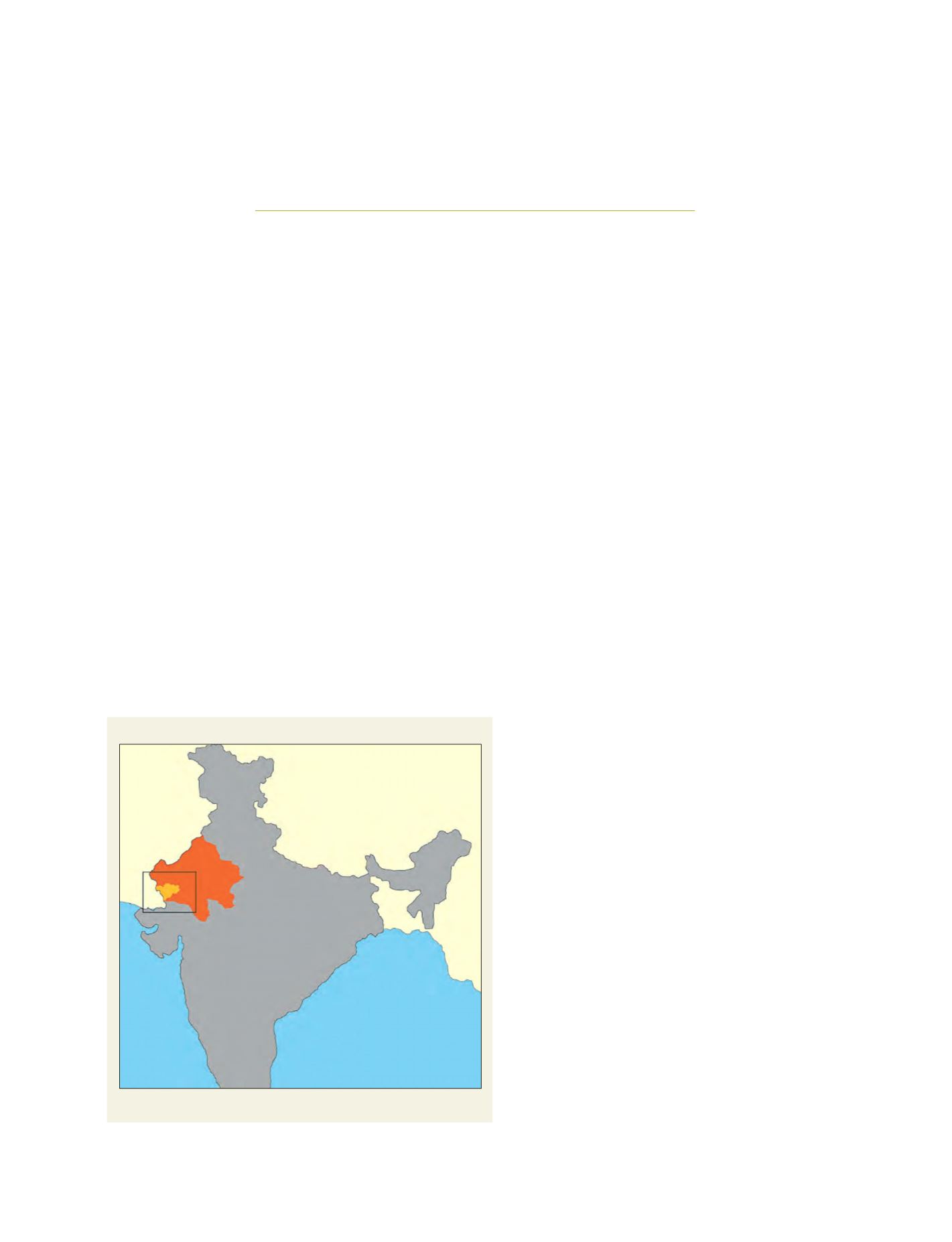
The Barmer district of Rajasthan
The Barmer district experienced unprecedented floods in 2006
Source: Safer World Communications