


 66 / 196

[
] 64
provides financial protection against drought conditions for up
to 400,000 people in Africa
• In Mexico, the state-owned reinsurance company Agroasemex
insured small cattle ranchers against droughts and other
climatic events that would reduce the animal feedstock on their
pasture. Swiss Re supported the transaction as an international
reinsurer
• In Canada, Swiss Re insured the state of Alberta against wildfire.
The insurance scheme helps the Forest Protection Division of
Alberta finance the cost of fighting wildfire and restoring
damaged forest.
Developing countries affected most
The effective reduction and financing of catastrophic risks requires
a combined response by both private and public sector players. As
complexity and costs rise, single organizations can no longer meet
the challenge alone. This is particularly true for developing coun-
tries, which, besides having fewer funds, also bear the brunt of global
warming. Public-private partnerships can help governments absorb
catastrophes – and thus also provide individuals and businesses with
greater financial security.
As a first step, governments and the private sector must work
together to raise awareness of risks and their possible solutions
through risk transfer schemes. This is critical as many perils have
rather low probabilities – i.e. long return periods – and are thus
frequently ignored. Major earthquakes are an example. Risk aware-
ness also includes showing possible solutions for risk prevention, as
well as for risk transfer and financing.
Partnership in risk transfer and financing
For insurance to work effectively, governments must ensure a frame-
work that allows market mechanisms to work unhindered.
Government intervention in a functioning insurance market should be
limited, since it can trigger unexpected side effects such as moral
hazard and may lead to further interventions rather than addressing
the root causes. For example, public and semi-private
insurance schemes that keep rates artificially low may
encourage homeowners to stay in highly exposed areas,
thus further increasing the burden of natural disasters for
society and the public sector.
The public sector plays a key role in setting a legal
framework that enables risks to be transferred to insur-
ers, reinsurers and the capital markets. In addition to
passing the necessary legislation, it must provide insur-
ers with efficient access to its markets.
In some situations, governments and international
organizations can help to expand the availability of risk
transfer solutions for individuals and corporations. For
example, they can encourage or enforce the creation of
‘risk communities’ through compulsory insurance in
order to establish a critical mass and make an event
insurable.
Governments may also act as reinsurers in order to
supplement private insurance schemes. For example,
governments – and NGOs – can encourage the devel-
opment of an insurance market by initially subsidising
insurance premiums. However, the public sector should
limit its involvement in order to avoid establishing false
incentives. Instead, it should focus its intervention on
expanding the availability of insurance schemes – with
the ultimate aim of establishing an efficient private-sector
market.
Public-private risk transfer partnerships clearly have
an important role to play in managing the increasing
level of disaster expenses. They enable the public sector
to fund disaster relief before – instead of after – a cata-
strophe occurs. As a result, governments will be able to
deliver immediate relief to the victims of climate cata-
strophes without creating a significant sudden burden
for public finances.
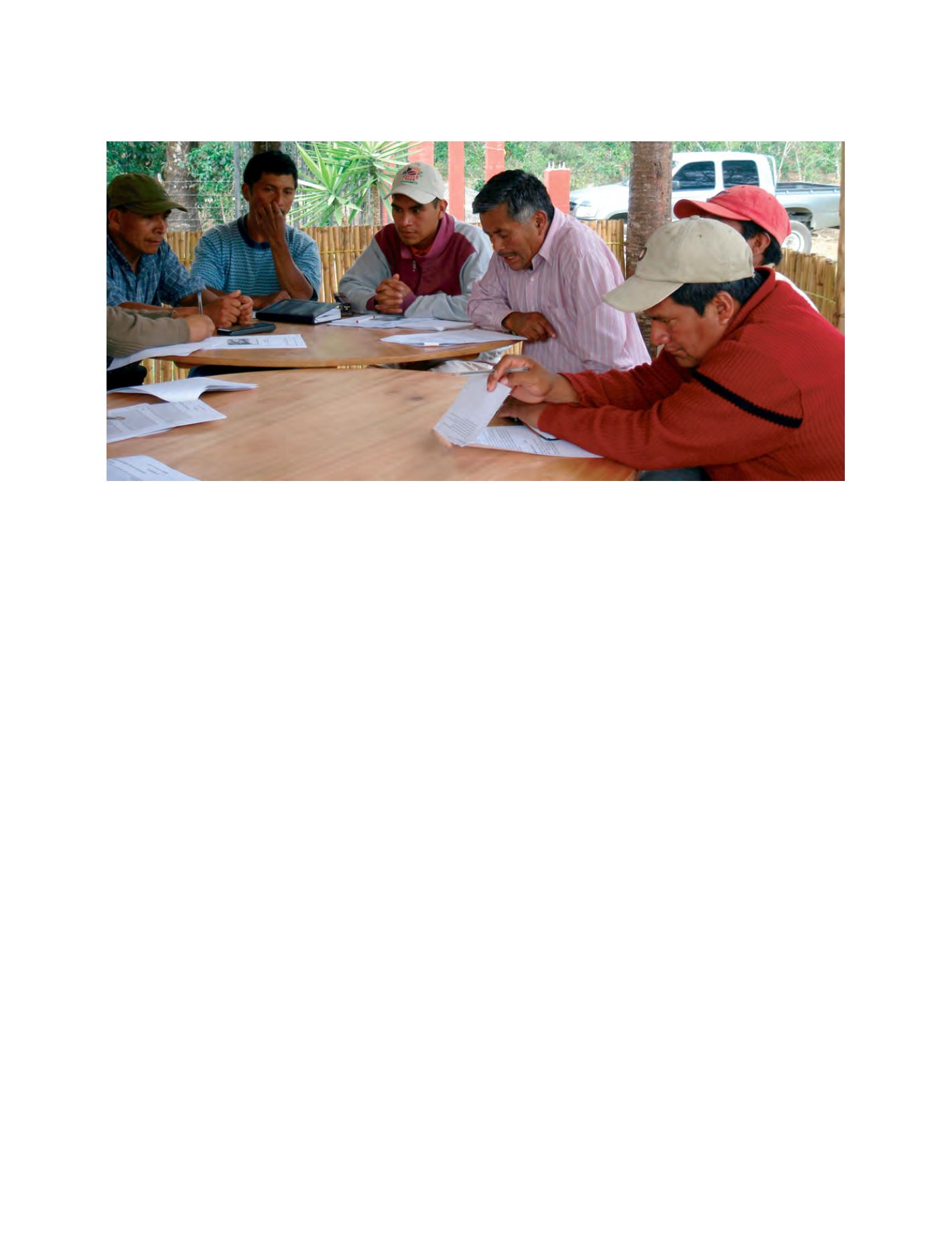
As part of a ‘Vivamos Mejor’ project supported by Swiss Re, a community in the Atitlán region of Guatemala develops
risk mitigation measures against natural catastrophes
Image: Vivamos Mejor