


 67 / 196

[
] 65
A model for learnership training programmes
in disaster management at higher education level:
a South African case study
A.J. Jordaan, University of the Free State; D. Pillay, Council for Scientific and Industrial Research,
and J. Madiba, Department of Science and Technology, South Africa
D
isaster preparedness essentially refers to a set of measures
that seeks to minimize the adverse effects of hazards that
result in loss of life and property, and it can be argued
that it is the responsibility of every individual as much as it is
the responsibility of governments and government agencies.
There has been a concerted effort to move from disaster manage-
ment practice to disaster risk reduction. It is primarily for this reason
that the key role players in this domain identified capacity building
as one of the more important strategies to mitigate disasters. Enabler
2 of the South African disaster management framework specifically
addresses disaster risk management priorities in education, training,
public awareness and research. This enabler describes mechanisms
for the development of education and training programmes for disas-
ter risk management and associated professions, and the
incorporation of relevant aspects of disaster risk management in
primary and secondary school curricula.
An affected community will need all the strengths and resources
available that can reduce the level of risk, or the effects of the disas-
ter. Therefore a community will need skilled personnel
with appropriate leadership and management attributes
to ensure the safety and security of the people. Many
organizations have taken the initiative to ensure that
training and development interventions are given prior-
ity, and we see greater involvement and investment from
government.
Funding model and key role players
The University of the Free State (UFS), in partnership
with the Department of Science and Technology (DST)
and the Council for Scientific and Industrial Research
(CSIR), has designed and successfully implemented a
graduate learnership in disaster risk management. This
learnership programme gives full-time as well as part-
time Masters students the opportunity to combine
theoretical work and practical experience as preparation
for the workplace.
CSIR, whose role is manifold, serves as the imple-
menting agency for the DST. However, the role of CSIR
is complemented by other key players such as the
University of the Free State, Department of Provincial
and Local Government (DPLG), Department of Water
Affairs and Forestry (DWAF) and others such as
Municipalities and Metros. The efficient and effective
execution of the programme depends a great deal on the
support and co-operation of these institutions.
The bulk of the funding is provided by the DST and in
2007 DPLG and DWF also began contributing. As a result
of the success of the programme, DST provided a further
USD650,000 for the 2008 and 2009 academic intakes.
Recruitment process
A rigorous recruitment process is conducted to ensure
that high calibre, committed students are enlisted for
the training. As a result of advertisements in the
national media more than 800 applications were
received for the 2008 intake from which only ten
students were selected. The CSIR put in place a very
comprehensive induction programme which included
appropriate training interventions such as technical and
scientific report writing, presentation skills, creativity
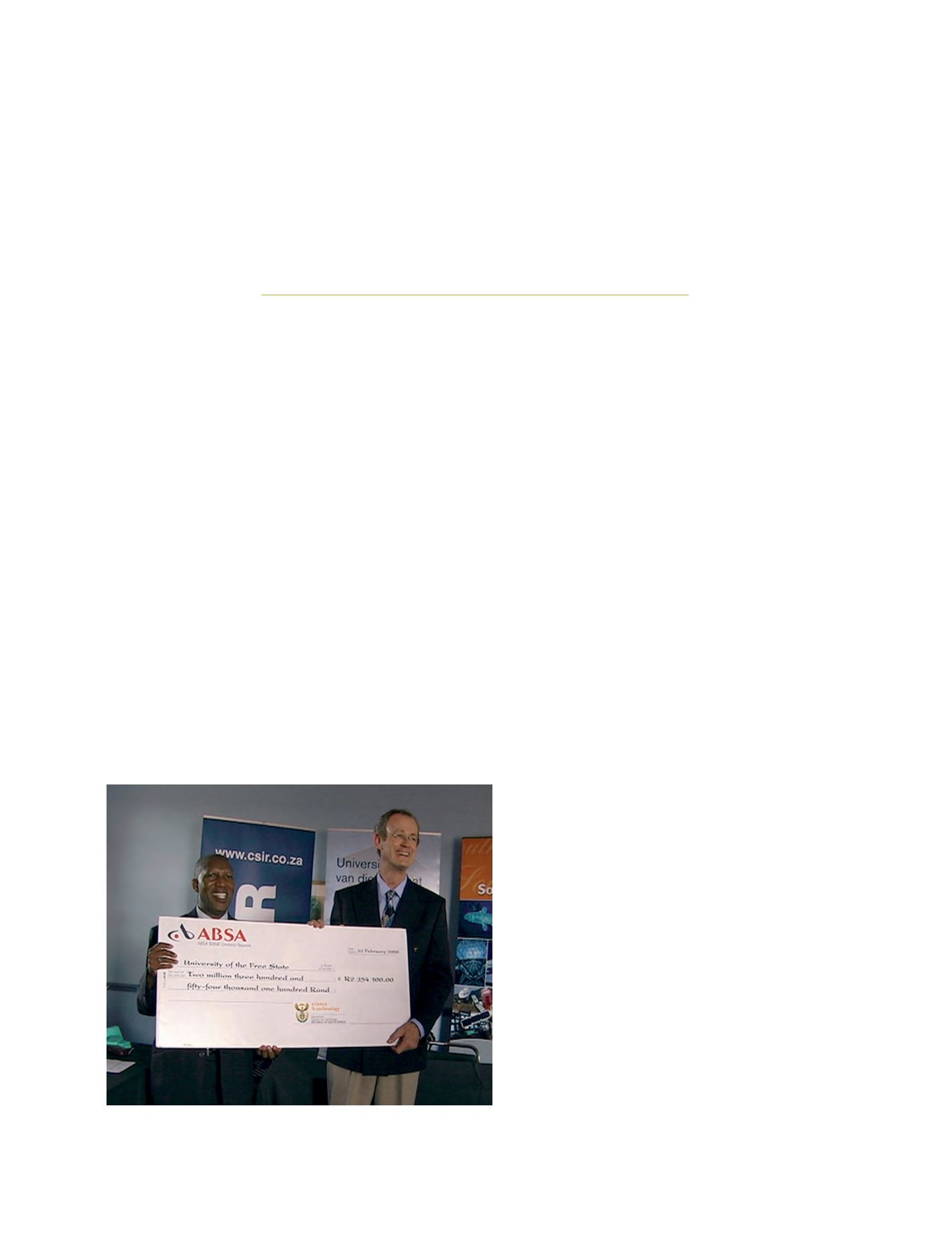
Mr J. Madiba from DST hands the first cheque of ZAR2.3 million to acting rector of
UFS, Prof. Verschoor
Image: DiMTEC