


 73 / 196

nities facing frequent disaster, the Philippine National Red Cross has
focused on community mitigation measures, which can involve phys-
ical structures, health related programmes or planning tools. Much of
the work in disaster risk reduction across the National Red Cross and
Red Crescent Societies is done by volunteers.
Tying it all together
The problem with disaster risk reduction among the membership of
the International Federation is that it is difficult to measure and
track, undertaken as it is by National Societies using resources from
many different sources. Currently, for the first time, the International
Federation is attempting an assessment of disaster risk reduction
across the organization, looking to identify the scale and scope of
the work being done and developing indicators against which to
measure future results. This coincides with the launch of the Global
alliance for disaster risk reduction, a means by which the federation
will attempt to scale up its work, focusing on target countries. The
programme will highlight the needs of communities and the reduc-
tion of their vulnerabilities.
More than this, however, the International Federation is keen to
increasingly identify itself with the global disaster risk reduction
agenda and to identify its own contribution to this agenda. Thus,
the focus will shift to creating support for the building of commu-
nity resilience, with the emphasis on core activities that
National Red Cross and Red Crescent Societies tradi-
tionally do well. These include community-based
disaster preparedness and early warning, awareness-
raising and education, and advocacy with governments
through the role that National Societies play as auxil-
iaries to government in disaster related issues.
Additional to these core activities will be country and
hazard-specific activities related to the individual
country’s needs. Bound together, this will become a
Framework for community resilience which will iden-
tify the Red Cross Red Crescent brand in disaster risk
reduction. In parallel, the International Federation has
launched a five-year strategic framework for food secu-
rity in Africa, emphasising the importance of this area
for disaster risk reduction on that continent.
The overall objective will be to orientate the National
Red Cross and Red Crescent Societies to support
communities in achieving safety and resilience, in the
face of disaster risk which threatens to be an increasing
problem because of climate change, the growth in urban
environments, environmental degradation and other
risks as yet unidentified.
[
] 71
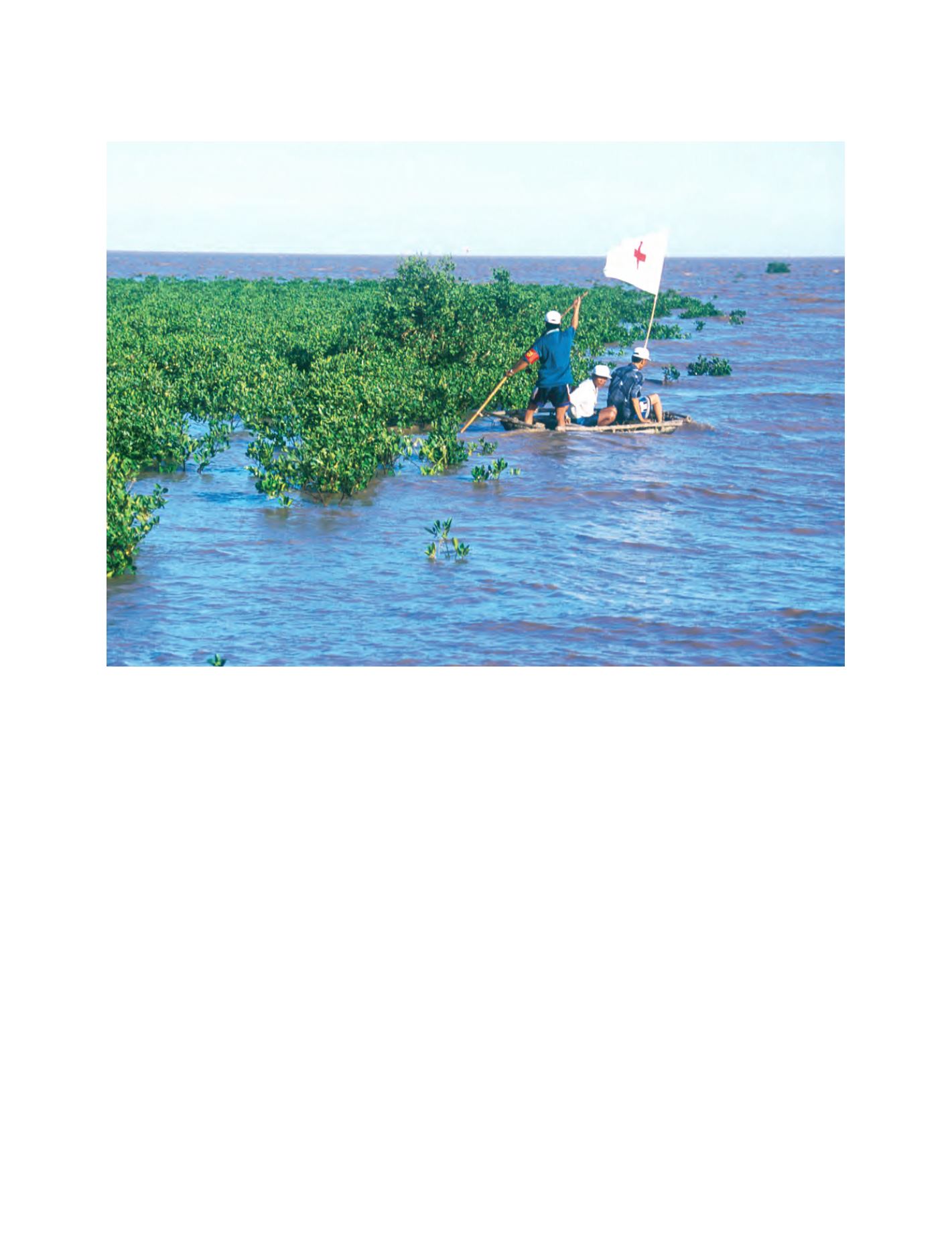
As a part of risk reduction activities for floods, the Red Cross of Viet Nam has planted and is maintaining over 11,000 hectares of mangrove trees along the seaward
side of the sea dykes in eight provinces in the past three years. Here, a group of the Red Cross of Viet Nam volunteers from the Hai Phong branch making a routine
check of the growth of the mangrove trees
Image: ©
Yoshi Shimizu/International Federation