


 70 / 196

[
] 68
Supporting community resilience – the approach
of the International Federation of
Red Cross and Red Crescent Societies
Mohammed Omer Mukhier and Kenneth Westgate, International Federation of Red Cross and Red Crescent Societies
T
o many people, the International Federation of Red Cross
and Red Crescent Societies (International Federation) is
viewed as an organization focused strictly on humanitar-
ian action in times of conflict and natural disaster. Others may
have a wider view, noting the National Red Cross and Red
Crescent Societies’ involvement in first aid training, the dona-
tion of blood, running ambulance services and other health and
care activities.
Few would identify the organization as being at the forefront of the
drive for disaster risk reduction despite the publication, nearly 25 years
ago, of the landmark Swedish Red Cross report
Prevention Better Than
Cure
. Disaster risk reduction is not necessarily seen as something that
the National Red Cross and Red Crescent Societies do. Part of the
problem is in the language – ‘disaster risk reduction’ is a relatively new
term that appeared to confuse even further the profusion of already
established terminology. But essentially, disaster risk reduction is not
something that the International Federation is seen to be involved with.
Closer examination, however, reveals that not only has the orga-
nization been involved in the implementation of disaster risk
reduction for years, but also that it has the kind of inter-
nal structure and established base that makes it a perfect
vehicle for activity with a community focus as well as a
long-term timeline. National Red Cross and Red
Crescent Societies work through a system of branches,
often growing out of the communities that they repre-
sent. Thus they have virtually permanent community
contact, are often in close touch with the needs and aspi-
rations of their communities and are able to tackle some
of the issues highlighted by progressive disaster risk. In
addition, National Red Cross and Red Crescent Societies
are permanent, national institutions and most of them
have been established for many decades.
International Federation policy and the decisions
of the statutory meetings
The key to unlocking the International Federation’s
involvement in disaster risk reduction can be found in
global policy statements and in the decisions of statu-
tory meetings. The guiding policy document
The
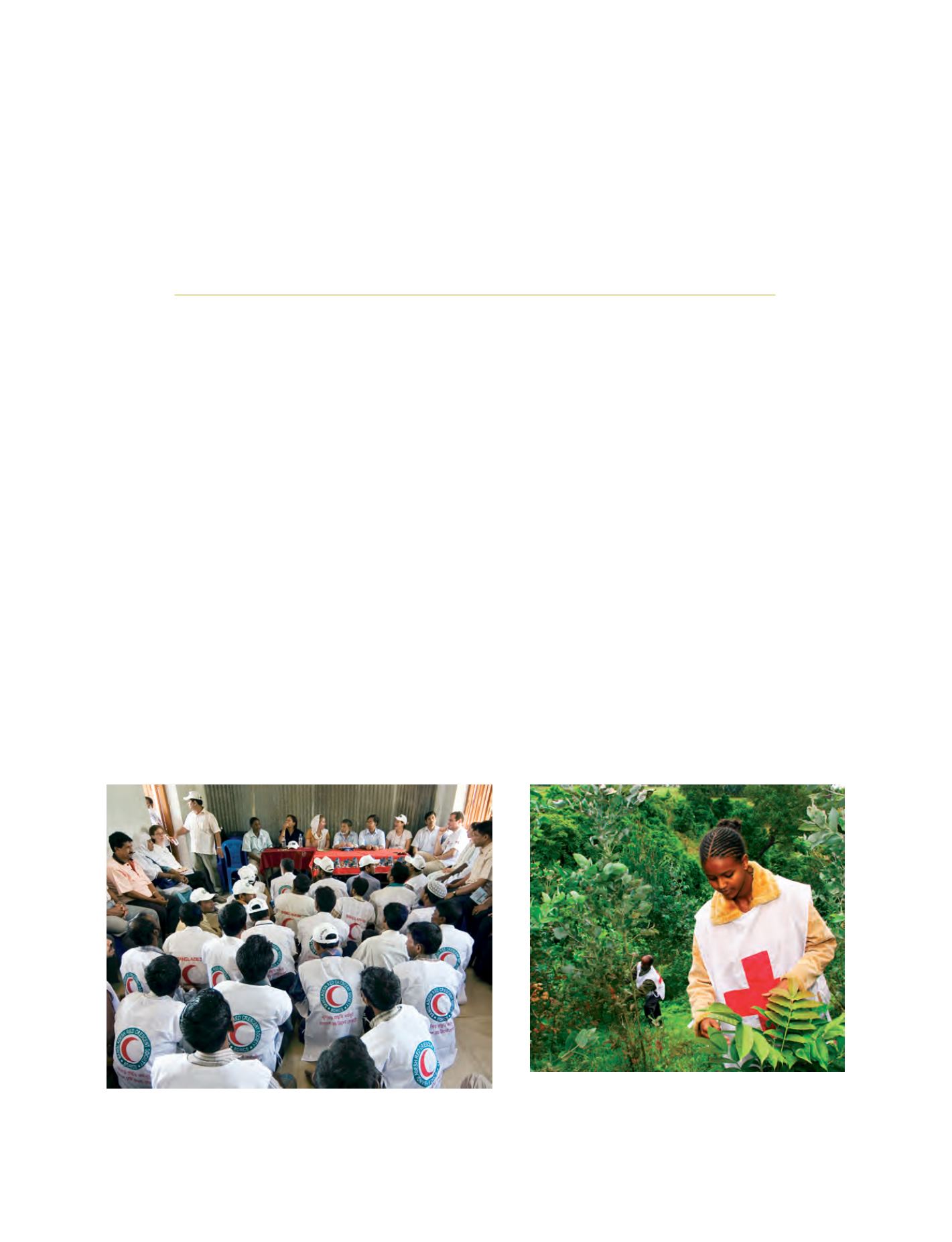
Community Disaster Preparedness Committee members and volunteers in a meeting
with the Red Cross and Red Crescent along with European Community representative of
Babugonj Red Crescent in Barguna, Bangladesh, 2 June 2007
Image:
© Shehab Uddin/Drik/British Red Cross
Arsi, Ethiopia. Alem Bekele, an Ethiopian Red Cross Society volunteer,
tends Eucalyptus trees that have been planted in seven hectares of
field by the Ethiopian Red Cross Society as a part of an income
generating programme.
Image: ©
Yoshi Shimizu/International Federation