



 76 / 196

[
] 74
Neighbourhood Disaster Volunteers:
the crucial role of local residents
Barbara Dätwyler Scheuer, Swiss Agency for Development and Cooperation
A
critical lesson of major disasters – indeed, of worldwide
experience – is that most earthquake victims are rescued
by local residents, neighbours and family members, not
by professionals of the official disaster response system. The
reasons for this are apparent: the official response system
requires some time to mobilize and professional rescue teams
cannot be everywhere at once. Their information on the location
of the injured person is often incomplete, getting access to local
knowledge is a challenge and may take some time. In many cases,
access is restricted. Thus, in the crucial 72-hour period follow-
ing an earthquake during which the survival rate drops
drastically with every passing hour, local residents play a major
role. In the first 24 hours, over 80 per cent of rescues may be
attributed to local residents.
However, local residents are normally ill-prepared for disaster inter-
vention and rescue work. Their effectiveness is seriously constrained
by the lack of knowledge and skills, organization, and essential rescue
equipment. Poorly prepared rescuers may even cause unnecessary
injury to disaster victims and themselves. Furthermore, when profes-
sional teams do arrive on the scene, there is no clear basis for their
collaboration with the spontaneous local volunteers.
This analysis of the potential and weaknesses of disaster volunteers
underlies the concept of the Neighbourhood Disaster Volunteer
approach (NDV), which was initiated in Kocaeli Province with Swiss
Agency for Development and Cooperation (SDC) support in the after-
math of the 1999 Marmara earthquakes in Turkey. In
particular, the approach recognizes that the effectiveness
and sustainability of disaster volunteers depends on their
organization into neighbourhood-based groups. The
NDV approach embodies four working principles:
• Through appropriate training, organization and
equipment, the immediate response capacity of
NDVs can be significantly increased and maintained
over the long term
• Thanks to their organizational structure, NDVs may
be readily coordinated by the professional teams as
soon as these professionals arrive; the capacities,
equipment and local knowledge of the NDVs may
significantly enhance the effectiveness of the official
response system
• As local residents, neighbourhood volunteers can
have a significant impact on the state of awareness
and preparedness of the community at large by
conducting schools programmes, identifying specific
risks in the locality, providing leadership in damage
mitigation and assisting with recovery measures and
the return to normality after the disaster
• Finally, the tasks of training and supporting the neigh-
bourhood disaster volunteers may be managed to a
large extent by the volunteer network itself once it has
evolved into a self-sustaining civil society organization.
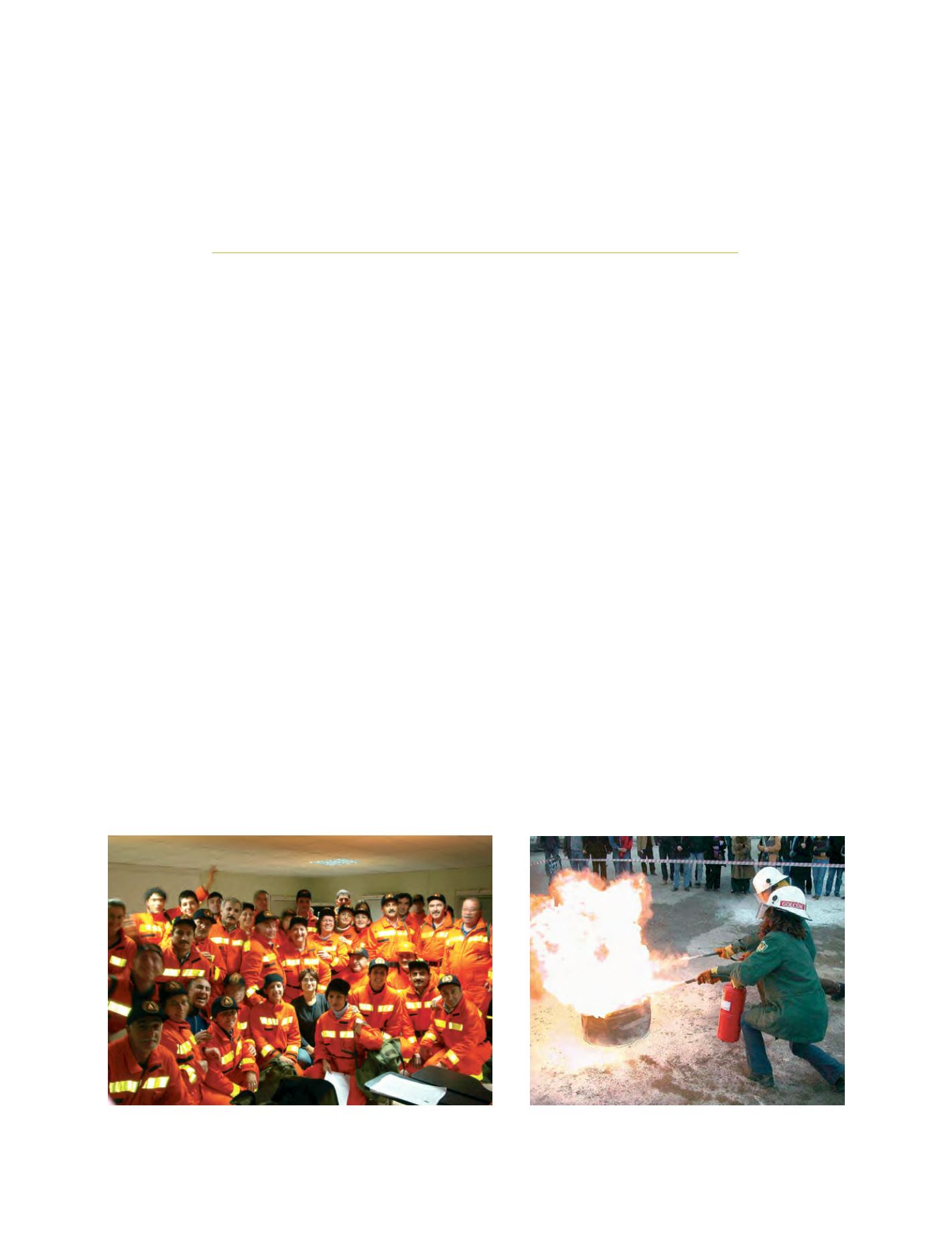
Appropriate training and equipment can increase the response
capacity of Neighbourhood Disaster Volunteers
Image: Neighbourhood Disaster Volunteer Foundation MAG
With the support of SDC, the Neighbourhood Disaster Volunteer approach prepares
local residents for rescue work
Image: Neighbourhood Disaster Volunteer Foundation MAG