


 79 / 196

[
] 77
bourhood head, who is official chairman of the NDC, and three other
members (and their alternates), who are elected by the volunteers
from their ranks. Elected committee members assume responsibility
for three main functions: volunteer coordination, logistics and the
assessment of risks and damages. NDVs become involved in aware-
ness building campaigns, school programmes and other public
service activities, while seeking to mobilize local support for their
mission. Today women account for 42-45% among the volunteers.
Women have a strong commitment and encourage their familiy
members to participate in NDV groups as well.
NDVs are linked in several ways to the official disaster manage-
ment system. First, the neighbourhood headperson implies
government involvement in the network through his/her position as
Chairman of the NDV Committee. Second, individual volunteers
are linked to the official system through their eligibility for regis-
tration as civil defence volunteers. While the NDVs respond directly
in the event of disaster in their neighbourhood, they operate under
the coordination of the civil defence authorities as soon as the
professionals are present.
At the provincial level, NDV associations have grown out of the
need of neighbourhood volunteers to secure the status and inde-
pendence of their local groups, interact with other neighbourhood
groups and act jointly in matters of common interest. Registration is
needed for practical matters such as obtaining telephone connec-
tions, and for more complex processes such as fundraising. The
provincial or intermediate level of organization is indispensable to
facilitate the provision of support to a growing number of active NDV
groups. As the associations become stronger, they are expected to
assume an increasing share of central support functions such as:
organization of refresher and advanced training; mobilization of new
volunteer groups; monitoring of equipment; organization of joint
exercises and social activities; public relations activities; and chan-
nelling district and provincial resources to the neighbourhood
groups.
Finally, a central support organization is needed to:
• Define and uphold NDV quality standards while safeguarding
the identity and effectiveness of the NDV network
• Mobilize and allocate resources required by the NDV network
• Provide necessary follow-up support to neighbourhood NDV
groups while strengthening the capacity of provincial associa-
tions to assume an increasing share of support activities
• Plan and coordinate inter-provincial NDV activities and further
expansion of the network
• Ensure a framework for cooperation among the NDV network,
civil defence authorities, and other stakeholders.
Current status
By mid-2008, about 3000 NDVs in 68 neighbourhoods of four
Turkish provinces have completed the basic training programme,
signed a volunteer cooperation protocol, received NDV ID Cards
and are active participants in the official disaster management
system.
The NDV model has gained national and international recogni-
tion. It has been recommended for implementation in Istanbul
Province within the Istanbul Seismic Mitigation and Earthquake
Preparedness Project, which is being implemented by the province
with World Bank financing. At the same time, the European Union
is using NDV as best practice in its Volunteers and Democracy in
Emergency Management Program.
Replication of the NDV approach has already
commenced in other countries. Preparations are under-
way to launch similar projects in the Medina of Fes,
Morocco and Amman, Jordan.
Testimony from Neighbourhood Disaster Volunteer
team members
As is known, it is impossible to assign professional search and
rescue teams simultaneously in case of disasters affecting
mass geographic regions and populations. It is essential to
take preparedness measures to perform efficient search and
rescue operations in the first 72 hours of the disaster, the
‘golden hours’. We as a civil defence institution provide and
support theoretical and practical training of members of
voluntary organizations to make them prepared in the face of
disasters.
Can Avci – Head of Civil Defence Brigade of Istanbul
We experienced the 1999 earthquake. We had no training on
search and rescue operations and how to help the injured
before the earthquake. We fell into a desperate mood as we
could not help others. We now develop our knowledge and
skills thanks to training we receive in the Neighbourhood
Disaster Volunteer Project. We have now self-confidence and I
am so happy to be a part of this voluntary initiative.
Celal Kara – Neighbourhood Disaster Volunteer
The NDV group has also contributed to our friendship. We now
know each other better. We discuss what we should and can
do in order to prepare ourselves for disasters and reduce the
risk in our own neighbourhood. We produce plenty of ideas
and the group helps us to focus on those that we can use.
Banu Tarim – Neighbourhood Disaster Volunteer
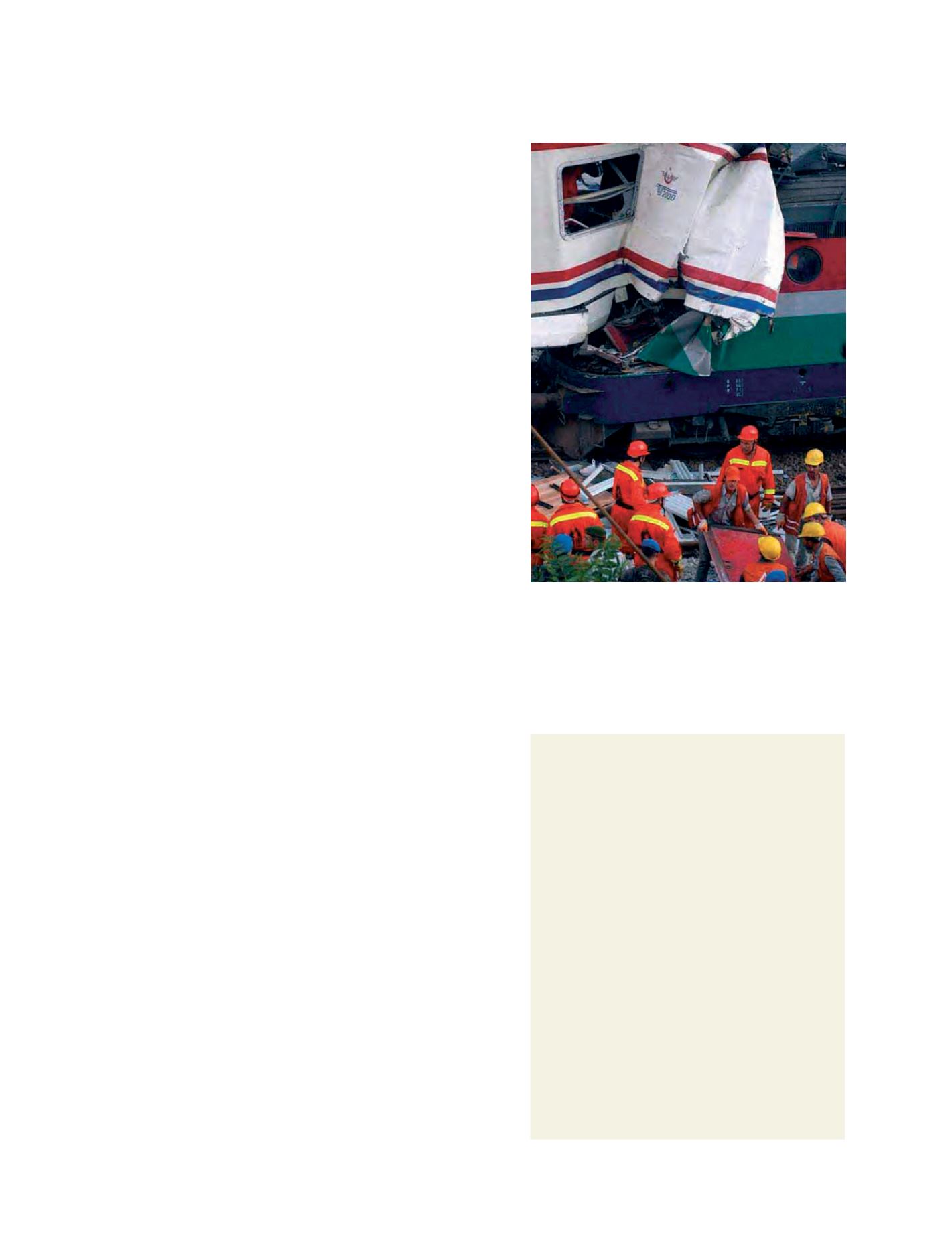
Neighbourhood Disaster Volunteers play a crucial role in saving lives
Image: Neighbourhood Disaster Volunteer Foundation MAG