



 81 / 196

[
] 79
conditions, substitution with ratooning rice
should be adopted immediately.
• As for rice plants that had reached the milking period,
five to seven days after the recession of the flood, If 20
per cent of the rice continued to burgeon, then the
rice paddy needed be harvested earlier, followed by
quick cutting of the rice stem. However, if fewer than
20 per cent of the rice plants continued to burgeon,
ratooning rice should again be immediately adopted
• If the rice paddy suffered serious flood stress, with
plant leaves slumped and damaged by chlorosis and
necrosis, the rice ultimately wilted in the sunlight. This
indicated that the rice was almost completely dead and
that the axillary bud could not normally elongate. In
this case, it was urgent to replant other crops.
The method of ratooning rice was introduced to miti-
gate flood disaster, which exploited the potential of rice
regeneration. Ratooning could adequately use light and
temperature resources, save both time and labour, and
alleviate the loss of food. The main technical determi-
nants for optimal use of ratooning rice to minimize the
damaging effects of flooding were to accurately judge,
cut the rice stems early, maintain the cutting-stem
heights as 20 cm, enhance fertilization (the application
of urea between 2,430 and 3,105 kg ha
-1
), and prevent
and control plant diseases and insect pests.
According to statistical results provided by the bureau
of agriculture and forestry in Sichuan province on 1
November 2007, the total farmland for ratooning rice
paddies were 18.2 hectares in the towns of Jiaming and
Fuji in Luxian county and the average yield was 4,950 kg
ha
-1
. Based on its market price of 1.70 RMB kg
-1
, minus
the input costs of fertilizers, pesticides and labour, farmers
are expected to earn a net income of 6,915 RMB ha
-1
.
The findings of ratooning rice have important ramifi-
cations for the world, especially to Asia, which faces the
task of feeding a fast-growing population with increas-
ing agricultural acreage being sacrificed for urbanisation.
the damage to the rice paddies, as determined by the effect on the
plant growth and development period, inundation time, growth
vigour, and so on:
• When rice is in the initial pregnation stage or just before this growth
period, the rice paddy should be reserved after the flood recession
• When the rice paddies were submerged for more than ten hours
in the pregnation and tasseling stages, the effects of flooding on
rice production and viability could be judged by the following
characteristics:
– Three days after the recession of flooding, although the plant
root grew normally, there was no dew on the leaf apex in the
rice paddy. This results demonstrates that the above-ground
parts of the rice had suffered serious injure and that ratooning
rice was needed. Moreover, the hydrophanous ears had devel-
oped a brown colour and some of them were rotting. It was
therefore, essential to cut the rice stem
– If 80 per cent of rice leaves in reciprocal two, three and four-
node positions were sharply elongated five days after the
recession of flooding, then the plant growth centres had trans-
ferred and the rice ears were damaged. Therefore, under these
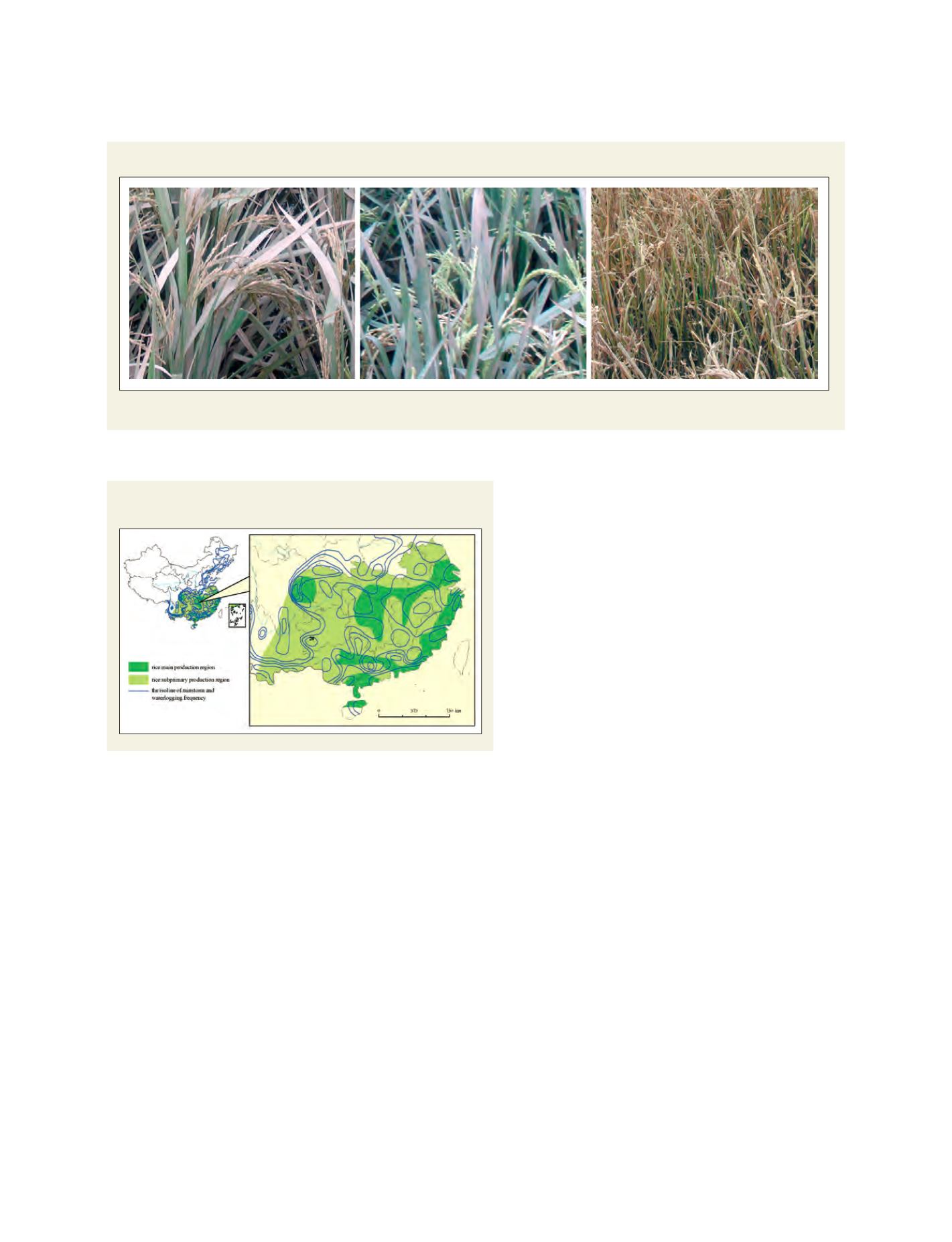
The growing vigour of a rice paddy with uncut-stems after the flood disaster
Source: IEDA, CAAS, China/Bai Wenbo
The frequency distribution of annual rainstorm and waterlogging in
rice main production region in southern China from 1961 to 2006
Source: IEDA, CAAS, China/Wu Yongfeng
16 July
20 July
20 August