


 82 / 196

[
] 80
Relief to risk reduction – a paradigm shift
Sanjeev K. Bhanja and Ramesh Babu, EFICOR
F
lood is a recurrent phenomenon in northern parts of Bihar
in India. The Dalit community, especially the Ram,
Paswans and Musahars, bear the brunt of flooding and its
resultant hazards. Women, adolescent girls and children are the
worst sufferers. The flooding and its aftermath badly affect their
living standards. Victims take shelter on embankments and
railway tracks, often under the open sky. Some take shelter on the
rooftops of school buildings or neighbours, if space is available.
Scarcity of food and drinking water compels people to consume
minimal amounts. People often drink contaminated floodwater thereby
risking diarrhoea and other water-borne diseases. Agricultural crops
are damaged and livestock is washed away. The floodwater destroys
road connectivity and communication between hamlets and villages,
thus cutting the community off from the nearby towns. Schools remains
closed for about three months during the flood season, which runs
from July/August to September/October. The post-flood season sees
heavy migration due to lack of wage opportunities in the agricultural
sector, which is the major source of livelihood for these communities.
Poor governance and improper service provision by the government
compounds the vulnerability of the flood-affected community in Bihar.
Bihar is one of the most populous states in India and is prone to
various disasters. It has a population of about 120 million and is one
of the poorest states in India, with about 42 per cent of the popula-
tion living below the poverty line. It is a land-locked central Indian
state that lies in the Gangetic basin, accounting for 16.5 per cent of
the flood-prone area and 22.1 per cent of the flood-affected popula-
tion of India.
A brief recent history of flooding in Bihar follows:
during the last decade the state was inundated at least
four times with the 2004 and 2007 floods being the
worst. The rivers that regularly inundate the plains are
the Kosi, Bagmati, Budhigandak and the Ganga and its
tributaries.
In 1999, 800,000 people were displaced due to floods.
During the 2001 flood 22 districts, 183 blocks, 1,653
panchayats and 5,477 villages were affected. It affected
81.28 lakh people and took 203 lives. The floods in 2004
affected over 9,333 villages spread over 20 districts in
the state, claiming 683 human lives and killing 2,354
livestock; and damaging about 717,000 houses in an
area of 4.986 million hectares. A population of over 21
million was affected and crops covering an area of 1.34
million hectares destroyed.
In early July 2007, Bihar faced its worst floods in 50
years due to heavy rains in the catchment areas in Nepal,
causing breaches in embankments along many parts of the
Kosi, Bagmati, and Budhigandak rivers and tributaries,
inundating the surrounding areas. The flooding affected
more than 9,333 villages spread over 28 districts in the
state, according to government reports. The flooding
claimed more than 900 human lives,
1
killed about 4,000
livestock and damaged 600,000 houses in an area of 4.986
million hectares. A population of over 21 million was
affected and crops covering an area of 4.34 million hectares
destroyed. Railway bridges and tracks were completely
washed out in several places.
Civil society organizations, non-governmental organi-
zations (NGOs, both international and national), bilateral
agencies and government have always responded to flood
emergencies in Bihar with relief assistance; as has the
Evangelical Fellowship of India Commission On Relief
(EFICOR), a national level NGO with expertise in relief
and disaster management. However, resource generation
for relief depends on the nature of coverage by national
and international media, particularly electronic.
Coverage of the 2007 south Asia flood by international
and national media shaped the mindset of international
government donors towards intervention.
In response to the flood emergency in Bihar in 2004,
EFICOR intervened with relief assistance in Madhubani,
Muzafarpur, Madhepura, Begusarai and Samastipur
districts, catering to the food, temporary shelter and sani-
tation needs of 21,000 families at a cost of USD500,000.
The story was repeated during the 2007 flood with fewer
families (16,000) supplied at a cost of USD300,000.
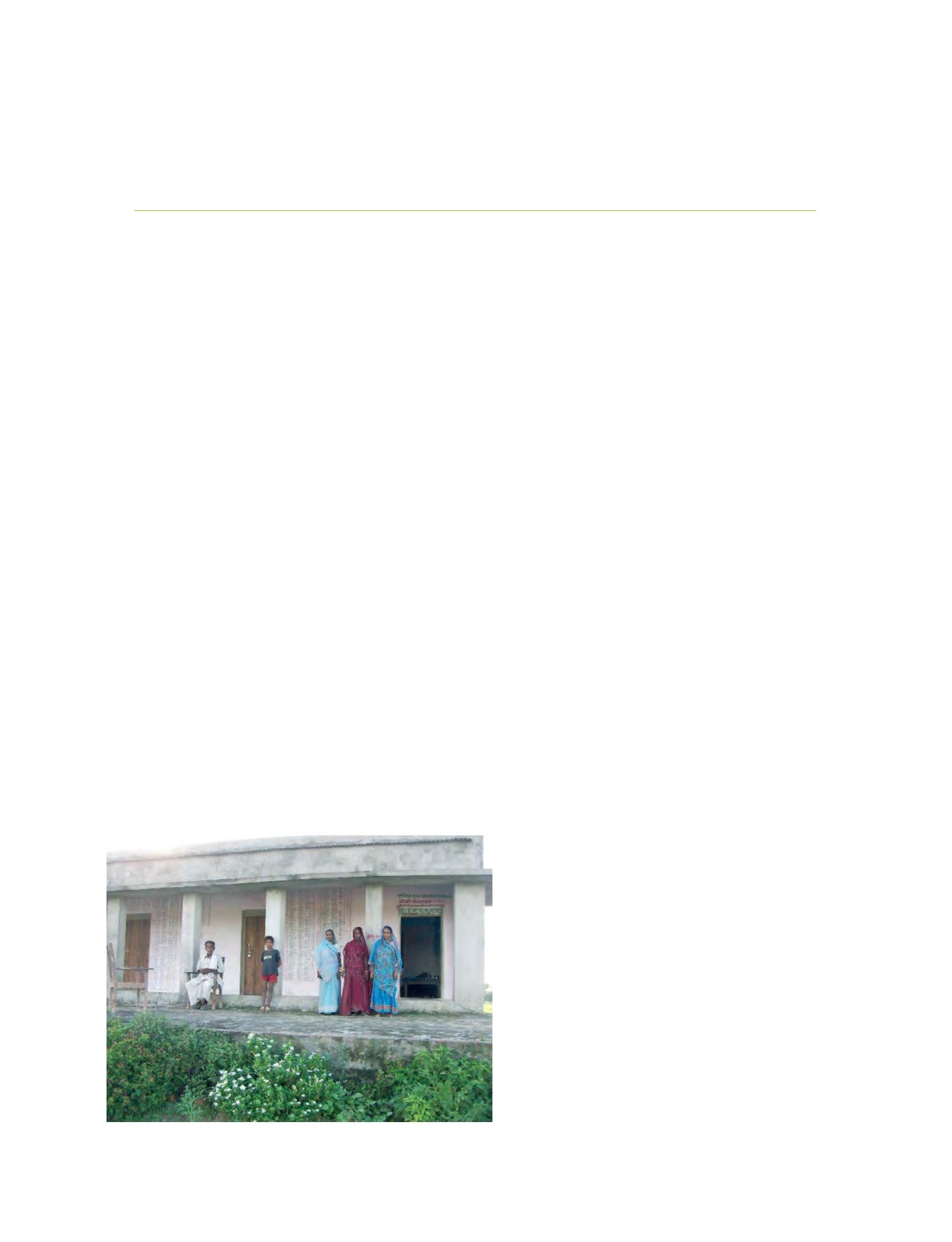
A flood shelter built on raised gound in Gandhrayan village
Image: EFICOR, DRR Project, Madhubani, Bihar