


 88 / 196

[
] 86
Toe the line for behavioural change: a capacity
development system for disaster risk management
Dr Rakesh Dubey, Disaster Management Institute, Bhopal;
Dr Christina Kamlage, InWEnt – Capacity Building International, Berlin; Dr Jürgen Bischoff, Director, ASEM;
Florian Bemmerlein-Lux, ifanos concept & planning, Nuremberg and Dr Sandhya Chatterji, ifanos concept India
O
n 23-24 April 2008, a key planning workshop on
‘Capacity Building for (industrial) Disaster Risk
Management’ (iDRM) was held in the city of Bhopal, the
site of a terrible accident in 1984 at the Union Carbide pesti-
cide plant – a deadly event that released approximately 40 metric
tonnes of methyl isocynate (MIC) into the atmosphere.
This incident sparked serious debate both in India and abroad on
the issues of chemical safety, and helped focus attention on protect-
ing people and the environment from ‘high consequence/low
frequency events’ by providing regulatory provisions to industries
as well as civil administrations. General consciousness about the
topic of risk rose. India enacted the 1986 Environment (Protection)
Act, which contained several regulations aimed at preventing any
future chemical accidents.
1
However, although India has created rules and regulations regard-
ing chemical safety, there is still a lack of proper monitoring and
implementation guidelines. Apart from adapting and detailing rules
and norms, what will matter in the long run is behav-
ioural change in the corporate sector, among the
regulating authorities and first responders, and in polit-
ical and civil society. A tragedy like the Bhopal accident
only provides momentum. It acts as a trigger to jump-
start change. As long as disaster preparedness is not
integrated into everyday traditions for ‘doing/not doing’
things, a repeat of the catastrophe remains a possible
scenario. The willingness and conviction to develop new
perspectives in prevention and preparedness have to go
hand in hand with changes in technical and management
capacities.
The last few years have been marked by a paradigm
shift in perceptions and discourse, and a corresponding
but slow change towards action.
Being proactive – a paradigm shift
The move from a reactive and relief-centred approach to
a more holistic and integrated approach will mean
nothing less than a sea change in how people think. It
places emphasis on the proactive phase of disaster risk
management. The primary goal becomes conserving
developmental gains and minimizing the loss of life,
livelihood and property.
Capacity development is the basis for a proactive strat-
egy that starts with building awareness about risks and
prevention; disseminating knowledge about threats,
potential dangers and their mitigation, and fostering
appropriate skills and expertise of key persons in educa-
tion, health, science, administration, the corporate sector
and civil society to plan, implement, respond to and deal
with disasters. Capacity development is a contribution
that has a long-term effect, and it has become one aspect
of policy concepts. India’s ‘National Disaster Management
Guidelines – Chemical Disasters’ from April 2007 state
that ‘there is a need to strengthen the existing training
institutions and set up additional training institutes in
fire, risk assessment, certification, safety audit and emer-
gency planning.’
Translated into more practical terms, this policy setting
has consequences for the core elements of capacity devel-
opment: building awareness, strengthening cooperation
and integration among actors/institutions, building up
knowledge and skills to perform, reinforcing the technical
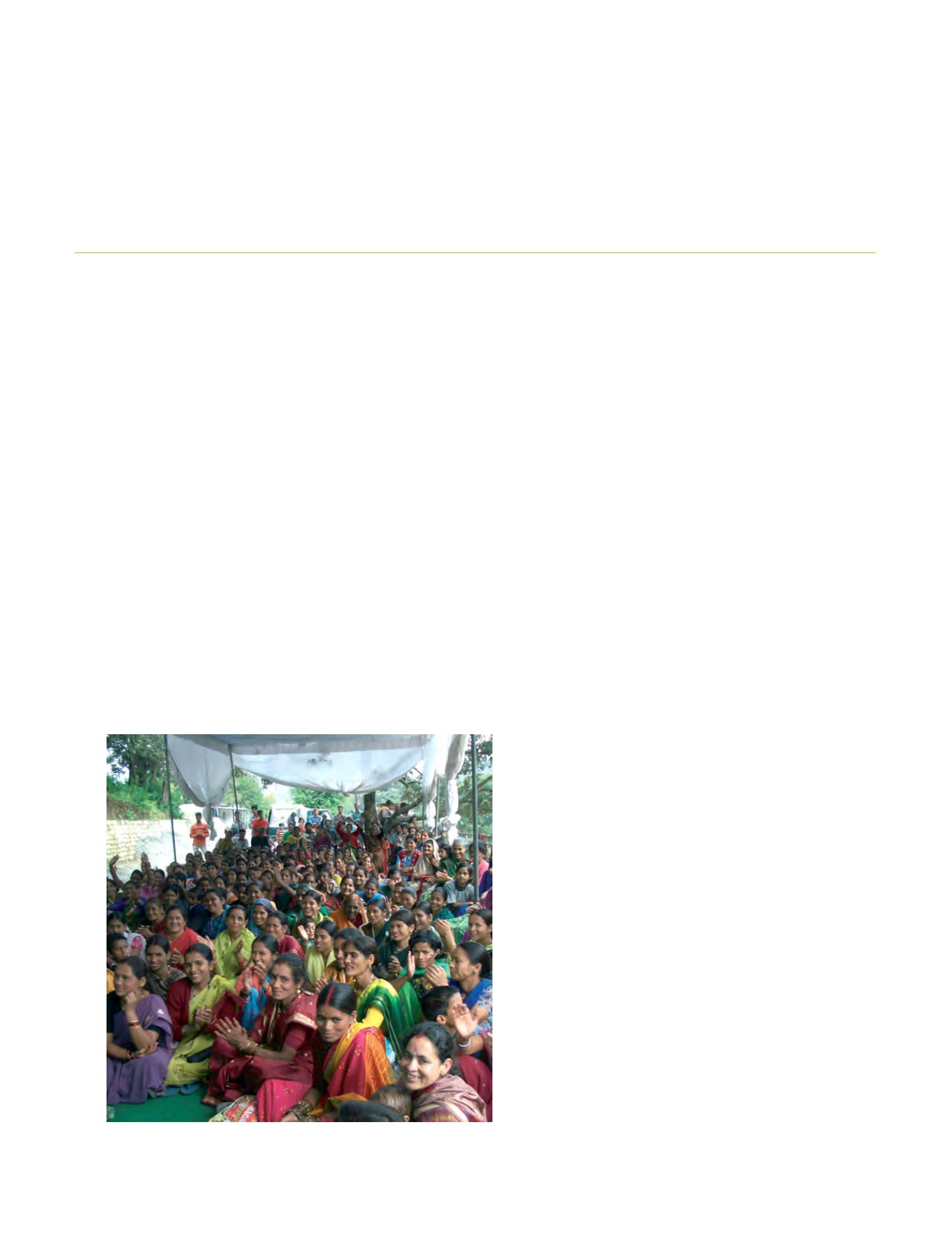
Acceptance: awareness campaign together with a community-based organization
Image: F. Bemmerlein-Lux