


 92 / 196

[
] 90
The centrality of risk management in
Concern Worldwide’s programming
Peter Crichton, Emergency Preparedness Coordinator and William Devas,
Disaster Risk Reduction Advisor – Emergency Unit, Dublin
C
oncern Worldwide is an international humanitarian orga-
nization dedicated to working with people living in extreme
poverty to achieve sustainable and major improvements
in their lives. Over the last five years, Concern has developed a
disaster risk reduction (DRR) policy, and delivered workshops in
all of our country programmes to consider how we analyse and
respond to risk and vulnerability facing communities.
We believe that the adoption of a more consistent approach to the
identification and management of risk should improve the quality,
appropriateness, design and sustainability of programmes and
improve the linkages and synergies within and between develop-
ment and humanitarian interventions.
Our operational context
All of Concern’s long-term programmes are in countries that fall in the
bottom 40 of the Human Development Index or have substantial propor-
tions of their population living in extreme poverty. Given the cyclical
nature of disasters in many of the countries in which we
work, there is an evident need to link our humanitarian
responses to these often recurrent disasters with a broader
approach that addresses underlying causes and vulnera-
bilities if we are to seriously address the causes and impact
of poverty. Many of the countries in which we work are
experiencing or recovering from conflict; have weak, under-
resourced systems of governance; and suffer from
inappropriate and unsustainable policies. In addition, many
are located in areas that are prone to floods, droughts, trop-
ical storms, earthquakes and landslides – hazards which
are often exacerbated by, or are a direct result of, poor poli-
cies and practice. The HIV/Aids pandemic and the
frequency of malaria have particularly high impacts on
many communities with whom we work as their liveli-
hoods are highly dependent on their own labour.
To this complex web of interacting hazards we must
add the rapidly evolving risk of climate change and the
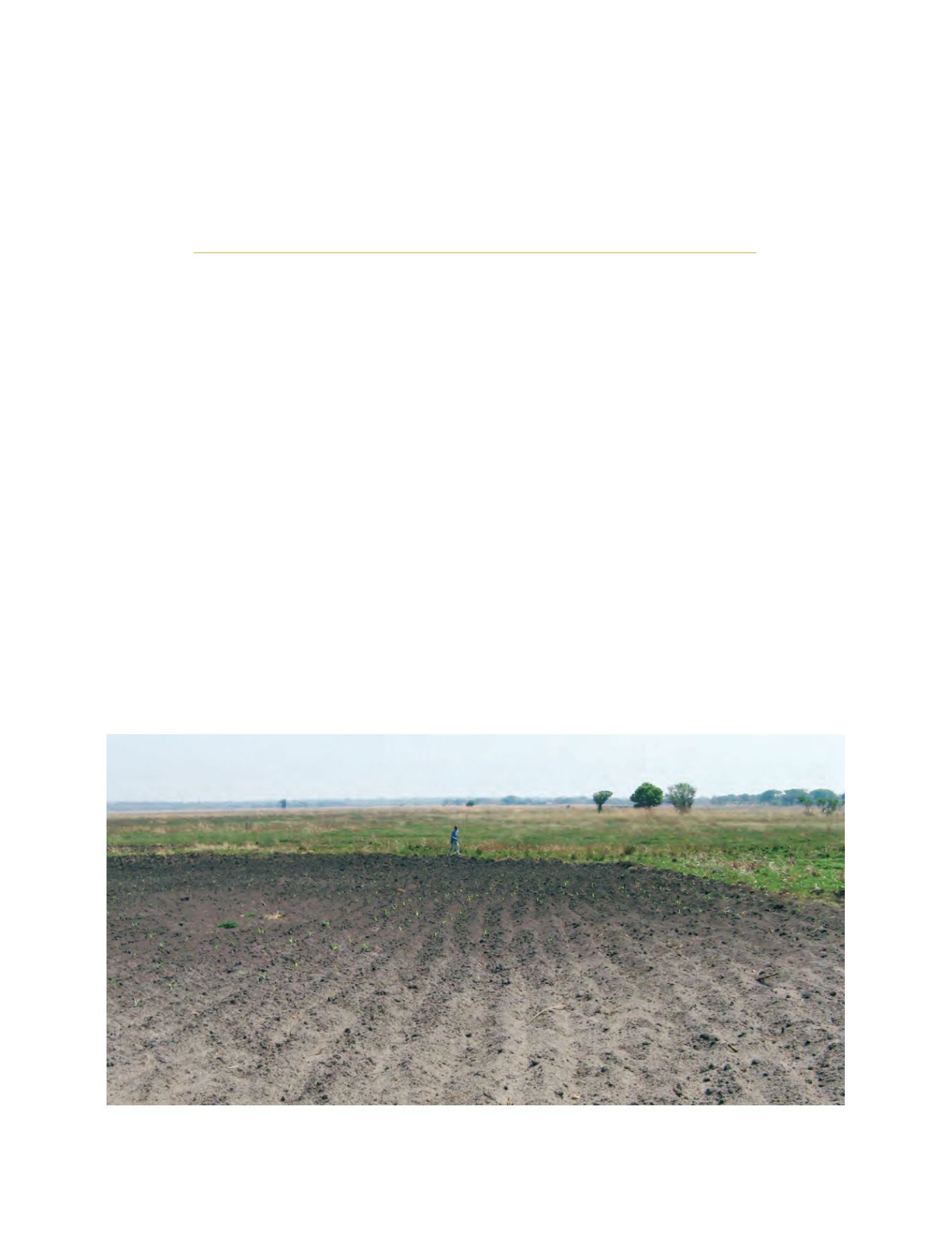
Zambezi Flood Plain, near Mongo, Western Province, Zambia. Changes to the timing and intensity of the rains and changes to the seasonal flooding of the
Zambezi plain is making maize more difficult to grow
Image: Peter Crichton