



 97 / 196

[
] 95
amounts to approximately 3,000, with 200 living on
Thailand’s Surin Islands and the rest residing in Myanmar.
The Moken are very knowledgeable about their
surrounding environment and natural resources. A
nomadic lifestyle has made them excellent navigators
with detailed knowledge of the winds, tides and lunar
cycles. They are adept at hunting marine animals, includ-
ing sea turtles, sea urchins, fish and giant clams. To aid
hunting, a variety of different tools are employed, varying
from hand lines to purpose-built spears, axes and
hammers. The Moken are also highly knowledgeable
about the terrestrial environment. They use at least 159
species of plants for food and medicine, building mate-
rials and fuel. This knowledge of the marine environment
helped them recognize the receding tide of 26 December
2004 as a warning sign. When the seawater started to
recede, the Moken knew that a ‘La-Boon’ (tsunami) was
coming, so they took refuge on high ground.
The Thai Moken settled on the islands decades ago.
Here, they built bamboo huts suspended on stilts several
feet above water. Men fished, sold their catch to the
mainland and used their earnings to buy rice. Children
grew up in the water, where they learned to dive and
swim with skill. During low tide, the women scoured
the reefs for sea urchins, crabs, mussels and sea cucum-
bers. For years, the Moken led an isolated life until the
Surin Islands were declared a national marine park in
1981. This has triggered a range of complex issues for
the Moken that continue to entangle them today, espe-
cially the Moken children.
Indigenous knowledge
– “Providing education to
indigenous children is always complex. There is a risk
that offering standardized formal education will alienate
coasts of southern Thailand, the Philippines, Indonesia, Malaysia and
to the far north in the Mergui Archipelago of present-day Myanmar.
In Thailand, almost 10,000 sea nomads remain dispersed over the
coastal area and numerous islands of the Andaman Sea. These people
belong to three distinct communities: the Moken, Moklen and Urak
Lawoi, each with its own set of cultural traditions and language.
Since 1998, the Andaman Pilot Project, led by Chulalongkorn
University’s Social Research Institute, which is supported by
UNESCO and, most recently by the National Oceanic and
Atmospheric Administration (NOAA), has focused on action and
research to achieve sustainable development on these islands as well
as cultural heritage conservation among indigenous groups. With
generous funding from NOAA, the project was able to build upon
this work and contribute to the development of a model for equi-
table governance for sustained conservation of natural and cultural
diversity in the marine protected areas of the Andaman Sea.
For nearly ten years, the Andaman Pilot Project facilitated research
on the indigenous sea gypsy communities that inhabit two of
Thailand’s national marine parks in the Andaman Sea: the Moken of
the Surin Islands National Marine Park and the Urak Lawoi of
Tarutao National Marine Park in the Adang Archipelago. The pilot
project focused on collecting socioeconomic data about the Moken
and Urak Lawoi and working with stakeholders to foster an enhanced
understanding of the communities’ indigenous ways of life, build
community capacity, identify economic options that promote cultural
survival as well as natural conservation and encourage a coopera-
tive approach to the protection of the natural and cultural heritage
of the Surin Islands and the Adang Archipelago.
The indigenous knowledge that saved the sea gypsies
–While the other
sea gypsy groups, the Moklen and the Urak Lawoi, have integrated into
Thai society and acquired a modern lifestyle on land, the Moken remain
semi-nomadic. They live on boats out at sea during the dry season,
coming ashore only during the monsoon season. The total population
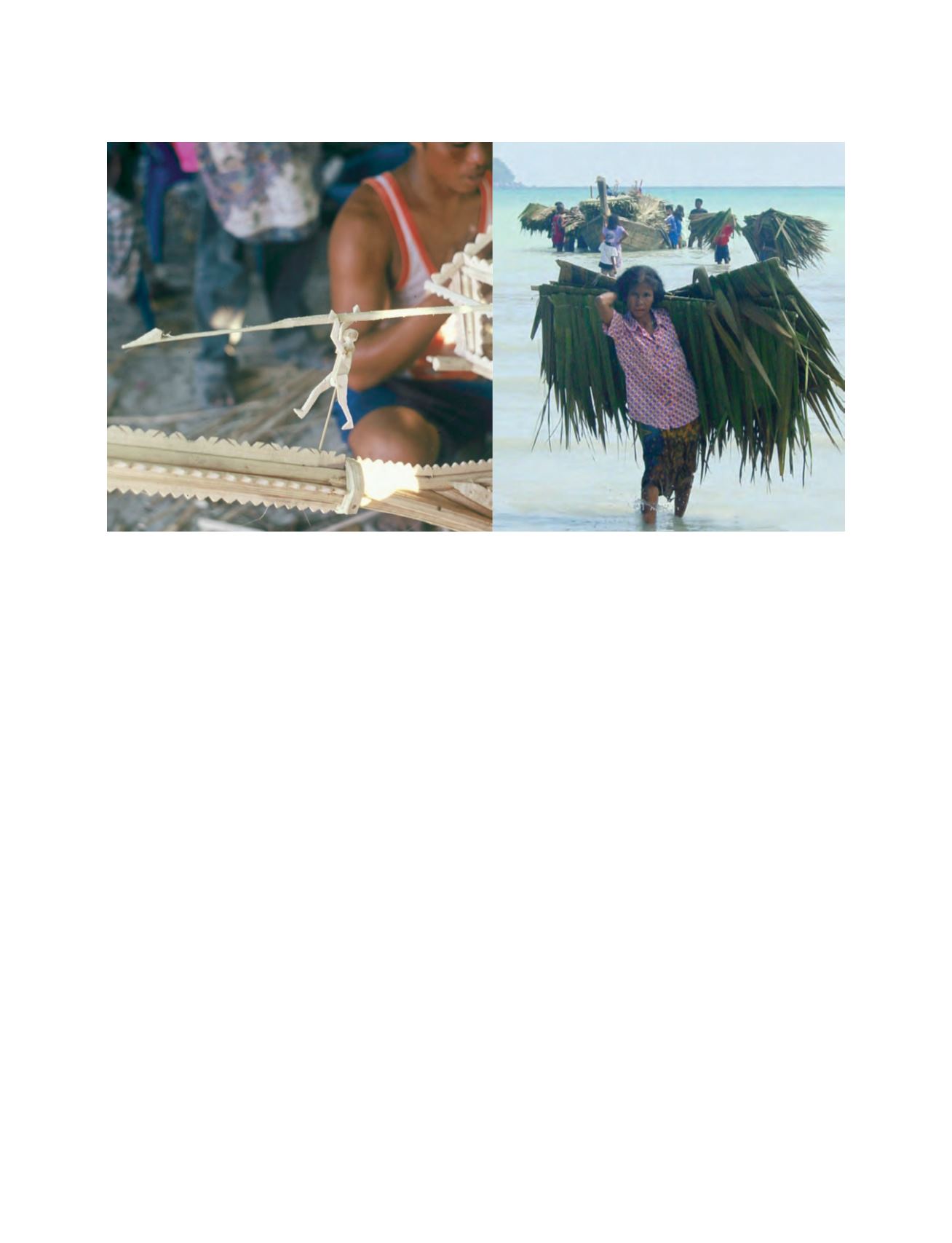
Rebuilding Moken village, Ko Surin, Thailand
Image: Derek Elias, January 2005, Ko Surin, Thailand