


 101 / 196

[
] 99
conditions. Demands and pressure by the international
community brought little positive shift. While aid-offer-
ing countries and bodies observed the Oslo Guidelines
that humanitarian assistance must be provided with full
respect for the sovereignty of the affected states (para-
graph 21), the Myanmar authorities lacked confidence
that the assistance offered would be purely humanitar-
ian. As the clock ticked, the devastated Ayeyawaddy
delta community turned desperate. Timeliness of aid is
key to any acute crisis in order to prevent further
damage or loss of lives.
Prior to Cyclone Nargis, Mercy Relief had minimal
and short-term engagements in Myanmar implement-
ing piecemeal development projects. Had there been a
sustained commitment and cooperation previously,
Mercy Relief would have had the necessary ground
network and trust and confidence of the local authori-
ties, to have been allowed continued and early entry to
provide more timely and effective penetration.
When the first groups were eventually allowed in, they
were from the immediate neighbours, followed by the
Association of Southeast Asian Nations (ASEAN)
members, then the other international agencies.
However, each country went in with its resources and
operated independently of each other. This resulted in
serious duplicity of resources leading to wastages, and
hence less efficient management of risk.
Whilst Mercy Relief awaited clearance from the
Myanmar authorities to move into the badly affected
delta areas, it dispatched the first two batches of relief
our responses on the community’s own priorities, knowledge and
resources. Third, we must scale up community responses by creat-
ing new coalitions with governments and advocating changes in
policy and practice at all levels.
“If we focus only on needs and vulnerabilities, we remain locked
in the logic of repetitive responses that fail to nurture the capacities
for resilience contained deep within every community. We have
talked about building capacity and resilience for decades. It is now
time to turn rhetoric into reality: to dispel the myth of the helpless
victim and the infallible humanitarian, and to put disaster-affected
people and their abilities at the centre of our work.”
What happens before and after a disaster is all related to disaster
risk reduction. The main concern is human life and human suffer-
ing. It is time to bring the humanitarian players together; to build an
alliance for effective action locally, nationally, regionally and inter-
nationally.
Objective and aims
Mercy Relief’s experiences in Myanmar, Sichuan and Aceh illustrate
the importance of alliances and how the interoperability of different
systems and institutional interactions are important elements in
disaster risk reduction strategy.
Case study: Cyclone Nargis – Myanmar, May 2008
Although there were clear signals that there was inadequate capa-
bility to manage the disaster alone, the Myanmar authorities were
hesitant to welcome foreign assistance. It was a situation where the
international humanitarian community, including foreign military
assets, had to wait by the sidelines and helplessly watch as the vulner-
able survivors try to find food and help in the deteriorating ground
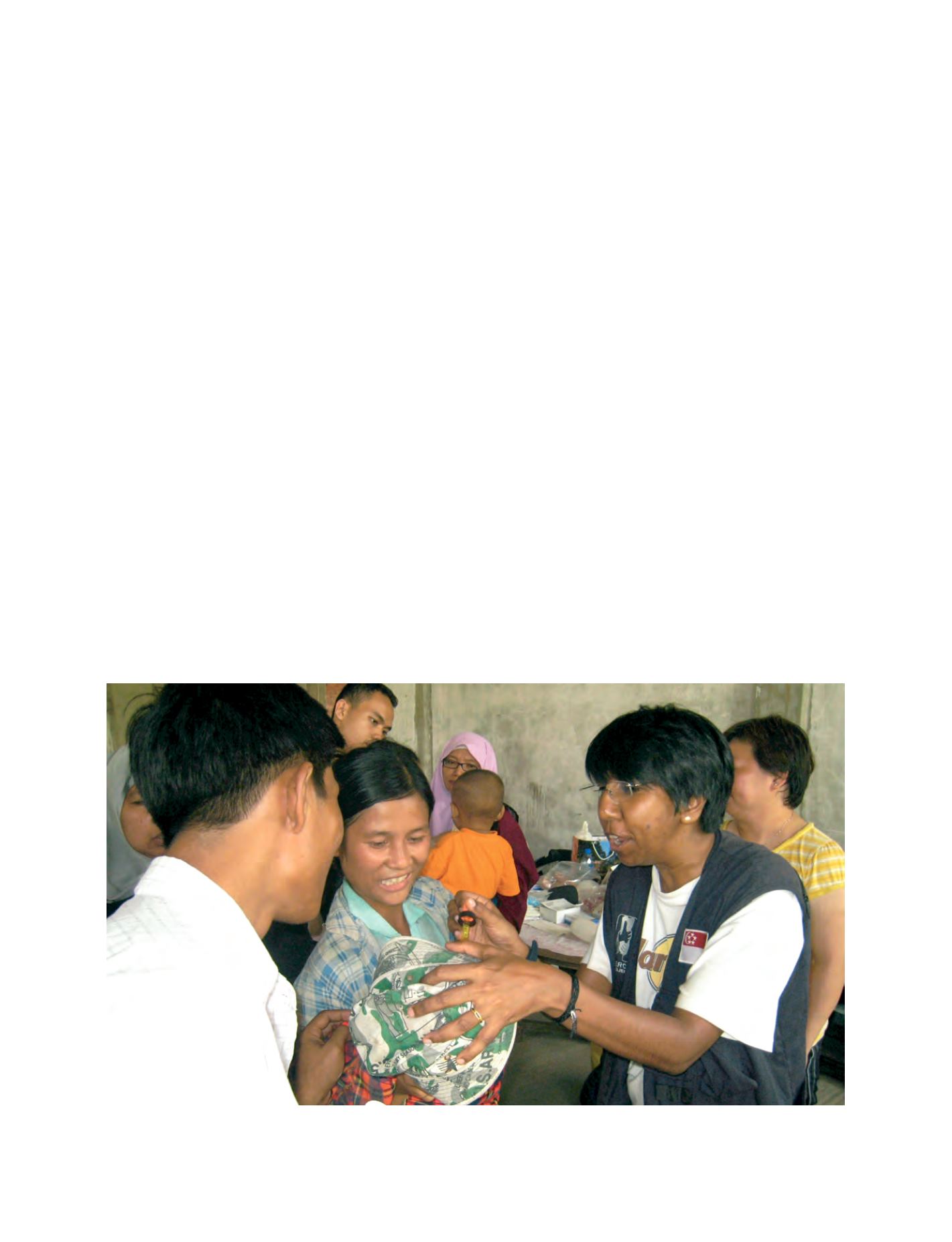
Myanmar: caught in the politics of hope – Mercy Relief’s volunteer pharmacist K. Thanaletchime administering medication during the daily mobile clinic runs in
Twante, Myanmar
Image: Jaffar Mydin