


 107 / 196

[
] 105
Reporting IBC – a Turkish NGO’s
response to the Pakistan earthquake
Ana Oprisan, International Operations Manager, International Blue Crescent
T
he International Blue Crescent (IBC)
1
is an emerging
Turkish non-governmental organization (NGO), working
since 1999 to improve the lives of the suffering people,
especially the most disadvantaged, both in Turkey and in other
countries, including Albania, Kosovo, India, Iran, Indonesia,
Pakistan, Bangladesh, Syria and Sudan. As its mission states,
IBC has been working to help in alleviating human suffering,
hunger and illiteracy among all people, regardless of national-
ity, ethnicity, race, colour, social origin, religion, belief, language,
political opinion, gender, age, sexual orientation or genetic and
physical features.
In April 2003, with the aim and intention of increasing its effective-
ness internationally, IBC became a member of the International
Council of Voluntary Agencies (ICVA), headquartered in Geneva;
and at the 13th ICVA General Assembly in 2006, IBC was elected to
its Board of Directors. In July 2006, it was given ‘Special Consultative
Status’ by the Economic and Social Council of the United Nations
(ECOSOC). IBC also has a member in the COPPEM Presidency
Council. Headquartered in Palermo, COPPEM is the Standing
Committee for the Euro-Mediterranean Partnership of
Local and Regional Authorities.
The Pakistan earthquake and IBC’s response
On Saturday 8 October 2005, at 8:50 am, a 7.6 magnitude
earthquake struck the India-Pakistan border with more
than 140 aftershocks, causing extensive damage in
Pakistan, India and Afghanistan. Reports indicated that
more than 82,000 people were killed and more than 3.3
million people were left injured or homeless.
In the post-disaster response, the international NGOs
added their inputs to the Federal Relief Commission’s
(FRC) joint collaboration with the military and the
United Nations Office for the Coordination of
Humanitarian Affairs (UNOCHA), leading to an effec-
tive coordination of the relief process. Later on, the
planning for rehabilitation and longer-term develop-
ment was led by the Earthquake Reconstruction and
Rehabilitation Authority (ERRA)2 and the core group
of donors.
While generally challenges were encountered in
managing the transition from military back to civilian
administration, from UN coordinated support for relief
to donor mobilization of long-term resources and from
a humanitarian response to a development process, it
can be said that the context of the emergency response
in Pakistan was unique in the sense that it involved
cooperative and competent national authorities.
The IBC Pakistan mission
IBC’s mission in Pakistan started one week after the
tragic event of the earthquake, the aim of the first
interventions in the field being to respond to the
primary needs of victims as winter approached in this
high-altitude environment and the settlements of
mainly Azad Jammu and Kashmir (AJK) were difficult
to access.
Consequently, IBC has continued its post-disaster
intervention through different rehabilitation and recon-
struction projects. In parallel with its activities in the
field, IBC has received long-term grant permission to
work in Pakistan from the Ministry of Economic Affairs
and Statistics, Economic Affairs Division (EAD). After
the emergency phase, IBC continued to implement its
projects in the framework of memoranda of under-
standing (MOUs) signed with ERRA.
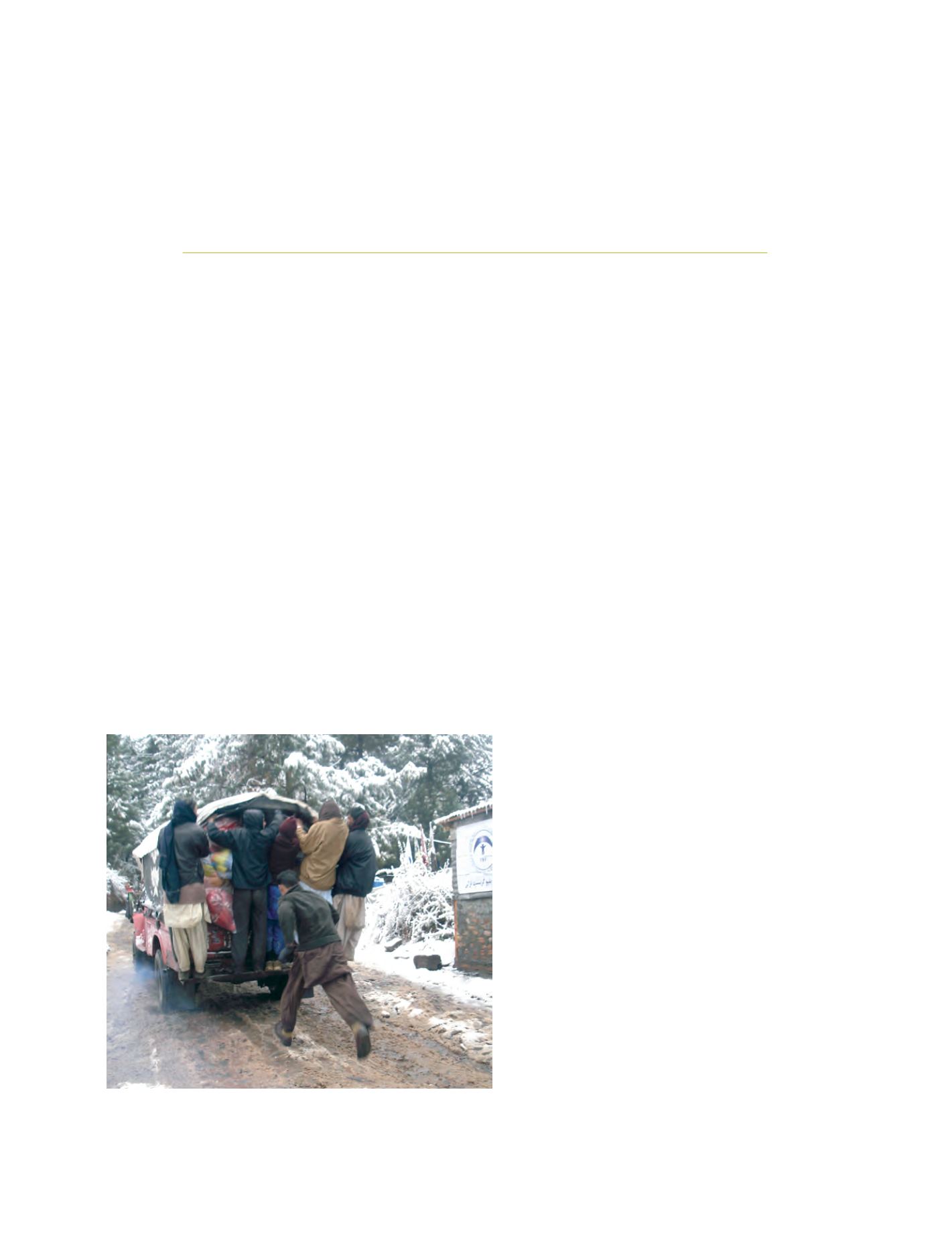
Beneficiaries loading vans: during December 2006-January 2007, beneficiaries of
IBC’s Winter Relief Distribution Project received kitchen sets, blankets, water tanks,
quilts and pillows
Image: IBC Archive