



 108 / 196

[
] 106
distribution of educational, recreational (toys) and
hygiene kits to 250 pre-school-age children, and instal-
lation of a playground in the village.
Given all the challenges in implementing post-disas-
ter activities in AJK, the early recovery took a longer
time. Now, the aim is to shift the focus from saving lives
to restoring livelihoods, thus effectively preventing
recurrence of disasters and harnessing conditions for
human development.
IBC’s involvement in the rehabilitation and recon-
struction phase
The common efforts of ERRA, UN-Habitat and NGO
partner organizations led to the elaboration and imple-
mentation of the ‘Building Back Better’ strategy for rural
housing reconstruction. The basic principles of the
approach included the fact that the reconstruction of
houses will follow the principles of enablement; locally
known construction technology will be promoted with
The Pakistan mission’s activities have been financially or techni-
cally supported at different stages and in different sectors by donors
as Malteser International, the United Methodist Committee on Relief
(UMCOR), the American Joint Distribution Committee (AJDC), UN-
Habitat, Trocaire Ireland, and other private donations.
IBC activities in the emergency relief phase
IBC’s immediate response after the earthquake in Pakistan consisted
in the following activities:
• Distribution of food packages, October-November 2005 –
provision of supplies for two weeks, for 600 families in
Rawlakot/Ali Sojal Tehsil
• Distribution of non-food items (NFIs), November 2005-January
2006 – provision of shelter and basic survival NFIs to 200 fami-
lies in the high-up villages in Bagh District (tents, CGI sheets,
bedding sets, stoves, kitchen sets and shelter fixing tools).
The emergency relief phase was planned to last around six months
after the October 2005 earthquake struck northern Pakistan.
However, even one month after the disaster occurred, a number of
activities were initiated to support the speedy recovery of the affected
population, concurrently with ongoing humanitarian and life-saving
operations.
On the other hand, the challenging environment of the earthquake-
affected area of Kashmir proved that providing only immediate
post-disaster relief activities would not be enough, as the region is
negatively affected by weather conditions at different times of year
(winter and Monsoon months) and the lack of infrastructure creates
a permanent need for intervention. For example, IBC had to keep a
bulldozer at its field camp in Salmia UC for a year, ready to clear the
surrounding roads which were blocked regularly due to landslides or
snow. This prolonged need for intervention led to an initiative to
support some village committees to start a road clearance and
construction project. Later on, this project proved a major support
for rural housing reconstruction, in terms of facilitating access for
transportation of construction materials and so on.
One year after the earthquake, during December 2006-January
2007, heavy snow affected hundreds of households in the area where
IBC operated, cutting off access to major cities nearby and forcing
people to demand immediate support from the teams deployed in
the field. In this particular case, a Winter Relief Distribution Project
was implemented with the prompt financial support of donors,
addressing 956 vulnerable households. The beneficiaries received
kitchen sets, blankets, water tanks, quilts and pillows.
Some months later, in April 2007, due to long rains causing major
landslides in Salmia, a Landslides Victims Support project was
required. During this emergency, 147 households received CGI
sheets, shelter fixing tools and plastic sheets. The assessments and
work done during the implementation of this one-time intervention
led later on to inputs to a Policy Paper for the Landless, on the
common contribution of UN Habitat, NGOs and ERRA.
The Sarbala Village Support Initiative is one example illustrating
the need for prolonged emergency intervention mixed with speedy
recovery activities. The first intervention in the village under the
IBC/AJDC venture included the distribution of NFIs after the earth-
quake in 2005. Between March 2006 and January 2007, activities
included road clearance provided after major landslides, erection of
large-sized tents for the boys’ and the girls’ primary schools, distri-
bution of winter jackets to the students of the primary schools,
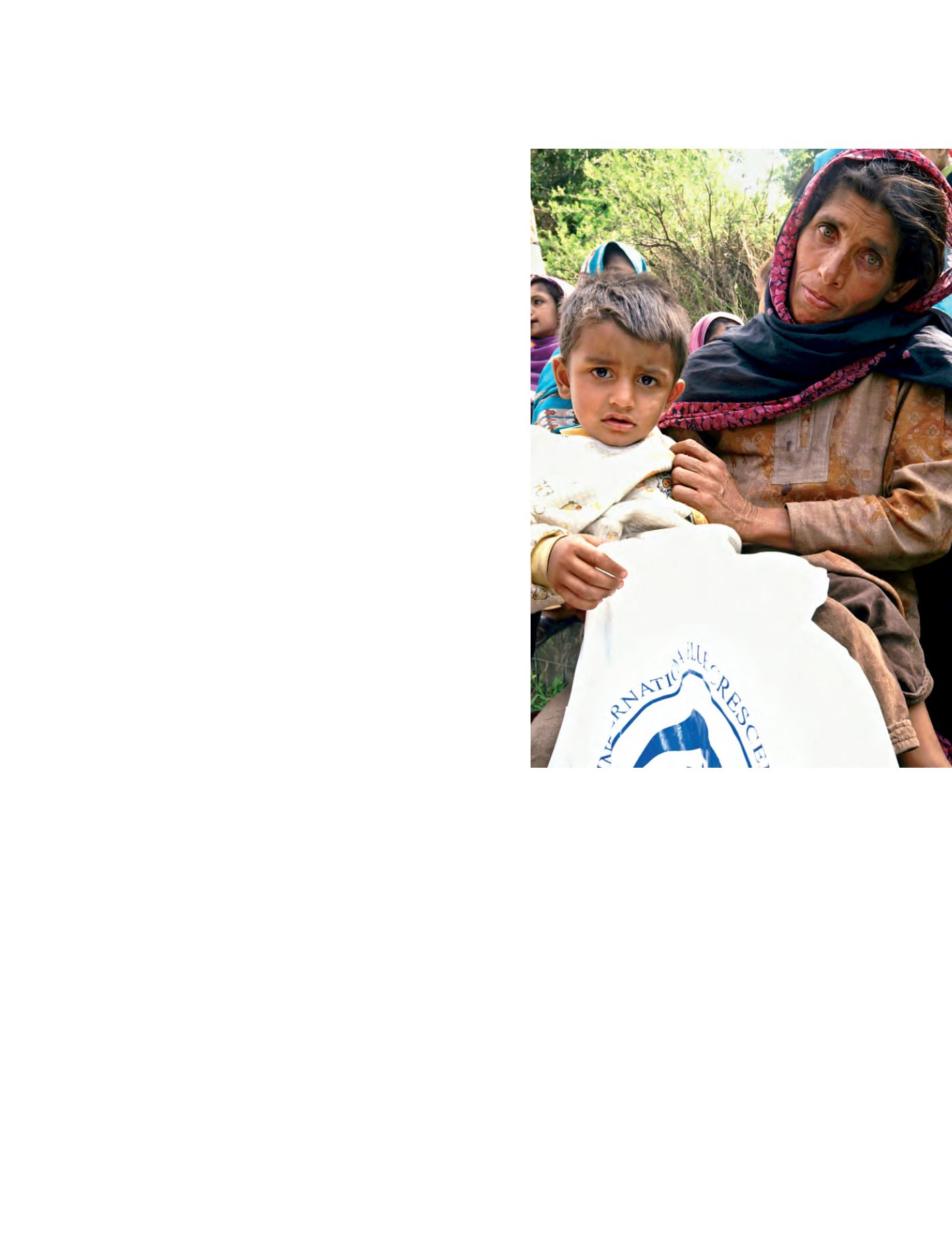
IBC worked to support children of all ages following the earthquake
Image: Florian Kopp