



 109 / 196

[
] 107
pragmatic improvements for seismic resistance; reconstruction will
be promoted based on timeliness, practicality, basic seismic safety
and local technology; future reliance of the community on technical
assistance will be minimized by creating a self-sustainable talent pool
in earthquake resistant construction; local uniqueness will be
respected over monolithic implementation of standards, and recon-
struction efforts will support environmentally friendly building
techniques.
Safe building training for rural housing reconstruction
For the implementation of the owner-driven Rural Housing
Reconstruction Strategy, IBC took over two Union Councils – Salmia
and Sena Daman, both situated in Hattian Tehsil, Muzaffarabad District,
AJK. The activities of these two projects were implemented by mobile
teams (each team having one engineer, one mason, one carpenter, one
male and one female social mobilizer) covering the area for community
mobilization and formation of Village Reconstruction Committees.
The main focus of the projects was to train self-builders and local
artisans in earthquake-safe construction techniques. All training
modules were supported by visual material and using accessible
language. Information materials with simple drawings and pictures
were distributed and explained. All members of the mobile teams
were trained before the start of the project by experts from UN-Habitat
and the National Society for Earthquake Technology (NSET), Nepal.
Both projects included door-to-door assistance for self-builders, with
IBC mobile teams monitoring and technically advising on earthquake
resistant guidelines. IBC also assisted the monitoring visits of the army
inspection (AI) teams in evaluating progress and supporting the bene-
ficiaries receiving housing instalments from the Government.
The Safe Building Training and Technical Assistance for Rural
Housing Reconstruction project in Salmia UC was implemented
between May 2006 and June 2007, covering 16 main villages and 45
sub-villages. The four mobile teams working in the UC provided train-
ing to 297 masons, 411 carpenters, 22 steel fixers, 9,205 male
self-builders and 388 female self-builders. The training sessions (both
theoretical and practical) were held at IBC Rawal Gali
field camp (also using multimedia) and at different
venues in the sub-villages. Hands-on training was facil-
itated through work contribution of the trainees in
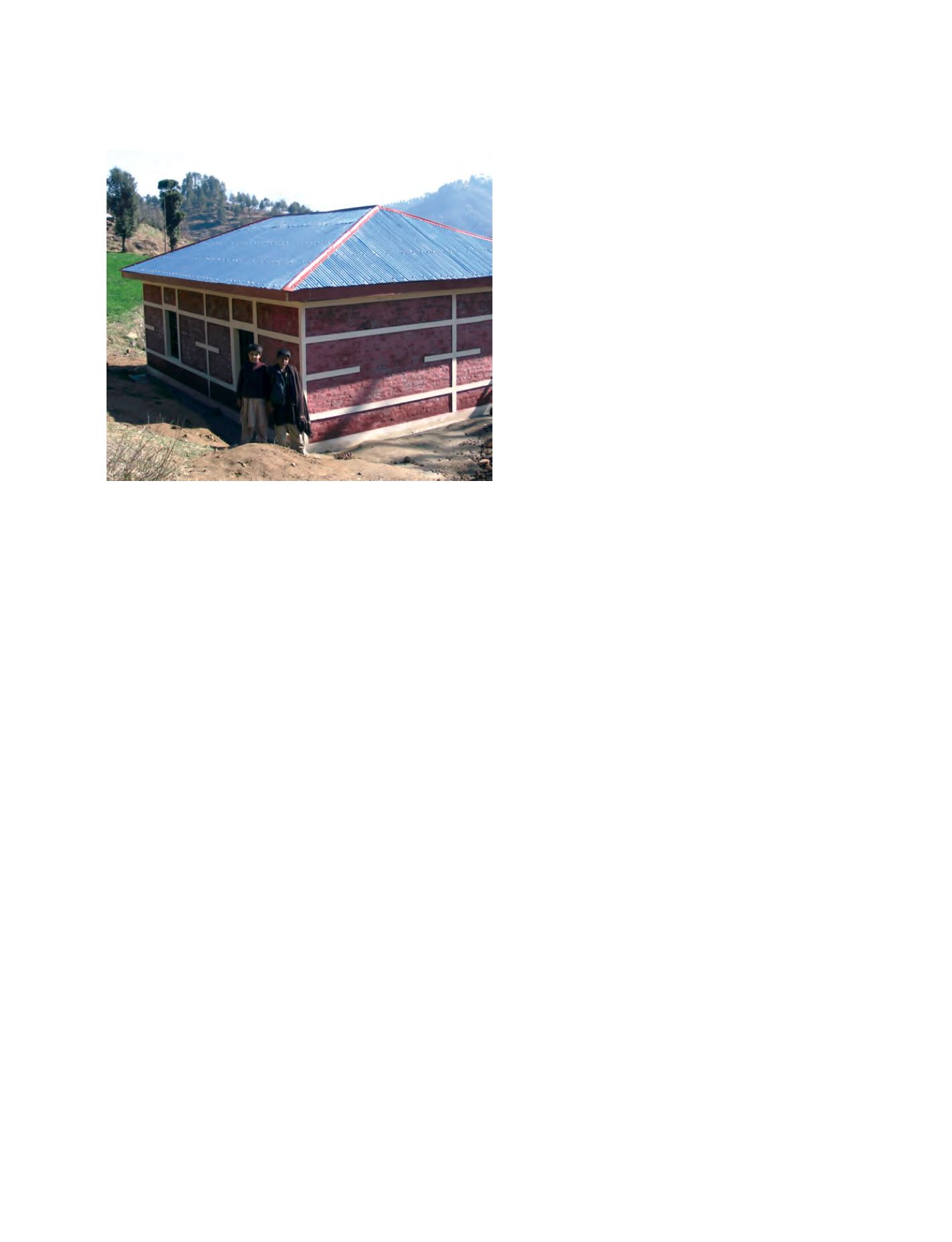
building earthquake resistant model houses for 80 of the
most vulnerable households (headed by widows,
disabled people and senior citizens). As part of the tech-
nical support component of the project, tools sets were
distributed to the self-builders, assistance was provided
for the registration of the landless, village link roads were
cleared and constructed, facilitating the transport of
construction materials to the villages.
The Safe Building Training for Rural Housing
Reconstruction programme in Sena Daman UC covered
19 main villages and was implemented between March
and December 2007. Five mobile teams were active in
community mobilization and lobby for use of earth-
quake-safe construction guidelines. During ten months
of project implementation, IBC trained 2,353 masons,
798 carpenters, 3,866 steel fixers, 3,014 male self-
builders and 707 female self-builders.
Reconstruction in the health sector
In the framework of rehabilitation and reconstruction
policy in the health sector, IBC is involved in the phys-
ical reconstruction of eight basic health units (BHUs) in
Muzaffarabad and Bagh districts (two BHUs in villages
that were earlier targeted by IBC during the emergency
phase), in AJK. The project was implemented with the
financial support and in partnership of Malteser
International, which is also going to provide the neces-
sary furniture and equipment and also eventually
support strengthening the referral system.
At each site, IBC is constructing earthquake resistant
clinics (with structural and architectural designs based on
detailed soil investigations and approved by the National
Engineering Society of Pakistan (NESPAK), the technical
consultant of ERRA), as well as two additional accom-
modation quarters for the lady health visitors (LHVs) and
medical officers (MOs) to be stationed at these clinics.
Reconstruction in education sector
As in the health sector, the reconstruction of education
facilities must follow the standards imposed by the regu-
lating body, ERRA – all physical reconstruction projects
have to pass the requirements of the technical body,
NESPAK, before receiving a Non-Objection Certificate
(NOC) for start of work. In the framework of the
venture with AJDC in Sarbala – the ‘adopted’ village for
reconstruction and rehabilitation – IBC is reconstruct-
ing three governmental school buildings: boys’ and girls’
primary schools and a girls’ middle school. The schools
will be provided with necessary furniture, ready to start
the new educational year.
Following IBC’s involvement in developing and intro-
ducing earthquake-safe and easy-to-build technologies,
plans are being developed for IBC to take over the phys-
ical reconstruction of an additional 100 schools, to be
sponsored by ERRA itself.
Hands-on training was given through the construction of earthquake resistant model
houses for the most vulnerable households
Image: IBC archive