



 115 / 196

[
] 113
Cultural heritage and seismic risk:
some European experiences
Francesc Pla, European and Mediterranean Major Hazards Agreement, Council of Europe
C
ultural heritage is a key element of the history and iden-
tity of societies, contributing to their economy and well
being. Disaster reduction, as a tool of sustainable devel-
opment, concerns not only the prevention of loss of lives and
property, but also the protection of cultural assets and the envi-
ronment from natural or technological hazards.
Founded in 1949, the Council of Europe with its 47 member states
seeks to develop common and democratic principles throughout
Europe, based on the protection of individuals, democracy and the rule
of law. Its main tasks include achieving a greater unity between its
members to find common solutions to the challenges facing European
society. Over the last 20 years, the Council of Europe has been promot-
ing the reduction of the vulnerability of ancient buildings and historical
settings from earthquakes and other risks through its European and
Mediterranean Major Hazards Agreement (EUR-OPA).
EUR-OPA currently counts 25 member states, and has served since
1987 as a platform for cooperation between European and Southern
Mediterranean countries in the field of major natural and techno-
logical disasters. Its field of action covers the knowledge
of hazards, risk prevention, risk management, post-crisis
analysis and rehabilitation. EUR-OPA also counts a
network of 25 specialised centres, some of which
develop projects and activities on cultural heritage and
risks: more than 60 seminars, courses, round tables and
workshops have been held over the years.
Four centres of the EUR-OPA network have been
focusing much of their attention on this subject: these
are the European University Centre for Cultural Heritage
(Ravello, Italy), the European Centre for Prevention and
Forecasting of Earthquakes (Athens, Greece), the
European Centre on Urban Risks (Lisbon, Portugal) and
the European Centre on Vulnerability of Industrial and
Lifeline Systems (Skopje, the former Yugoslav Republic
of Macedonia).
Learning from the past
It is a fact that it is impossible to completely protect a
construction against seismic force, which is sometimes
beyond the limits of human capabilities. However, all
over the Mediterranean, many historical monuments
and traditionally constructed buildings and settlements
exist, and for hundreds of years these have repeatedly
survived seismic action, even in areas of particularly
high seismic risk. Such a historical experience could and
should be studied in order to identify possible aseismic
techniques already used in the past, which have proved
to be efficient and can therefore be reused or updated
on ancient buildings and settlements.
Learning from monuments
Trying to identify ‘native’ techniques used in past times
to increase resilience of monuments (such as churches
or palaces) seems an obvious course, as restoration tech-
niques mainly attempt to keep the actual building as
close as possible to its original configuration due to its
clear historical value. Furthermore, many of those
monuments are nowadays managed by public authori-
ties (local, regional or national) which care about their
public access as touristic facilities and can adopt quite
sophisticated techniques and materials to protect them
from future events.
The European Centre for Prevention and Forecasting
of Earthquakes, in Athens, has devoted a large part of
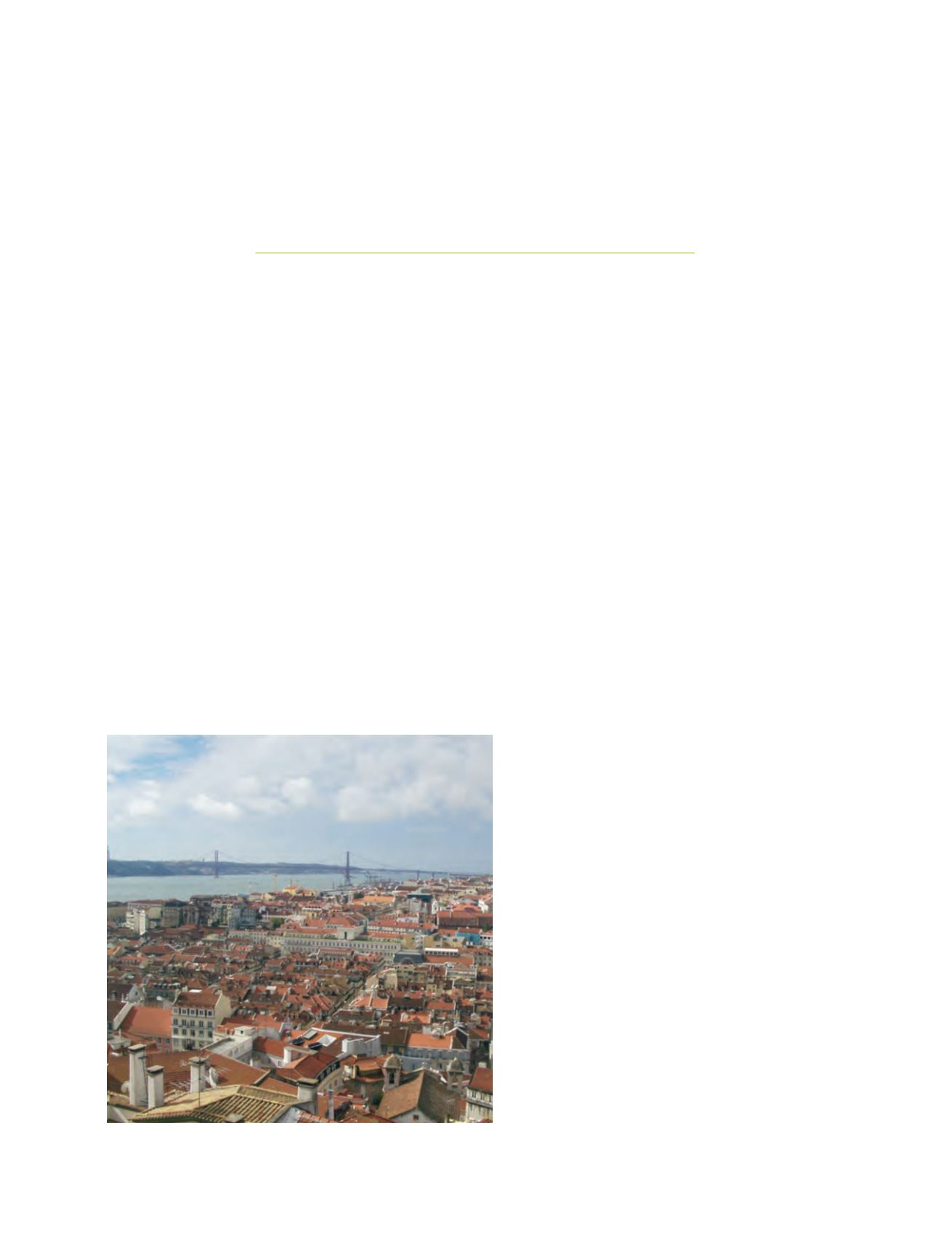
Lisbon’s historical centre
Image: Francesc Pla