



 118 / 196

[
] 116
Multidimensional post-earthquake
reconstruction: the Chakama Valley
in Pakistan-administered Kashmir
and the Uri Block in Indian-administered
Jammu and Kashmir
Najmi Kanji, Aga Khan Development Network
T
he South Asian earthquake of October 2005 devastated
large parts of Kashmir on both sides of the Line of Control
(LOC) as well as significant parts of the North West
Frontier province in Pakistan. The death toll in Pakistan was
around 73,000 (almost 30,000 children) with another 70,000
severely injured or disabled and 4 million made homeless. On the
Indian side, damage was confined to two districts with 1,300
deaths, 7,500 injured and over 37,000 buildings damaged. Within
days of this catastrophe, the Aga Khan Development Network
(AKDN) responded through its affiliate FOCUS, to provide relief
assistance to the affected communities. On the Pakistan side,
AKDN’s fleet of helicopters flew over 1,500 sorties, providing food,
blankets, tents and tarpaulin, and evacuated nearly 2,000 injured
from the affected areas. On the Indian side FOCUS
provided winterized tents and warm clothing to nearly
400 families in 14 villages. On both sides of the LOC,
nearly 200,000 people were assisted.
Rebuilding lives and livelihoods
As the relief effort continued, AKDN began to concep-
tualize the implementation of a three-year, multi-input
reconstruction programme in one of the poorest and
remotest valleys in Kashmir, with the aim to mobilize
and assist local communities to rebuild their lives quickly.
It was felt that getting people to start working on daily
existence problems would help them to deal with the
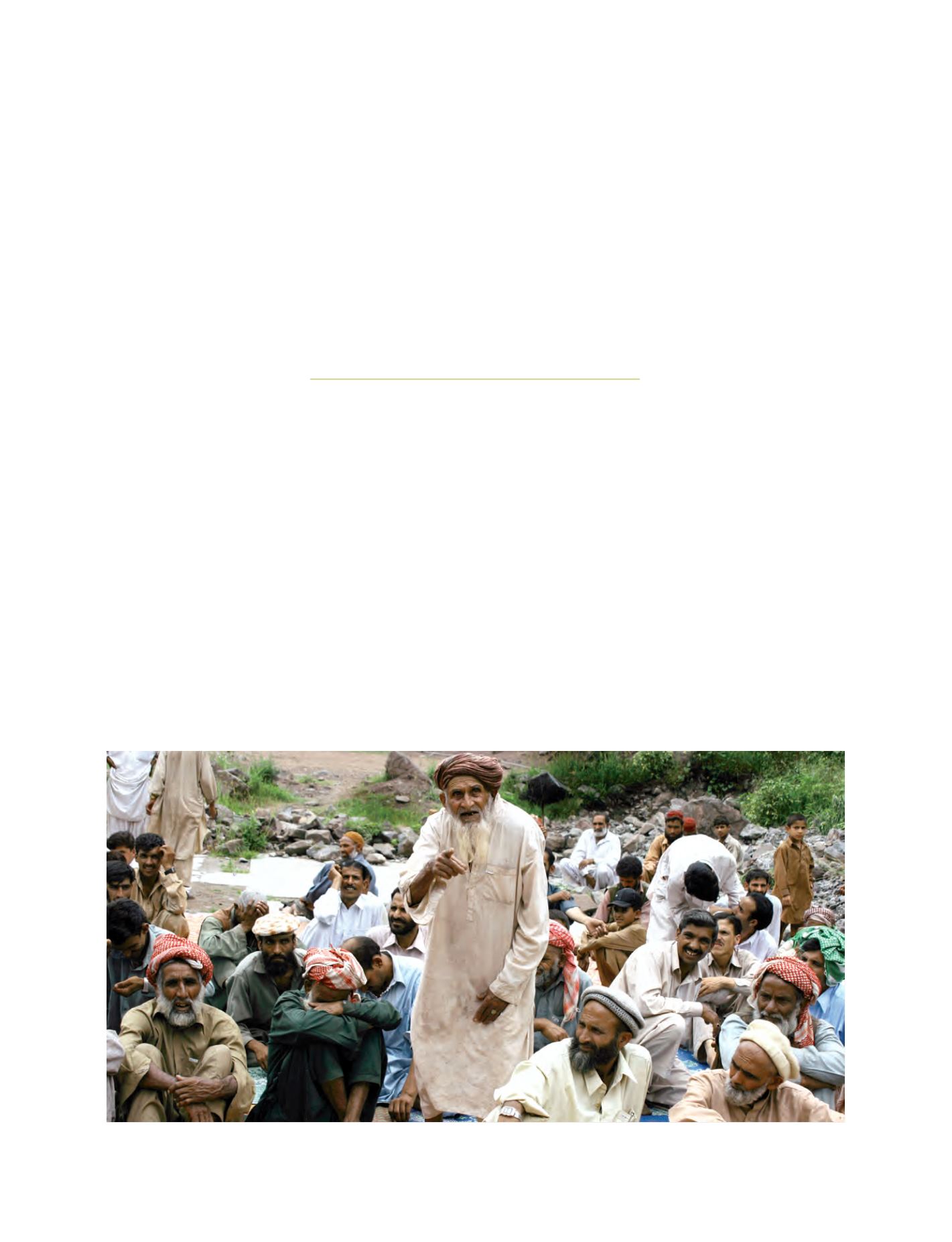
Communities in the Chakama valley take part in activity-based groups such as village organizations
Image: AKDN Kashmir Programme