


 119 / 196

[
] 117
• (Re)construct critical economic/social infrastruc-
ture, including schools and health centres
• Facilitate the (re)creation of livelihoods
• Improve the quality of health services and schools
• Promote disaster risk management with an
emphasis on community preparedness.
It was clear from the start that the enormous effort required
to rebuild people’s lives could not be achieved unless
people themselves were central to the decision-making
processes and the implementation of the programme.
Thus, community mobilization, with the establishment of
democratic village and women’s organizations, formed the
programme’s fundamental activity, upon which all other
aspects of the programme have been built.
Chakama Valley and the Uri Block
Both programme areas lie off the main Muzzaf-
arabad/Srinagar highway, but comprise some of the
remotest and highest valleys in the region. The Chakama
area comprises 14 revenue villages and around 33
hamlets, with a population of around 34,000 in some
5,500 households. In the Uri Block, the programme
covers around 20,000 people in 17 revenue villages. The
topology is very similar across both areas, and maize,
wheat and rice in lower areas, are grown mainly as subsis-
tence crops. Walnuts are an important cash crop in Uri.
Incomes are derived primarily from government/army
employment and remittances. The areas’ strategic impor-
tance, from a military perspective, meant that the
population had been reasonably well serviced by the
respective Government and army, and the desire to do
things for themselves was limited. Furthermore, the
communities were somewhat divided along party polit-
deep trauma they had suffered. The Chakama Valley on the Pakistan
side and the Uri Block on the Indian side, where rapport had been
built up with communities during the relief phase, and which lie adja-
cent to each other across the LOC, were selected for the programme
with the following objectives:
1
• Promote the establishment and strengthening of civil society
organizations
• Facilitate the construction of seismic resistant and thermally
insulated homes
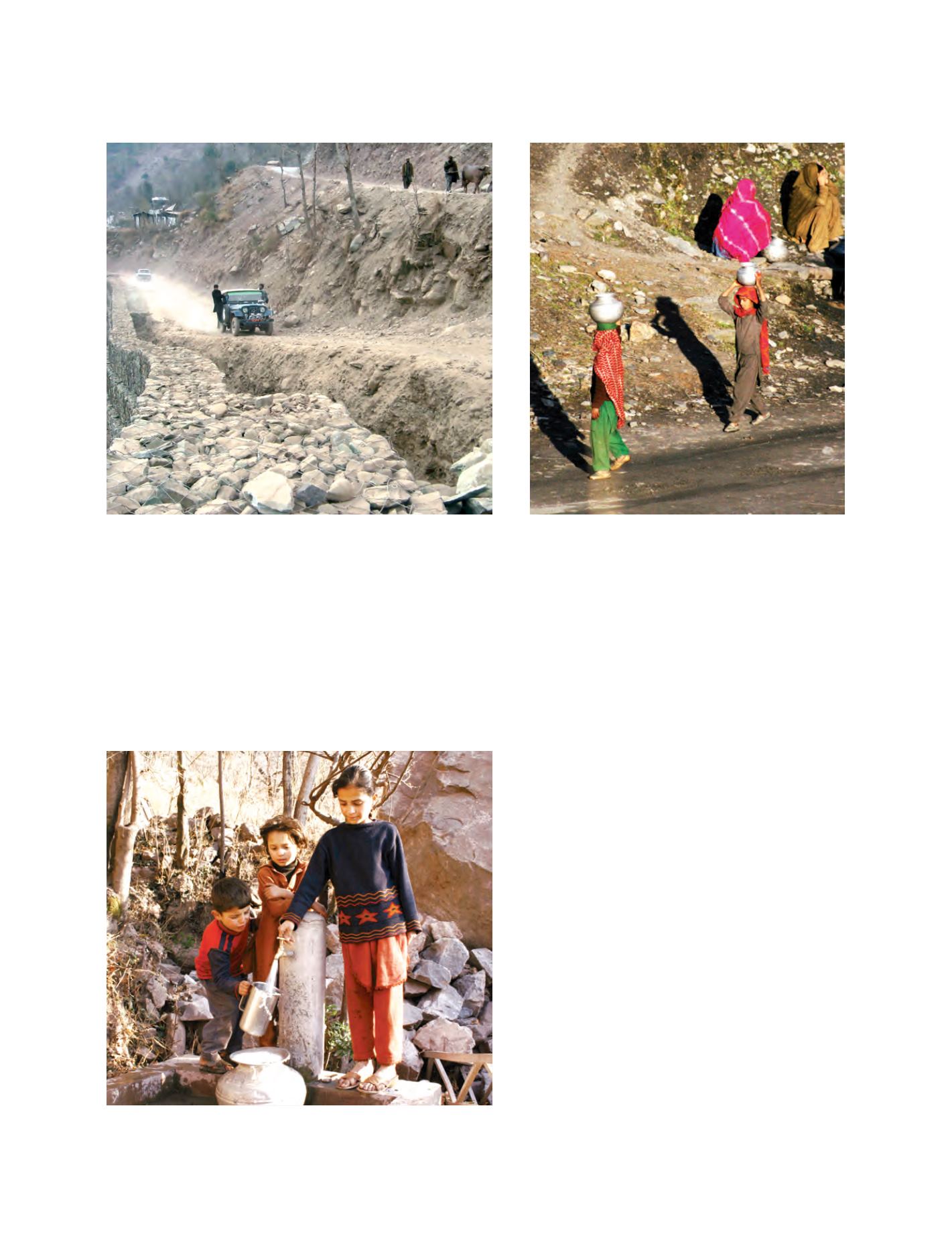
Repairs helped to improve traffic on the valley road
Women collecting water from the river
Image: AKDN Kashmir Programme
Image: AKDN Kashmir Programme
Household contributions have enabled the construction and
maintenance of water systems
Image: AKDN Kashmir Programme