


 121 / 196

[
] 119
costs for families, and a transport subsidy would be provided to
families living in the upper valleys of both programme areas.
• Each house would be provided with an
environmentally friendly, smoke-free stove.
By the end of March 2008, almost 3,000 seismic resistant homes were
being built, with around 900 completed. Nearly 200 local craftsmen
(masons, plumbers, carpenters and electricians) had been trained.
The training of local masons has ensured that seismic resistant build-
ing technology is now known in the area. A positive spin-off in the
home construction programme has been the reintroduction of the
traditional
dhajji
(timber frame) construction, a seismic resistant
design that had been abandoned over recent decades in the quest for
modern cement/steel structures. In addition to being technologically
sound, the
dhajji
design is more appropriate for the higher valleys
where wood is locally available, and where transport costs for
steel/concrete can be exorbitant. In the Uri programme, homes are
being built with roof-water harvesting pipes and tanks.
Public buildings
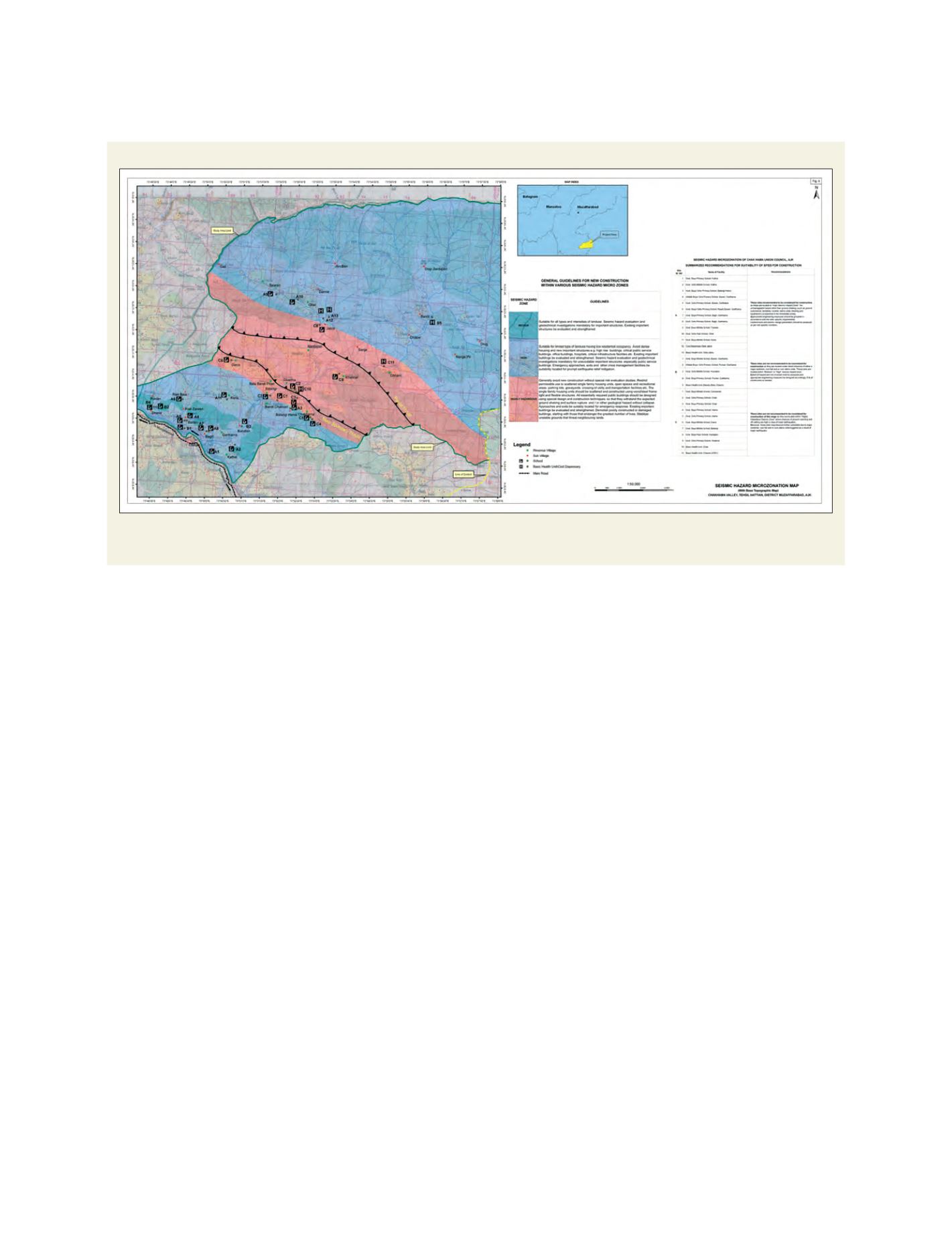
The microzonation studies that categorized both programme areas
into ‘medium’ (suitable for all types of land use), ‘high’ (suitable for
limited land use) and ‘highly hazardous’ (generally avoid new
construction without special risk evaluation), revealed that many of
the schools and health clinics had been built in high and highly
hazardous zones. This information was shared and discussed with
government officials and VOs, and it was decided that in Chakama,
AKDN would build four schools and one Basic Health Unit (all
seismic resistant and thermally insulated) in zones deemed appro-
priate for constructing public buildings. To ensure that children
continued to go to school, the Network partnered with the United
Nations Children’s Fund (UNICEF) to provide first
winterized tents, and later prefabricated structures to
replace the destroyed schools.
4
In Uri, AKDN is build-
ing three schools, including the only Girls’ Secondary
School in Uri, and retrofitting another four schools. The
construction of schools has been complemented by
training teachers in improved teaching and learning
methods, materials development and the reactivation of
school management committees which are beginning to
play an active role in the running and maintenance of
the schools.
Where soils studies have shown existing school sites
to be unsafe either because of slope instability of flood-
ing risk, communities have offered safer plots for their
own land holdings when possible. Not only has the
importance of safe sites for public buildings been fully
internalized by communities, but when possible, they
are willing to provide their own land for the collective
safety of their children and of the sick.
In the Chakama programme, apart from the physical
construction, a major effort has focused on the soft
elements of health and education. Over 36,000 health
consultations have been carried out; 500 children under
one year old have been fully immunized; over 200 preg-
nant women and 1,200 women of child-bearing age
have received anti-tetanus vaccination; and 29 commu-
nity health workers, two health promoters, nine lady
health visitors and 28 traditional birth attendants have
been trained and are working. Similarly, over 150 teach-
ers have received formal training and continue to
receive support through a mentorship programme. A
The microzonation map
AKDN commissioned a microzonation study to divide the region into areas of relative risk and allow discussions with government and communities on the
construction of seismic resistant buildings
Source: Commissioned by AKDN