



 123 / 196

[
] 121
ter preparedness. Discussions about moving out of the area also
prompted people to think that if they were going to stay in this earth-
quake prone area, they would have to reconsider where and how they
built and, most importantly, learn skills and acquire knowledge about
what to do before, during and after a disaster.
School students, teachers and health workers have all been trained
in how to react when tremors are felt. Other risks such as fires, slides
and floods have also been discussed and the basics of first aid and
search/rescue techniques taught to teachers and older students.
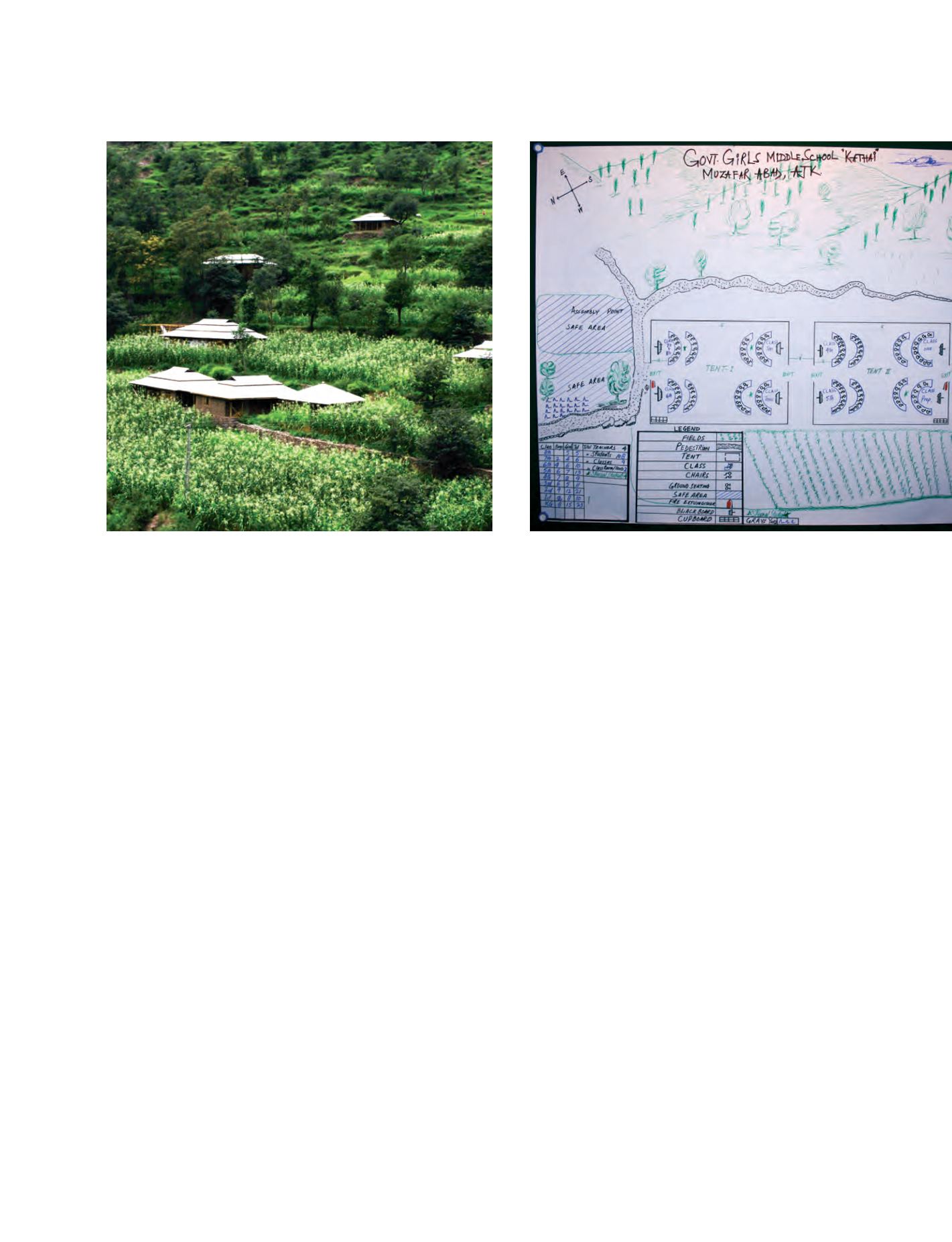
School and health unit evacuation plans have been drawn up, and
regular simulation exercises are carried out to ensure a degree of
preparedness. At the village level, 33 search and rescue kits, contain-
ing basics such as spades, rope, buckets, torches and batteries, have
been housed at safe sites. A further 17 will be placed after the local
emergency response teams have been trained. These kits are managed
by a committee of the VOs and are for use by the Local Emergency
Response Teams (LERTS) that have been formed to cover all the
villages in the valley. The LERTS will have nearly 2,000 trained
members, 40 per cent of whom will be women.
What has been learned?
One clear lesson is that much of the reconstruction effort may have
stalled or had limited effect if communities had not been encour-
aged to be in the forefront of decision-making and taking
responsibility for many of the activities. Secondly, community prior-
ities were defined by social, economic and psychological factors that
did not necessarily match the donor funding timelines or priorities.
Thirdly, reconstruction after a major disaster cannot be limited to
one sector or aspect of life – it needs to address them all. From the
wider perspective of what risk means to people, how they can be
supported to prepare for risk and how development agencies might
promote this more effectively, some further points may be of consid-
eration:
Reconstruction efforts need time to plan and implement
– Often, people need time to overcome or deal with the
trauma they have suffered before they can effectively
start rebuilding their lives. In contexts like this, one year
or less donor funding for infrastructure projects is unre-
alistic.
Areas need to be assessed for risk
– If reconstruction is
to avoid building public and other infrastructure in inap-
propriate (risky) areas, then time, effort and funds are
required to carry out the appropriate studies to define
areas and types of risk. Such understanding is currently
limited in donor countries.
Mainstream risk analysis and mitigation
– Donor
support for reconstruction is currently provided through
humanitarian assistance or rehabilitation funding lines.
If people, governments and development agencies are
to be encouraged in carrying out a reasonable amount of
risk analysis before embarking upon development
programmes, then risk analysis and mitigation must be
mainstreamed into general development thinking and
budgets.
Information needs to be understood
– Risk analysis
needs to merge hard science with community knowl-
edge and create simple, understandable information that
communities can internalize and act upon.
Retrofitting is essential
– In many seismically active
zones of the world, longer-term retrofitting programmes
need to be initiated to make homes and public buildings
seismic resistant. This requires sharing risk information
with communities and also making available microin-
surance and loans for home retrofitting. The costs of
rebuilding after destruction are likely to far outweigh the
costs of retrofitting.
Local level village hazard map plan to evacuate a school in time of need
Maize seed was distributed to all households in April 2006
Image: AKDN Kashmir Programme
Image: AKDN Kashmir Programme