


 129 / 196

[
] 127
of risk-reduction planning in disaster-prone areas. Built
environment professionals can provide vital support in
bridging these gaps, as the example of Rob’s work in
Montserrat has shown.
The international organizations involved in disaster
relief are often geared toward providing immediate relief
and usually exit the situation once short-term relief has
been provided. On the other hand, with the Indian Ocean
tsunami there was enormous pressure to be visibly seen
to spend the huge amounts of public donations that were
made. However, NGOs acknowledged that they were not
reconstruction experts – a report commissioned by the
International Federation of Red Cross and Red Crescent
Societies (IFRC), evaluating its response during the first
few weeks after the tsunami, ‘concluded that the organi-
zation had so much money that it entered areas – like
house-building on a massive scale – that were outside
its usual mandate and poorly handled’.
3
One of the few
good things to come out of disasters is the opportunity
to ‘build back better’, but that opportunity is too often
missed, or comes too late for the affected communities.
Discussions with the humanitarian relief commu-
nity and needs identified
The RICS Commission has built extensive links with
the humanitarian community, and has advised NGOs
and UN agencies, and the World Economic Forum on
guidelines for public-private partnerships; it has also
sourced professionals, on request, to advise on projects.
Meeting with those already involved in disaster relief
and recovery has been crucial to the MDMC’s approach
in seeking ways to bridge the gap. From the discussions
with the humanitarian relief community (such as UN
organizations, NGOs, professional bodies, the World
Bank, the World Economic Forum) the following were
key issues raised:
humanitarian relief after a disaster and the long-term reconstruction
process. The reasons for the gap include institutional constraints,
gaps in communication, lack of access to appropriate use of profes-
sional skills and knowledge to support the local effort, and failures
in management and planning. It was also found that the funding of
recovery from disasters is inflexible and short term-focused, which
made it difficult to plan and create a smooth and rapid transition to
long-term reconstruction.
The report identified that long-term reconstruction is ‘constrained
by the lack of planning, coordinated management and targeted funding
of the response in the post-disaster recovery phase.’
2
Significant short-
falls in knowledge, skills and capacity exist, which cause delays in the
reconstruction of communities post-disaster, and restrict the efficiency
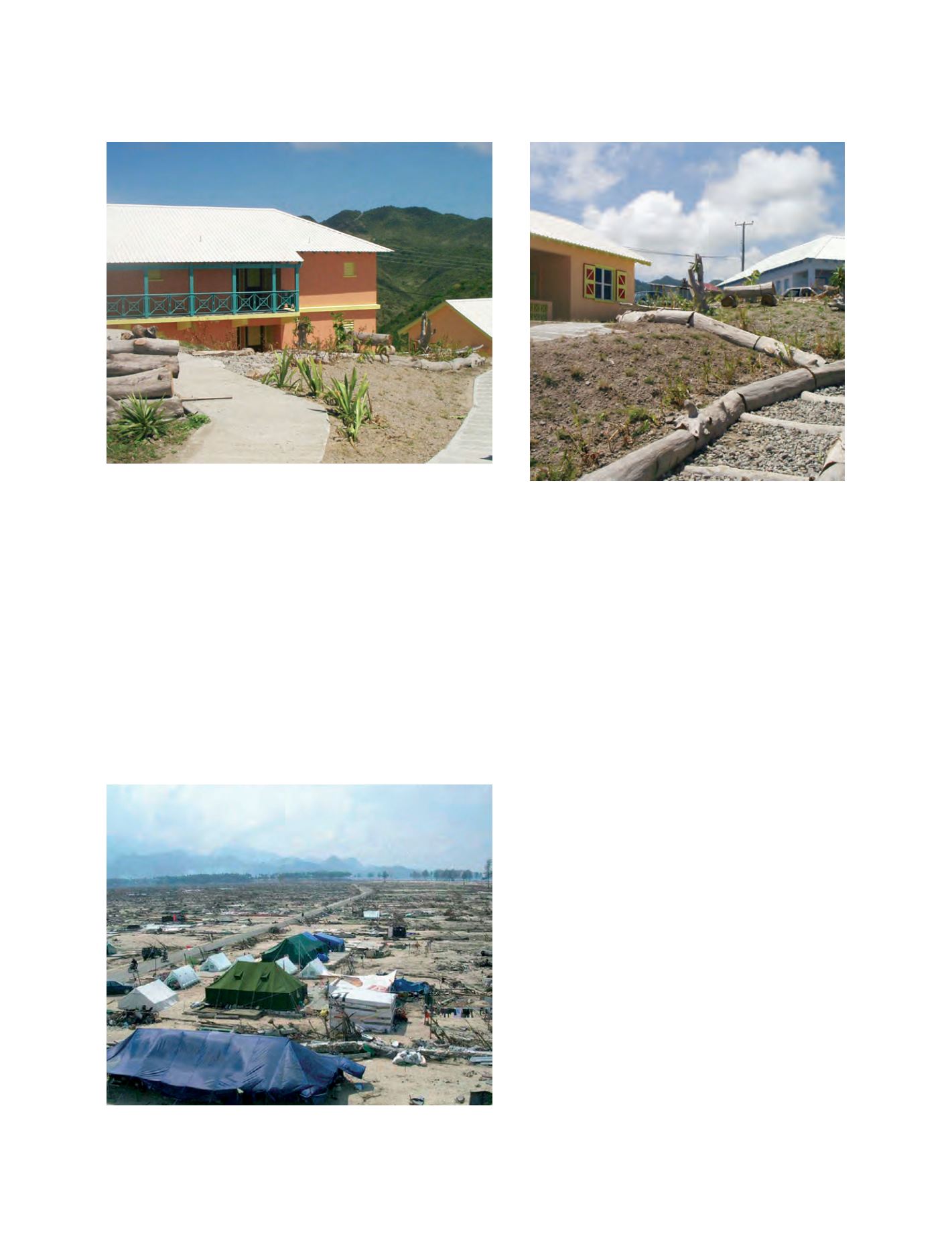
A transitonal camp in the Lampu-uk area, Sub District Lhok Nga,
Aceh Besar District, Aceh
Image: M Rizal
50 houses for old people were built at Lookout, a new village created after the
volcano. The project was split into seven packages to assist local builders
Image: Rob Worthington
The old people’s houses and community centre
Image: Rob Worthington