


 132 / 196

[
] 130
the people; therefore another focus area was to suggest
sustainable occupational patterns for the residents.
Impact of the tsunami
Official records put the total number of casualties at 317,
with 66 per cent being female and 33 per cent male. This
was because most of the womenfolk were within the huts
at the time of the event. A study of village causalities indi-
cated that villages that had coconut groves on the seaside
– those located at a higher elevation – had very few to
no deaths. This reinforced the need to maintain a setback
from the high tide line, as suggested in the CRZ notifica-
tion. It also brought forth the need to address location
specific guidelines – areas with higher elevations could
be nearer and safer. The existing vegetation and landform
types can be analysed for their protective value.
Since the major occupation was fishing, the extensive
damage to boats, vessels, nets and equipment had
rendered the inhabitants jobless. The fishermen were not
entering the sea due to the trauma and fear. Also, the
fishing points had changed. Some deepwater species such
as jellyfish and starfish were spotted at the beach, which
indicated a change in fish composition. The need for an
alternate means of livelihood was at its highest at this
juncture.
As water sources were mostly groundwater, the supply
deteriorated with rising salinity. Sanitation facilities,
which were mainly dry-pit latrines, were constructed
again, but the few public toilets were damaged.
Electricity poles withstood the tsunami and the area did
not lose its communication network during the disas-
ter. The single bridge over the backwater was a major
lifesaver and withstood the tsunami. We found a huge
Cuddalore district lies between 11° 5´ and 12º 30´ of the northern
latitude and 78º 37´ and 80º of the eastern longitude. The study area
along the coastal belt is connected to Cuddalore and Chidambaram
towns by district roads. The total population of the area was 38,206,
which was 1.75 per cent of the total population of the district. The
highest population in the study area was 8,478 (22 per cent), recorded
at Devanampattinam, due to its urban characteristics. The rest of the
belt was largely rural, constituting mostly of fishing villages. Average
family size was four persons, with a literacy rate of 68.35 per cent.
The major occupation was fishing and related activities, with a work-
force participation rate of 39.3 per cent. Both sexes participated, the
men being engaged in the actual fishing with women associated with
processing of the catch and so on. With an average annual income of
INR6,000, economic activities catered mainly to sustenance of the
majority of the population. This made the study area even more vulner-
able to any disaster. Situated in a backward rural area, the water supply
and sanitation facilities were substandard. However, the electricity and
communication network was found to be good.
The land use of the coastal belt showed the majority of the area
under barren land (53 per cent), followed by vegetation (23 per cent),
with settlements occupying 11 per cent, and agriculture and water
bodies covering the rest at 13 per cent. Thus the impact of the tsunami
was not only observed on the population but also the ecosystem. The
major aspects of the study concerned the impact on people and prop-
erty, and the ecosystem.
This was arrived at by carrying out a socioeconomic survey of the
settlements and mapping of landform and vegetation. The impact of
the tsunami was studied through official records of the district admin-
istration, discussions with the affected people and visual observations.
This was followed by delineating zones within the study area based
on CRZ notification and natural features. Proposals were prepared to
address the issues of disaster mitigation through appropriate physi-
cal developments. The tsunami had eroded the occupational base of
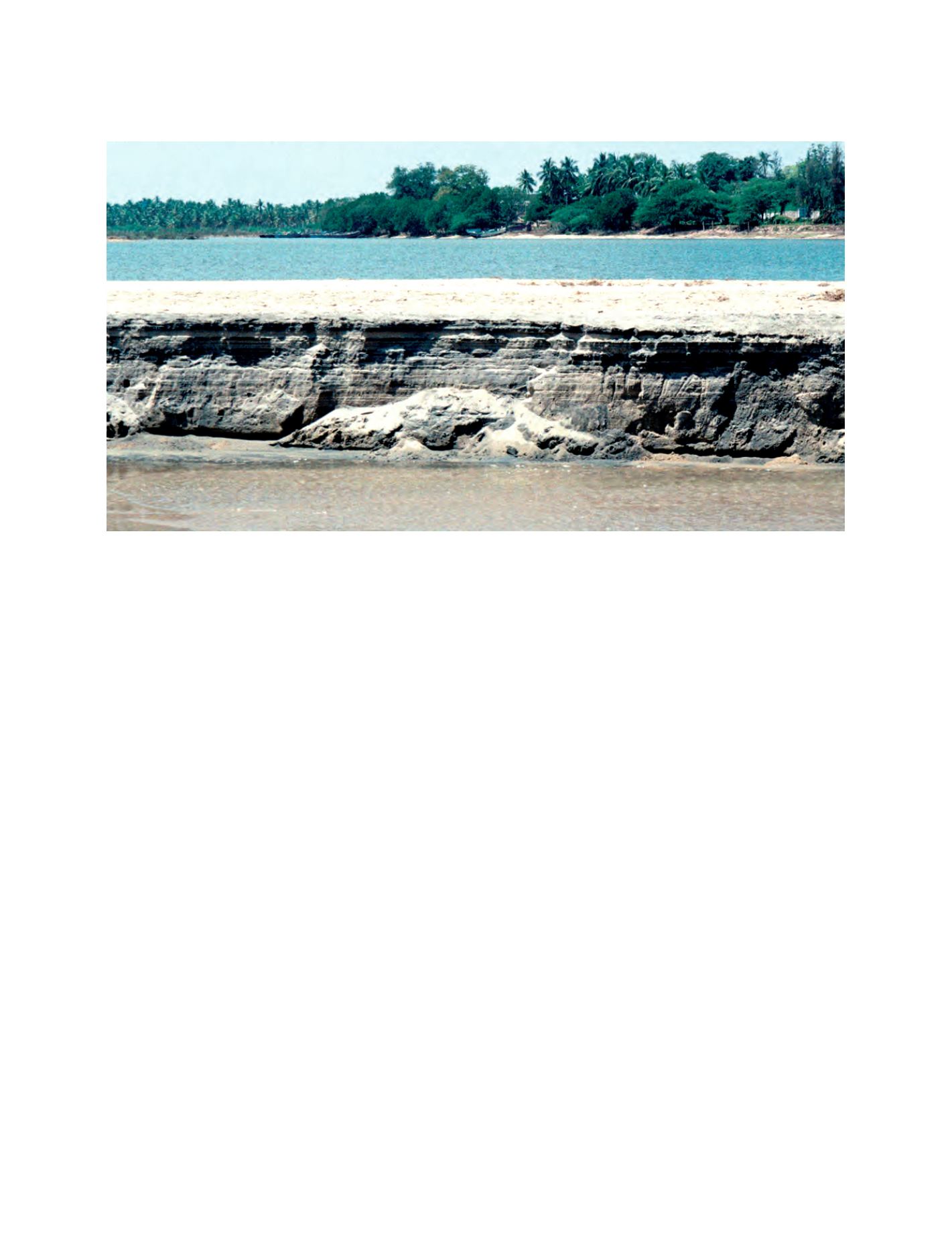
Sand deposition created by the tsunami
Image: Environmental management measures; Cuddalore District: Studio Report,
Department of Environmental Planning, School of Planning and Architecture, May 2005