


 136 / 196

[
] 134
The way ahead
International Financial Institutions such as the World Bank and
Asian Development Bank should consider allocating a certain
percentage of their relief and development budget for disaster risk
reduction in schools of hazard-prone countries.
The International Federation of the Red Cross and Red Crescent
Societies, being one of the oldest humanitarian movements having
physical presence in many countries, should encourage its national
chapters to demand safety from school authorities and develop
national action plans to work with vulnerable schools.
ISDR is situated at the core of the UN system to develop global
risk reduction strategies, and can influence other UN agencies such
as UNESCO, UNDP and national governments. ISDR is best placed
to build on its own global campaign and other initiatives in devel-
oping countries to further integrate safety issues in ongoing
programmes on HIV/Aids, climate change adaptation and good
governance. In addition to developing strategies, capturing lessons
and promoting best practices, ISDR should focus more on support-
ing pilots and demonstration projects on the ground.
National governments should undertake nationwide school safety
audits backed up with resources to implement recommendations and
safety measures identified by such audits. National governments must
also promote and integrate disaster risk reduction in school curricula
at various levels.
Private sector insurance companies should inspire their policy-
holders to demand certificates of school safety from their respective
education authorities. Authorities should certify if the school is safe
and prepared for any possible disaster risk. Once such a demand is
built, schools and governments are bound to act. The insurance sector
has the resources and the weight to take the lead. As in politics or
economics, progress will follow the law of demand: let policyholders
create a demand for protecting children at school.
8
Similarly, construc-
tion firms and contractors must provide a certificate of safety after
completing a school building or retrofitting old buildings.
Civil society organizations should directly engage with
and support vulnerable schools in learning and imple-
menting risk reduction measures through demonstration
projects, influencing government policies, and introduc-
ing programmes to integrate risk reduction for children.
A world without poverty is not possible without the
poor having access to education, to schools – indeed, to
safer schools. The poor have the right to life: the life of
their children and the life of their children in schools.
School safety is not possible without scientific awareness.
Safety and poverty removal are not two separate issues.
HFA priority:
Ensure that disaster risk reduction is a
national and local priority with a strong
institutional basis for implementation.
Identify, assess and monitor disaster
risks and enhance early warning.
Use knowledge, innovation and education
to build a culture of safety and resilience
at all levels.
Reduce the underlying risk factors.
Strengthen disaster preparedness for
effective response at all levels.
Safer Schools campaign application
Opportunities for disaster risk reduction through safer schools initiatives are synthesized into publication
and disseminated on local, national and regional levels. In its direct work with local communities, the
Safer Schools Campaign assesses human resource capacities and promotes community participation.
The Safer Schools campaign works with partner institutions in their respective states to identify disaster-
affected and vulnerable schools. School Safety Audit has been conducted to identify specific needs in a
representative sample of India’s vulnerable schools. School Safety training strengthens local capacities
for identifying hazards and reducing risks.
The Safer Schools campaign is imparting knowledge through education directly to school staff, or to local
trainers working directly with school staff, to build a culture of safety by spreading scientific awareness.
The campaign works in partnership with local governments and civil society agencies, thereby involving a
broad range of institutions in building a culture of safety on many levels.
In addition to assistance in the identification of risk factors, the Safer Schools campaign works to reduce
those factors. Structural improvements are made to buildings when resources allow, and innovative
plans such as disaster and accident microinsurance are used to reduce risk for students, teachers and
their families.
School Safety training sessions promote preparedness tools and strategies in schools. Supported
schools are also provided with fire extinguishers, first aid kits and IEC displays. Case studies have shown
that children extend preparedness strategies to their families, including lessons on what to do before,
during and after disasters.
How can the HFA framework comply with Safer Schools campaign activities?
Source: All India Disaster Mitigation Institute (2008). “School-based Disaster Risk Reduction: Lessons for South Asia”
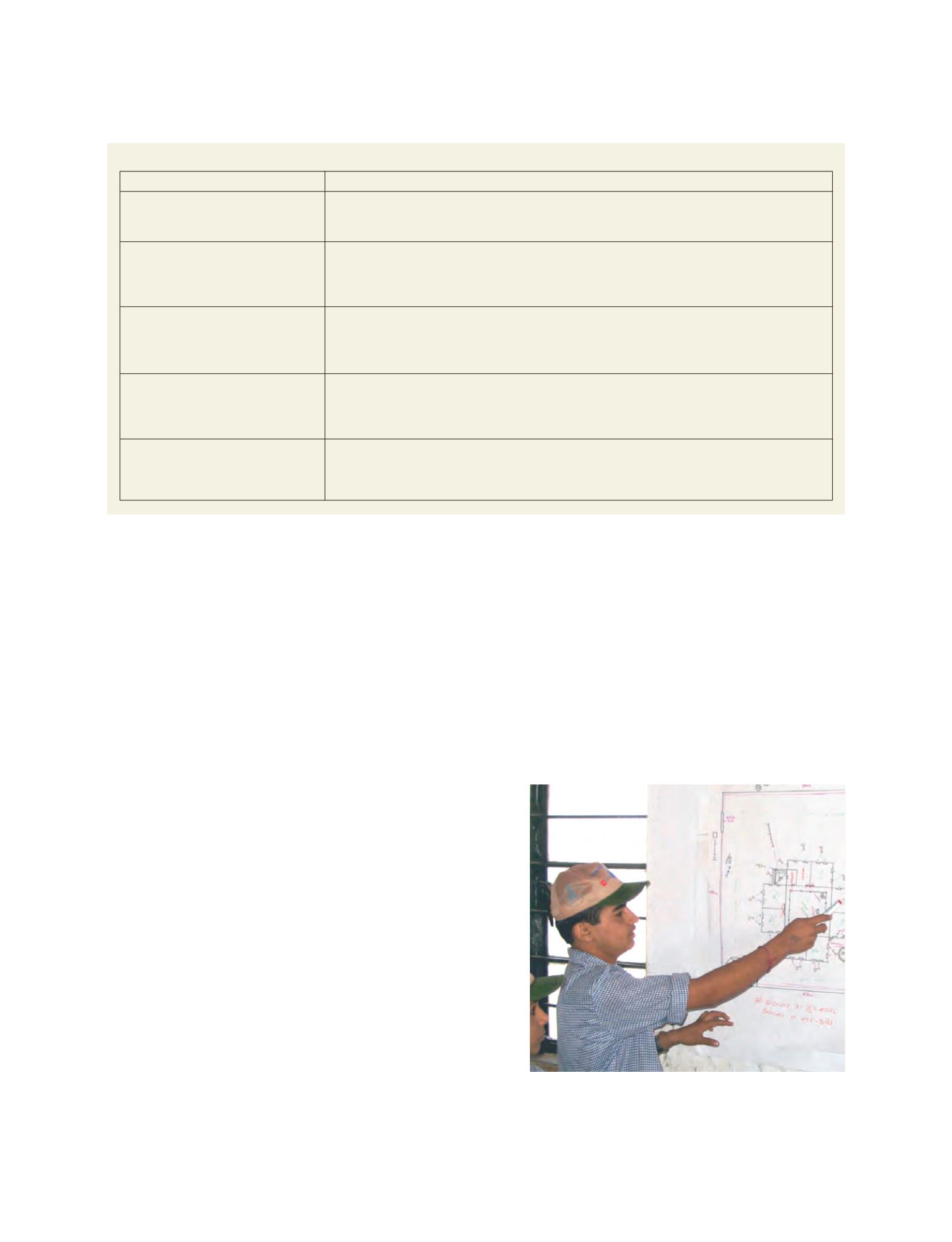
www.southasiadisasters.netA student presenting a risk assessment for his school during School
Safety training by AIDMI and the European Union in Kutch. Active
participation of students in designing school safety measures ensures
their better response during emergencies
Image: AIDMI. School safety training 2005