


 133 / 196

[
] 131
amount of debris and solid waste, piled up on the beaches as a
precautionary measure.
The major plant species within one kilometre of the stretch consisted
of coconut, casuarinas, cashew nuts and palm. The palm species was
the most damaged amongst them– the trees were showing a withered
condition due to water stagnation and salinity. Casuarinas and coconut
plantations had acted as effective barriers in buffering the force of the
tsunami. Terrestrial plants not adapted to saline conditions – agricul-
tural crops, home gardens and grasslands were adversely affected.
Physical impacts on water bodies resulted in closure of the estuary
mouth, discontinuation of water flow at the existing harbour and the
creation of new water bodies. Large volumes of sand had been
deposited on salt marshes, and the formation of barrier islands at the
sea edge due to sand deposition modified the coastline in certain areas.
Seawater had penetrated to a depth of about one metre, affecting the
root zones. Preliminary salinity tests by the District Agriculture Office
showed pH values in the range of 7-9. Colour changes in the soil –
dark patches, deposition of new sediments – indicated a change in
nutrient availability and other properties.
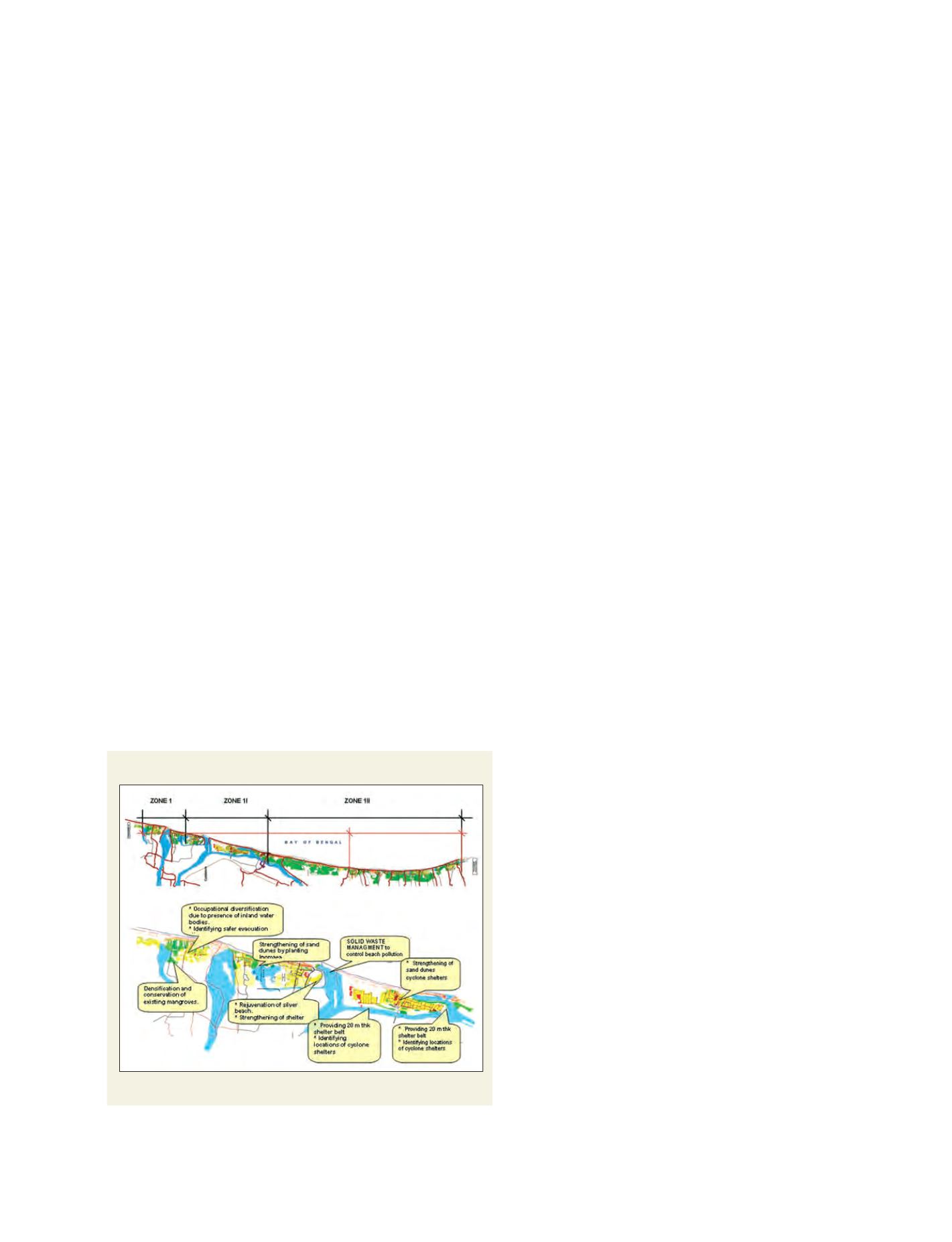
The study area was divided into three zones:
• Zone I: settlements having urban characteristics
• Zone II: settlements near water bodies such as backwaters and
lagoons
• Zone III: settlements within vegetated areas – coconut, cashew
plantations.
This helped in formulating proposals for the areas.
Framework for proposals; environmental
management measures
The proposals were arrived at by attempting a strengths, weaknesses,
opportunities and threats (SWOT) analysis of the study area, zone-
by-zone, to address location specific issues within an overall
framework to achieve safer conditions.
The management measures were formulated keeping
in mind the three-tier decision-making and implement-
ing mechanism prevalent in the study area. Any
long-term measure should address national policy – to
enable policy modification, especially amendments to
the CRZ notification, by making it more location-
specific.
At the state level, a strategic plan for disaster prepared-
ness for vulnerable areas was suggested. The major focus
of the proposals was for the local area. Depending on the
characteristics of each zone the measures addressed:
• Location of future developments
• Provision of cyclone shelters
• Formulation of escape routes
• Landscape upgradation
• Infrastructural upgradation
• Occupational diversification.
Time phasing of proposals
The proposals were to be executed in a phased manner
– short-term and long-term.
Short-term (six months to a year):
• Construction of cyclone shelters and boat shelters
• Defining escape routes
• Installing warning systems.
Long-term (one to two years):
• Shelter belts
• Rejuvenation of the beach
• Diversification of occupations
• Rehabilitation.
The study has been presented at various levels and
through seminars held in various coastal cities of India.
We hope that this will have triggered action in the right
directions.
To conclude, the tsunami might have been a disastrous
event in the history of mankind, but it has given an impetus
to new developmental activities in the coastal hamlets.
Although policies and programmes have always advocated
the safety of people in these coastal villages there is always
a huge gap between planning, implementation andmanage-
ment. The calamity of 26 December 2004 has modified the
entire concept of coastal regulation.
Carried out by planners having a special concern for
environment, the study attempted to understand the
scenario post tsunami and its implications for different
aspects of human settlements. One can easily envisage
developmental activities for the coastal people, but the
real test lies in the implementation on site. In the long
run, it is the participation of the people and their
response to such developmental programmes which
matters. The dependence of human settlements on
natural resources calls for management measures which
are oriented towards the betterment of the people. This
studio assignment
1
was a small endeavour in this field,
which aims at evolving some basic environmental
measures for the tsunami-struck areas, with Cuddalore
as an example.
Environmental management measures for the tsunami affected area
Source: Environmental management measures; Cuddalore District: Studio Report,
Department of Environmental Planning, School of Planning and Architecture, May 2005
Diagrams showing delineation of zones and time phasing of proposals