


 130 / 196

[
] 128
• RICS is seen as a way for the community to access firms in the
built environment private sector, which it has not engaged in
the past
• The humanitarian sector does not generally have expertise in
the built environment
• There is a need for immediate professional advice at the
scene of a disaster (for example mapping damage to infra-
structure to identify routes to sites, assessing buildings for
safety before people can return to their homes, identifying
rubble materials that can be used again), and during the
recovery phase
• The international community is looking more at disaster relief
in terms of risk reduction and preparedness, so the work of the
Commission should address this area.
Whilst initiatives such as the Hyogo Framework for Disaster Risk
Reduction
4
have put into place policies for risk reduction, tools and
processes are required for implementing these policies.
5
Skills of a chartered surveyor
Millions of people live in areas vulnerable to natural disasters due to
rapid urban growth.
6
More of the urban population is living in
poverty, so increased urbanization has led to more people being
vulnerable due to insecure land rights, poorly built housing and
unstable informal settlements.
7
Chartered surveyors are involved in the whole lifecycle of land
and buildings, including:
• Master planning
• Building quality audits pre- and post-disaster, particularly
resistance to disaster risks
• Advising on building standards
• Knowledge of local regulatory frameworks and ways they could
be improved
• Land surveying, GIS and rapid mapping of disaster impacts and
risks
• Assessing structural damage to buildings
• Knowledge of land and property legislation,
providing support on land rights and claims and
resolving disputes
• Valuation, cost planning and spending priorities
• Sourcing construction materials and equipment
• Managing money, and accounting for it to allow
reporting back to donors with confidence
• Project managing construction – delivering
buildings on time and on budget, by managing a
range of competing interests and deadlines safely
and sustainably
• Building local capacity and partnerships – training
and knowledge transfer
• Links with other built environment professions;
inter-disciplinary and team working
• Contacts with local business and industry.
There are chartered surveyors all over the world – RICS
has 140,000 members in 146 countries. Local knowl-
edge is important to applying some of these skills.
It is important that those involved in disaster risk reduc-
tion and management are aware of the diversity of skills
offered by the built environment community, and one of
the aims of RICS has been to raise awareness of these skills.
BuildAction – delivering built environment skills
The MDMC works with the private and public sector to
provide built environment professionals on a ‘for the
public good’ basis to help deliver projects initiated or iden-
tified by humanitarian agencies. The MDMC is calling this
initiative BuildAction, and it will be managed by RICS.
8
This opportunity is available to not-for-profit organiza-
tions working in disaster risk reduction or disaster recovery
and reconstruction. Our member organizations are based
all over the world, providing an ideal partnership to deliver
staff with regional expertise on a ‘public good’ basis.
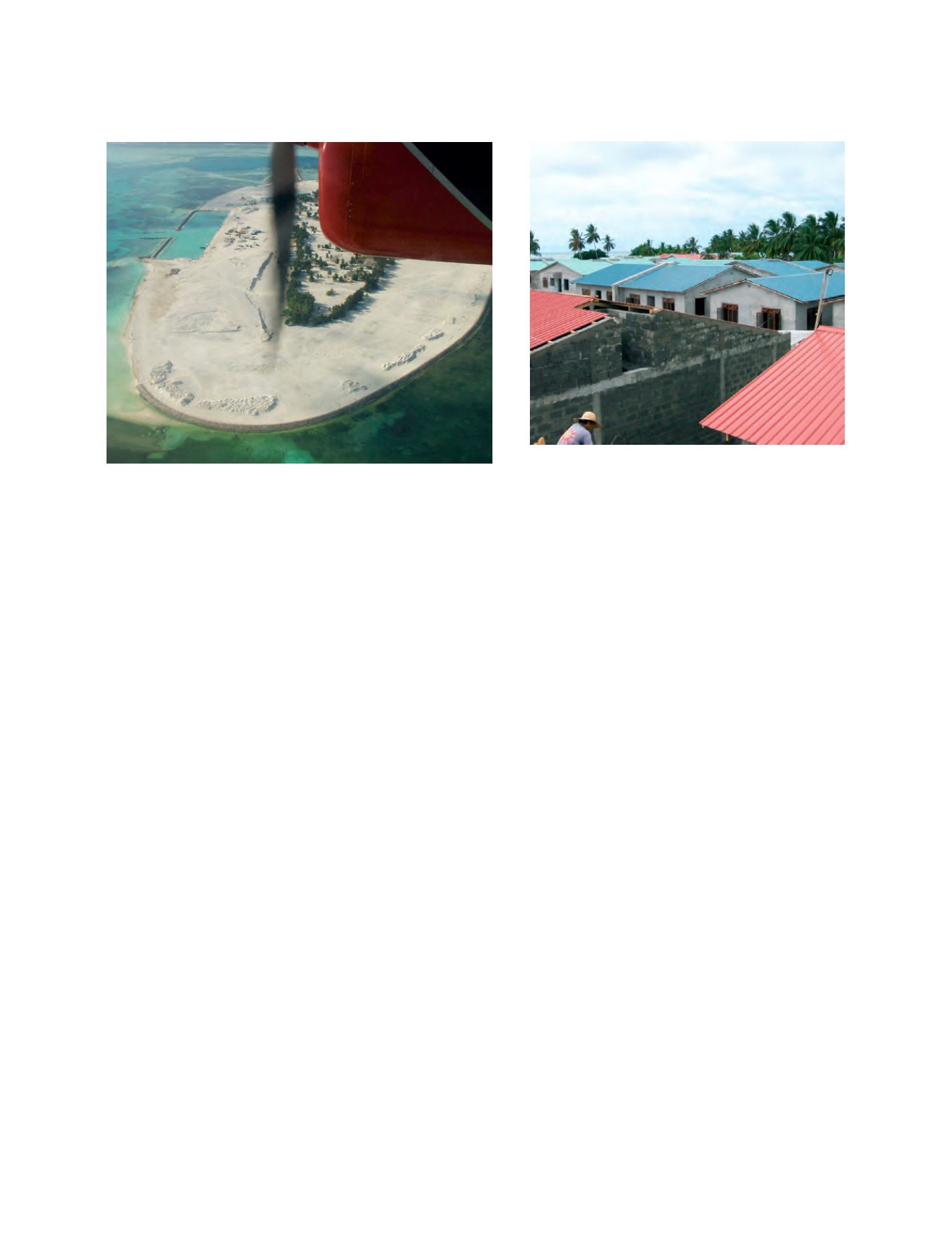
Vilufushi, March 2007: after land reclamation but before the start of construction. The
original island is within the ring of palm trees (the only things that survived the tsunami)
Image: Rob Worthington
Vilufushi, May 2008: building progress on the 250 houses. The plots
are small, as the Government wants to move more people here from
more vulnerable islands
Image: Barry Davies