


 135 / 196

[
] 133
dination with the respective local government authorities
and uses range of quantitative and qualitative methods to
gather evidence on school resilience. In many ways this
is a mitigation measure.
The audit covered schools in a range of disaster-prone
areas: flood-affected portions of Assam, Rajasthan, and
Maharashtra; earthquake-affected portions of Gujarat and
Jammu and Kashmir; and tsunami-affected portions of
Tamil Nadu. In each of these areas the audit assessed the
staff understanding of hazard safety, the structural safety
and preparedness plans, and the impact of existing miti-
gation measures. The influence of non-school actors –
government, non-governmental organization (NGO) and
corporate – on school safety was also reviewed. Although
the comprehensive analysis of findings is pending, the
following five points are clearly emerging:
1. Processes and methods that reduce disaster risks –
such as the design of seismically safe buildings – are
not considered even after the area served by the school
has faced a major disaster. School buildings are often
structurally unsafe.
2. The focus of reconstruction after any disaster has
been on new and big buildings and not on safer school
buildings. Size matters. Safety does not.
3. The schools that are safer have not shared their
experiences with schools that need to rebuild. Schools
are temples of learning but school-to-school learning on
safety is not occurring.
4. The teachers in the surveyed schools have high
levels of interest in making schools safe. They do not
know where to access basic, useful information. Current
constraints in time and resources inhibit this access.
5. Where school safety activities are promoted by
NGOs, government or the corporate sector, follow-up
is often lacking. This almost guarantees that the high-
cost initial effort will have diminishing returns. In short,
we are not demonstrating sufficient concern for the
safety of our children.
campaign has undertaken a dynamic effort to empower schools for
disaster preparedness and response.
In conjunction with local partners in six states, the campaign iden-
tifies India’s most vulnerable schools and supports them with training
programmes, disaster education, risk-transfer initiatives and other
capacity-building mechanisms. Its operations place emphasis on Hyogo
Framework for Action (HFA)
4
and Tsunami Evaluation Coalition
5
recommendations, and the Minimum Standards of Education in
Emergencies guidelines of the Inter-Agency Network for Education in
Emergencies.
6
Awareness, education and training comprise the central
elements of the campaign’s work. The campaign reaches out to rural and
urban schools in disaster-prone and disaster-affected areas, training
staff in disaster and accident response, helping schools to develop emer-
gency response procedures, educating students in disaster preparedness
and distributing educational materials to students, staff and parents.
The Child’s Right to Safer Schools campaign operates largely on a
local level; it helps schools to build capacities for managing their own
disaster risk reduction activities. It reaches schools specifically targeted
for disaster mitigation assistance, and in doing so promotes disaster
preparedness for vulnerable communities. It works in partnership with
civil society organizations and government bodies such as District
Chief Education Officers or Block Resource Centres. The campaign
supplies schools with fire extinguishers and first aid kits, covers
students and teachers with disaster microinsurance to ease financial
hardship incurred by accidents and disasters, and provide additional
community-tailored, need-based assistance. AIDMI, with ProVention
Consortium,
7
is promoting the use of risk transfer approaches in India
and beyond through demonstration and research. The campaign works
with more than 400 vulnerable schools across these six states in India.
It strives to meet the recommendations of the UN International
Strategy for Disaster Reduction’s HFA. The table below demonstrates
how campaign activities comply with the Hyogo Framework.
School Safety Audit
A recent school safety audit in 60 schools in six hazard-prone states
of India revealed that school safety is not a high priority for either
public or corporate officials. The audit method was developed with
schoolteachers, school administrators, parents and children, in coor-
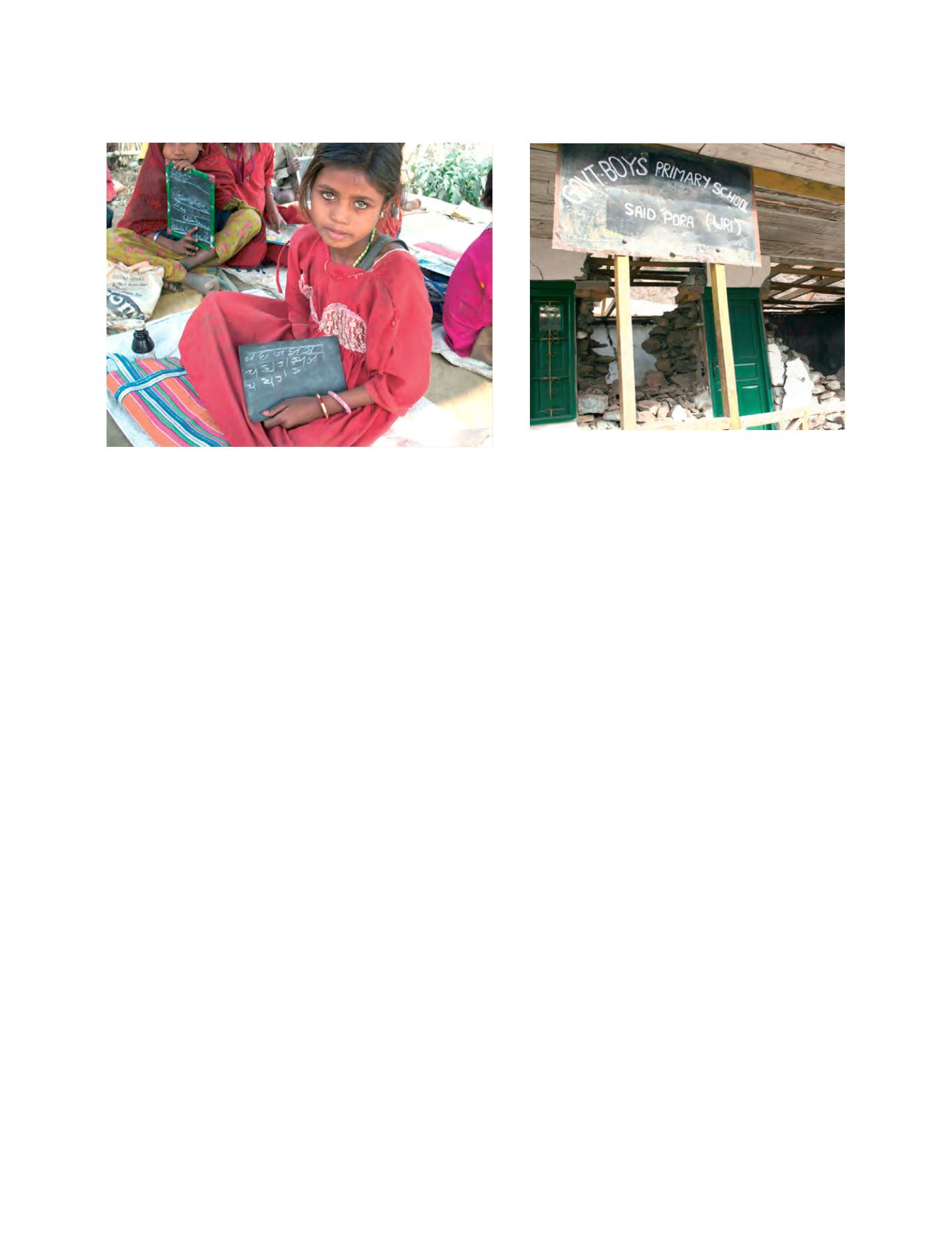
Nearly half of all victims of natural disasters are children under the age of 15
Image: AIDMI. Bihar flood recovery 2007
Damage to school structures induces injuries and also setbacks to
enrolment and progress, which can last for many months
Image: AIDMI. Jammu and Kashmir earthquake 2005