


 128 / 196

[
] 126
RICS: building resilience
Karen Gardham, Royal Institution of Chartered Surveyors, UK
F
ounded in 1868, the Royal Institution of Chartered
Surveyors (RICS) provides the leading international
professional qualification in land, property, construction
and related environmental issues. With over 140,000 members
in 146 countries, across the public, private and third sectors,
RICS is one of the largest independent, not-for-profit profes-
sional bodies dedicated to serving the public interest. RICS
provides expert, impartial advice to governments, non-govern-
mental organizations (NGOs) and business worldwide.
Following the Indian Ocean tsunami of December 2004, many char-
tered surveyors contacted RICS to offer their help and expertise to the
relief effort. RICS set up a Major Disaster Management Commission
(MDMC) to address how built environment professional skills and
knowledge could be deployed to help vulnerable communities, at all
stages of the disaster management cycle. The commissioners are char-
tered surveyors and other built environment experts with many years
of experience in a range of disciplines and regions of the world, includ-
ing disaster-specific and international development work.
How do chartered surveyors work in disaster management?
Rob is a retired member of RICS, formerly of project and cost manage-
ment consultancy Faithful & Gould. He decided towards the end of
his career to give up his company Jaguar and travel to the volcano-hit
island of Montserrat. Rob started his professional life as a land surveyor,
becoming a quantity surveyor and member of RICS
because of the better pay. As a quantity surveyor, Rob used
his professional skills to assist the reconstruction work as
part of a humanitarian team for the UK Department for
International Development (DFID). He went on to work
for the British Red Cross in the Maldives, post-tsunami.
In Montserrat, Rob encountered initial scepticism
from government officials who were wary of outside
advice. However, the advice, skill-sharing and capacity
building that Rob helped achieve meant that the govern-
ment recognised the value of DFID’s work and
welcomed it. Part of Rob’s work was to oversee a mate-
rials grant scheme, which issued grants to households to
enable them to rebuild their homes either themselves or
through local skill-sharing cooperatives. Four hundred
and thirty houses were built through the scheme, all
individualized as people modified them to suit their
needs. In addition to supervising reconstruction work,
Rob identified a need for education on tenders and esti-
mates for local construction workers. He ran classes for
local workers on tendering, and on basic accounting,
which he also identified as a weakness. The result of this
was that he left behind a stronger infrastructure for local
businesses. Rob also encouraged local contractors to
form consortiums and work together to strengthen small
business and maximize the efficiency of rebuild efforts.
Rob felt that it was invaluable to have professional
skills available early following a disaster in order to plan
and prioritise effectively. He says that he felt his age and
experience were beneficial to working in challenging
conditions and an unfamiliar cultural environment. He
encountered many difficulties during his work in
Montserrat and the Maldives; political circumstances
were at times challenging, as foreign assistance is not
universally welcomed (often due to historical experi-
ences) and tact and empathy for local concerns was
important. In terms of his employers, the agencies Rob
worked for were familiar with what a land surveyor does
but not other surveying professions. Part of the problem
is that using professional firms charging commercial
rates was often prohibitively expensive, and as agencies
don’t fully understand the professional skills on offer,
such skills are simply not used. Raising awareness is an
area the MDMC at RICS is focusing on.
Mind the Gap
The MDMC commissioned an independent report,
Mind
the Gap!
1
which identified the gap between immediate
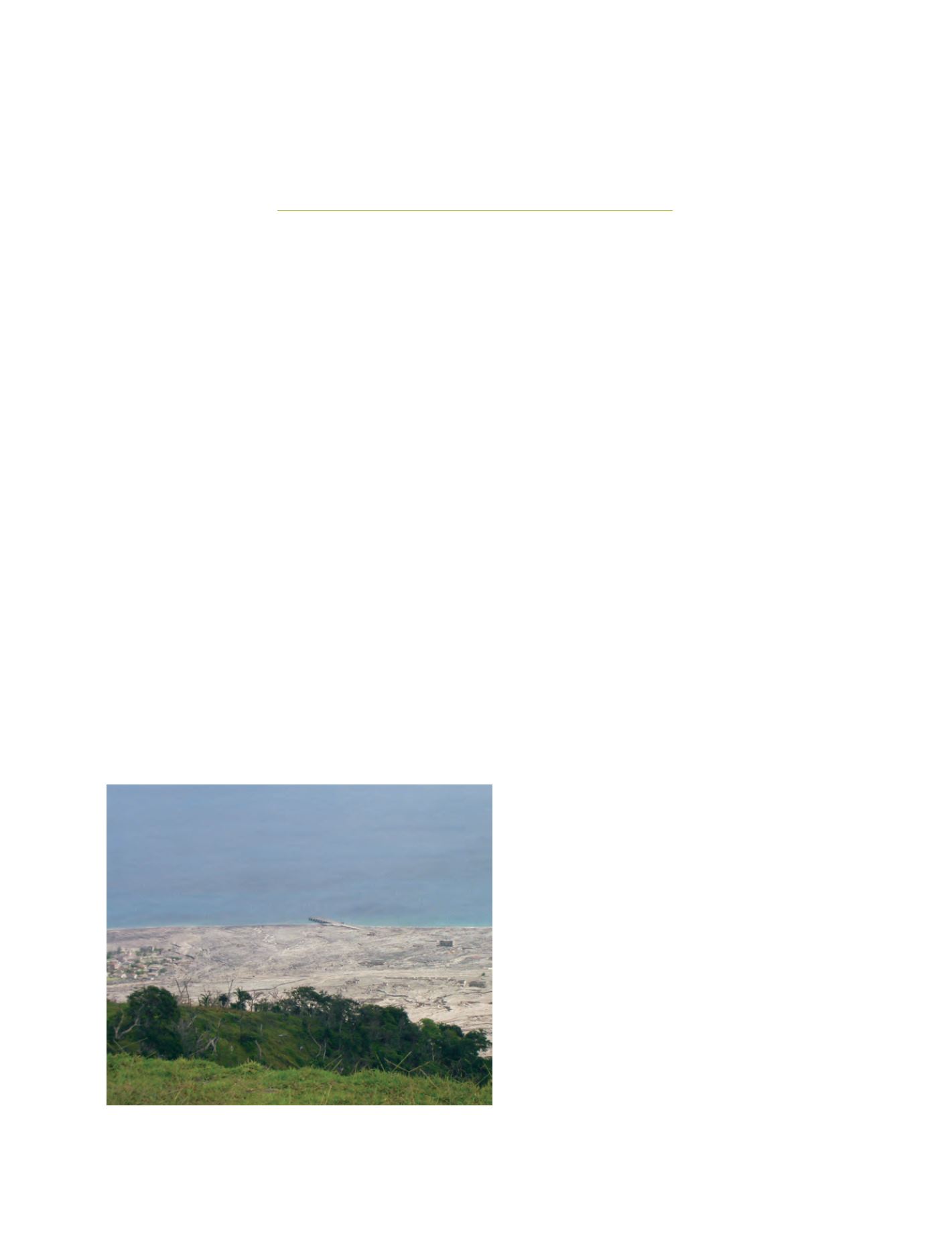
Plymouth, the old capital of Montserrat, about ten years after the first eruptions.
The ash now covers the top of the church steeple
Image: Rob Worthington