


 124 / 196

[
] 122
Iran earthquake risk reduction strategy
and the International Institute of Earthquake
Engineering and Seismology (IIEES)
Mohsen Ghafory-Ashtiany, Distinguished Professor, Founder and Past President, IIEES
I
ran, being located in high seismic hazard regions of the
world with frequent occurrence of devastating earthquakes,
has experienced high human, social and property losses in
past decades due to vulnerability of the built environment, rapid
population growth and seismically-incompatible urban devel-
opment. To ensure the sustainable development of Iran requires
a multidisciplinary risk reduction strategy with the objective of
saving human lives and resources; along with an effective imple-
mentation programme. The establishment of the International
Institute of Earthquake Engineering and Seismology (IIEES) in
1989, with the cooperation of UNESCO, provided an excellent
platform for answering the increasing demand for safety, devel-
opment of the required disaster reduction programme and
providing the required know-how and expertise for hazard and
risk mapping, vulnerability reduction and public awareness and
preparedness.
Considering that not a great deal was done before the
Manjil earthquake, for the purpose of the following
discussion, the risk reduction efforts in Iran can be
divided into two main eras: post-Manjil earthquake
(1990-2003), and post-Bam earthquake (2003-present).
Post-Manjil earthquake (1990-2003)
The first move toward earthquake risk mitigation in Iran
was started after the devastating Manjil earthquake of
June 1990, with its heavy socioeconomic impact. After
this tragic event and in the beginning of the
International Decade for Natural Disaster Reduction
(IDNDR), the Government decided to implement a
multidisciplinary strategic research and mitigation plan
called the Iran Earthquake Risk Mitigation Program
(IERMP). The programme, which was developed by
IIEES, had the following objectives:
• Increasing the scientific knowledge required for
earthquake hazard mitigation
• Reduction of risk of failure in different types of
constructions and the need to build safer structures
• Increasing public awareness of seismic hazards and
promoting a collective prevention culture
• Developing plans for post-earthquake actions.
The comparison of the indexes before and after the
implementation of the programme indicates the signif-
icant steps (though not yet sufficient) that have been
taken toward risk reduction in Iran, which made the
Manjil earthquake a turning point in the earthquake
risk reduction history of Iran. The main practical
achievements of this programme can be summarized as
follows:
• Expanding seismic and strong motion networks as
well as establishing advanced geotechnical and
structural laboratories; this resulted in better
assessment of Iran’s seismicity and seismic related
hazards
• Improvement of research, education, technical
knowledge and the know-how required for
implementation of a risk reduction programme in
Iran
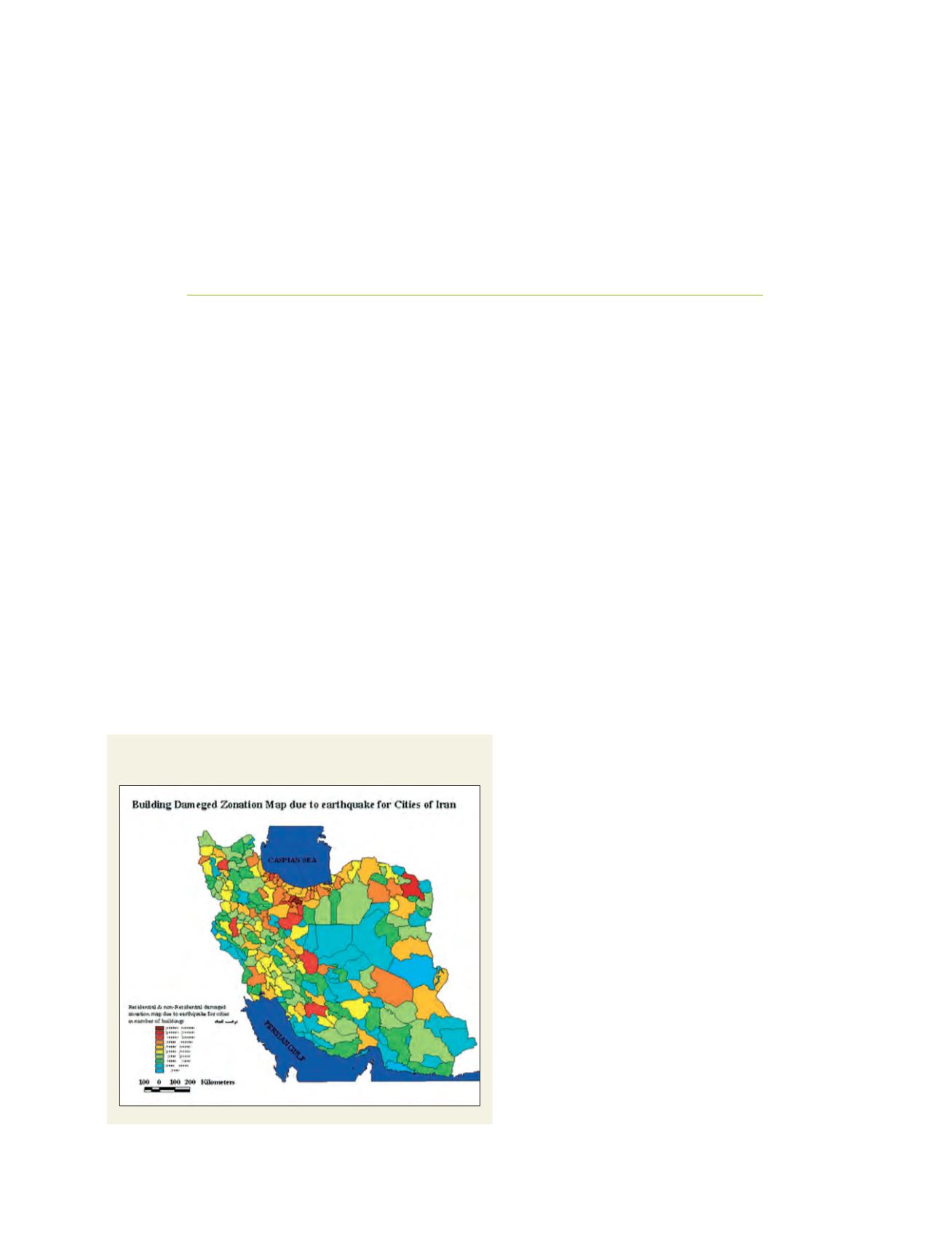
A map showing building damage zonation for anticipated
earthquake hazards in Iran
Source: Ghafory-Ashtiany