


 122 / 196

[
] 120
On the Pakistan side of the LOC, the AKDN has estab-
lished a branch of the First Micro Finance Bank in
Chinari, the nearest commercial hub to the Chakama
Valley. This has allowed people to access credit for
reestablishing or starting new businesses, and to open
savings accounts that can be used to support loan appli-
cations. Up to March 2008, communities in Chakama
had saved over USD90,000 and accessed loans of nearly
USD200,000. Sixty per cent of the savings account
holders and 59 per cent of those who received loans
were women.
Understanding risk and being prepared
Mobilizing people to understand the types of natural risk
in their environments and preparing to mitigate the effects
of future disasters proved initially difficult. There was a
general feeling of resignation and helplessness among
communities, and a lack of belief about how anybody
could do anything to withstand the sort of disaster they
had recently experienced. It was only after the basics of
life were reestablished and a limited sense of normality
returned, that people started thinking of the future.
Simplifying the results of the microzonation study, soil
studies and hazard assessments to share them with
communities was critical in terms of people beginning
to think of how to be more prepared for future disasters.
Involving communities in developing village-level
hazard/vulnerability maps allowed them to think through
what measures were, or were not possible with regard to
localized hazards such as rockslides, avalanches and
flooding. The whole concept of building seismic resis-
tant homes and public buildings brought about a level
of confidence amongst communities on the issue of disas-
learning resource centre has been established for teachers to access
teaching materials, and school management committees are func-
tioning in all primary and middle schools. Six boys and four girls
have received two-year, merit-based scholarships for higher educa-
tion. The teacher training programme for the schools in Uri is
scheduled to begin in July 2008.
Recreating livelihoods
Most households had lost the seed that they were saving for plant-
ing in the winter of 2005 and spring of 2006. Therefore, the first
priority was to distribute maize seed to all households in April
2006, to be harvested in November of the same year; and then
wheat seed in October to be planted after the maize harvest and
reaped in May 2007. To improve incomes, vegetable seed was
distributed to willing households in the lower and middle valleys,
where climatic conditions are more suitable, at a subsidized rate.
Over 22,000 animals in the valley were wormed and vaccinated;
sheep, goats, cows and buffalo were distributed to selected members
of the communities to start the process of restocking the animals lost
during the earthquake. To create livelihood opportunities for poor
women, nearly a thousand poultry birds were distributed. In Uri,
mountain-hardy goats have been distributed to women’s groups on
the basis that each woman will receive a kid to start the slow process
of rebuilding animal stocks. Recipients were all selected by VOs on
the basis of need and ability.
In an effort to stabilize some of the slopes and to provide an income
for local communities, over 120,000 trees have been planted in block
plantations, and over 30 demonstration orchards have been estab-
lished with nearly 4,000 saplings planted. Another 55,000 fruit and
forest trees have been planted in 30 backyard nurseries in the hope
that, if afforestation can become an income and fuel source for
communities, there is a better chance of deforestation continuing at
current rates.
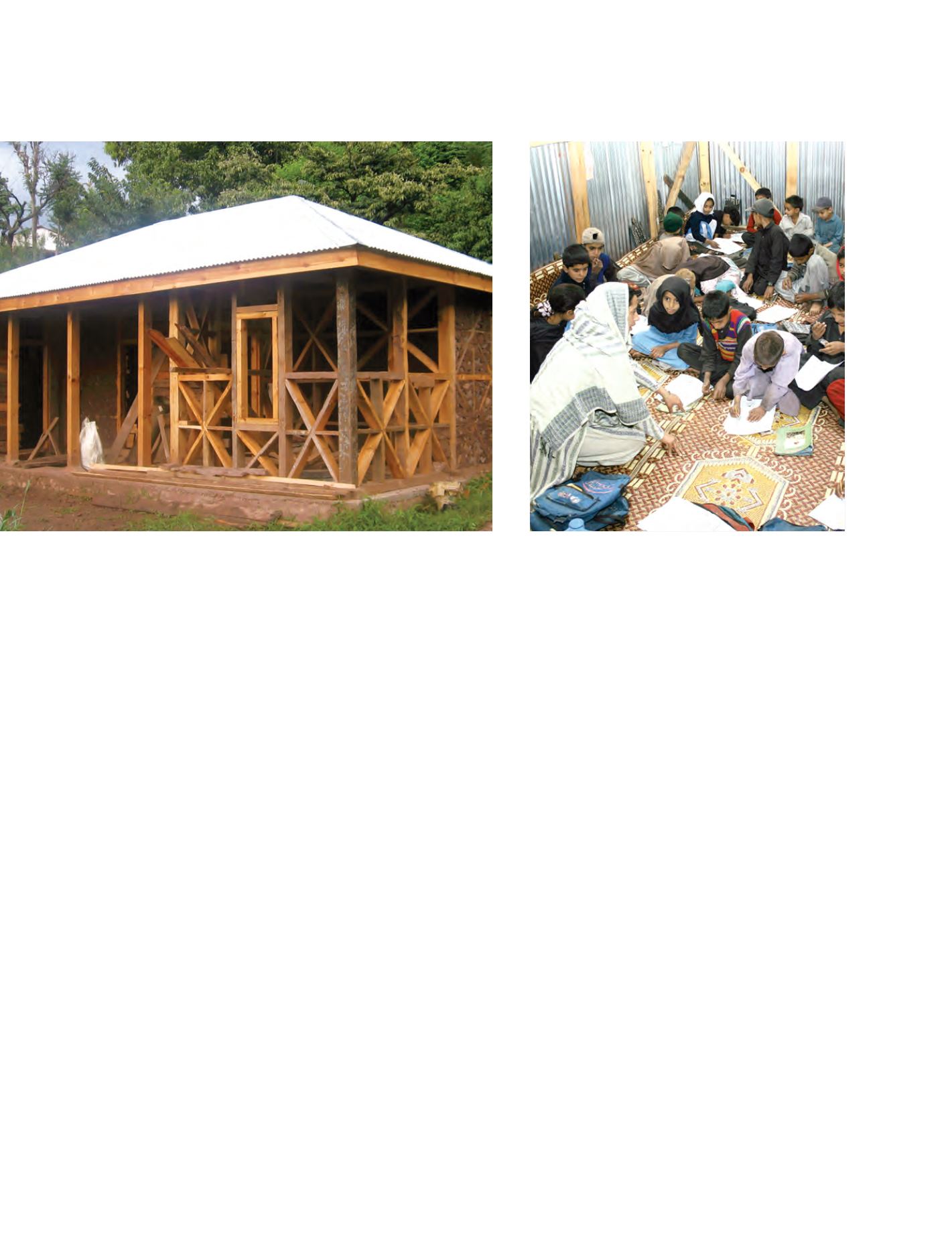
A
dhajji
design demonstration home with its traditional timber frame construction
Image: AKDN Kashmir Programme
Children in a primary school class studying inside a transitional shelter
Image: AKDN Kashmir Programme