



 117 / 196

[
] 115
monuments, for which historical data is insufficient, or for aggregates
of historical buildings where interaction is crucial. Simulation
approaches have been presented to better deal with such specificities.
Focusing on individual monuments
The first approach is to concentrate on a specific monument and
study its possible resilience to a potential event without reference to
previous similar events. To do so, an experimental approach has to
be applied, simulating the potential impact on it of different earth-
quakes. Obviously, such an approach has to rely either on purely
numerical calculations or on experiments on associated scale models.
The adequacy in specific cases of various reinforcement measures to
mitigate seismic effects can then also be tested along the same lines.
The European Centre on Vulnerability of Industrial and Lifeline
Systems in Skopje is involved in the international project
PROHITECH (within the FP6 of the European Commission) to
develop suitable methodologies for the use of reversible mixed tech-
nologies in the seismic protection of existing constructions, with
particular emphasis on buildings of historical and artistic interest.
Such buildings cover a wide and diversified range of structural cate-
gories – such as masonry reinforced concrete buildings and some
steel constructions – needing to be fitted with adequate aseismic
provisions. Part of the activities focus on analysing four models, each
representing a characteristic cultural heritage: an Islamic mosque, a
Gothic cathedral, a Byzantine church and a Greek temple. The
applied methodology includes:
1. In situ measurements of dynamic characteristics of the
historical monument
2. Shaking table tests of original and strengthened models
constructed in 1/10 scale
3. Based on the test results, a proposal for the implementation of
strengthening measures.
Dealing with aggregates of historical buildings
If the previous approach is extremely useful, it turns out to be quite
reductive when the ancient building is in fact embedded within a
more complex network of other ancient and modern buildings.
Historical buildings designed prior to the introduction of reasonable
earthquake requirements into building codes, buildings
with relatively low resistant structures and more recent
ones built after major earthquakes can coexist in aggre-
gates, and will determine different responses according
to their specificities.
The European Centre on Urban Risks in Lisbon has
developed a study to forecast the possible effect of
various earthquakes on the historical centre of Lagos,
in the Algarve region of Portugal. After characterizing
the building area through an enquiry carried out to
obtain experimental evaluations of building frequency,
the seismic analysis of the building stocks behaviour
must be determined taking into consideration previous
studies on source locations, soil effects, past seismicity,
typologies and spatial aggregations. This work has made
it possible to characterize the exposed vulnerability of
the aggregates, and the number of homeless and injured
people, which is calculated by a percentage of the
number of collapsed buildings with several damages
(according to their frequencies and site location, for
intensities of seven to ten). Policy decision-makers and
populations can then design a more efficient emergency
plan based on the different seismic scenarios and
promote some complementary actions (including educa-
tional ones) to assure the minimization of damages.
Future challenges
In the future, work on cultural heritage and risk under
the EUR-OPA Agreement will also have to address an
additional challenge: the specific impact of climate
change on risks via its possible consequences on cultural
heritage. Even if climate change essentially affects mete-
orological risks and apparently has no impact on seismic
risk itself, the ageing of the structures and their wearing
out due to various causes (such as humidity, ground-
settlements or pollution) make historical structures
much more vulnerable than modern ones, and in partic-
ular with respect to seismic risk.
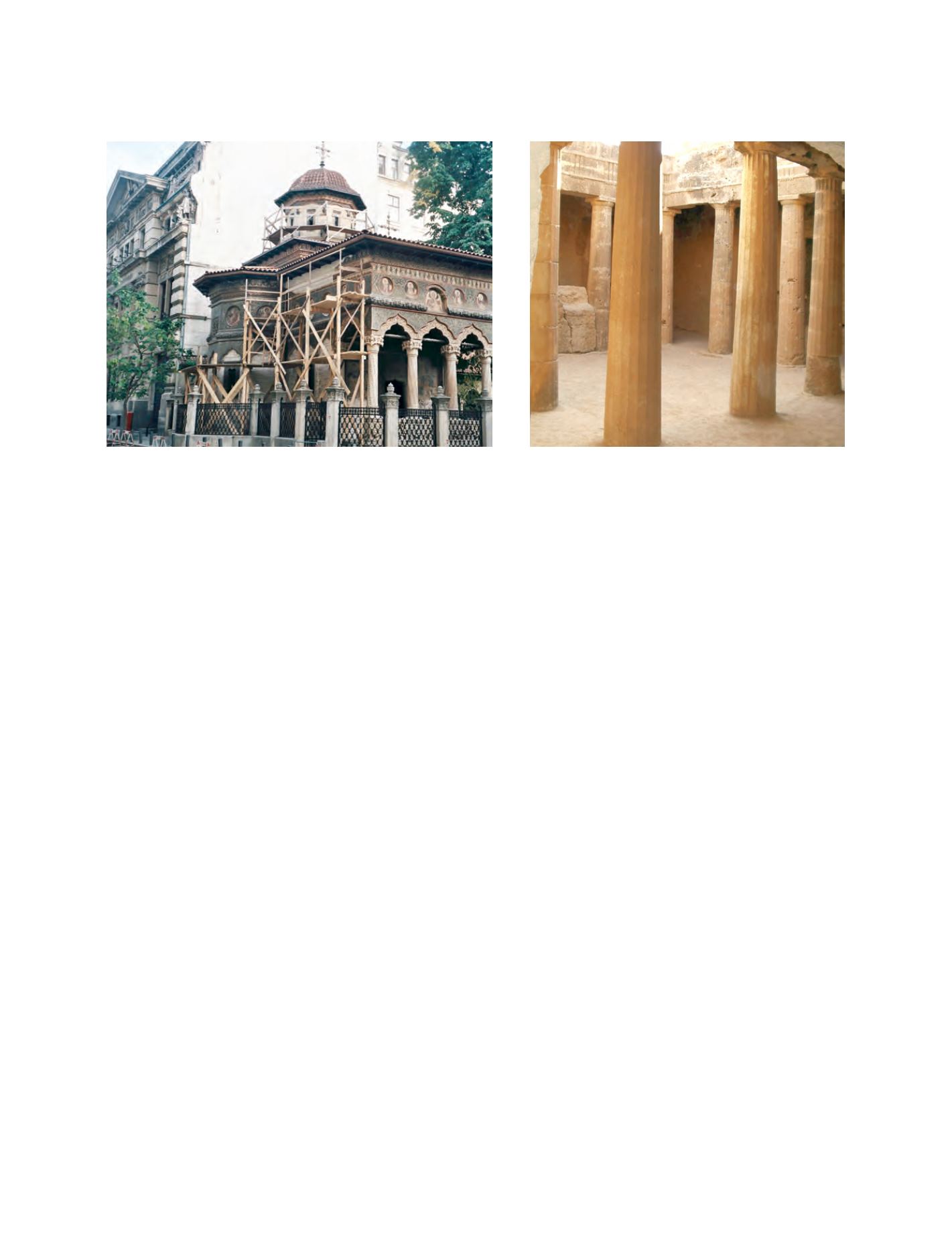
Orthodox church in Bucharest
Image: Francesc Pla
Hellenic vestiges in Paphos
Image: Francesc Pla