



 116 / 196

[
] 114
The European University Centre for Cultural Heritage
in Ravello, Italy, has developed an active effort in that
field, both in Italy and with international partners. As
the use of such buildings evolved and their (mostly
private) ownership has changed over time, they may have
suffered more successive adaptations than monuments.
After having identified traditional building techniques
for disaster resilience (but also potential conflicts with
modern techniques applied to such buildings), the work
has emphasized the role of other factors such as associ-
ated land usage or maintenance habits, leading to the
wider concept of ‘local culture’. Thus, over many years
the centre has developed a course to promote the redis-
covery and adaptation of accurate traditional techniques
as preventive measures against earthquakes, and to
diffuse that knowledge among professionals such as
architects and urban planners, and authorities that can
support such local reinforcement projects.
Preparing the future
The approach presented above was mainly based on
archaeological and historical works and thus mostly relies
on the pre-existence of significative data on their histor-
ical resilience to disasters. As already pointed out for non
monumental buildings, such prerequisites may be difficult
to fulfil in some cases and more specially for quite ‘recent’
its recent activities to improving the classification and manipulation
of data concerning the present status of Hellenic region monuments
facing seismic risk. A first step is to identify the monuments that
actually suffered past impacts and the extent of such impacts. A
second step is then to focus on the intrinsic structural properties
that protected them from the successive disasters they suffered. After
preliminary work to identify typical structural systems related to
seismic vulnerability and response, a more systematic Digital
Database is underway. This information will be useful to prepare
guidelines on principles and criteria for mitigating the vulnerability
of monuments through structural restoration that is adapted to each
typical structural system, and which takes into account structural
properties concerning their foundation aspects (such as topography
effects, soil movements, action of underground water), that are gener-
ally ignored in the usual aseismic codes.
Learning from traditional constructions
Cultural heritage cannot be reduced to monuments: buildings that
have survived also include many non-monumental ones, such as
traditionally constructed housing or settlements. In those cases, the
previous two-step methodology could also be used in order to iden-
tify the good practices of the past in terms of construction. However,
their possible resilience to previous disasters turns out to be more
complex: records on previous disasters they suffered are generally
less systematic due precisely to their absence of symbolic value for
past generations.
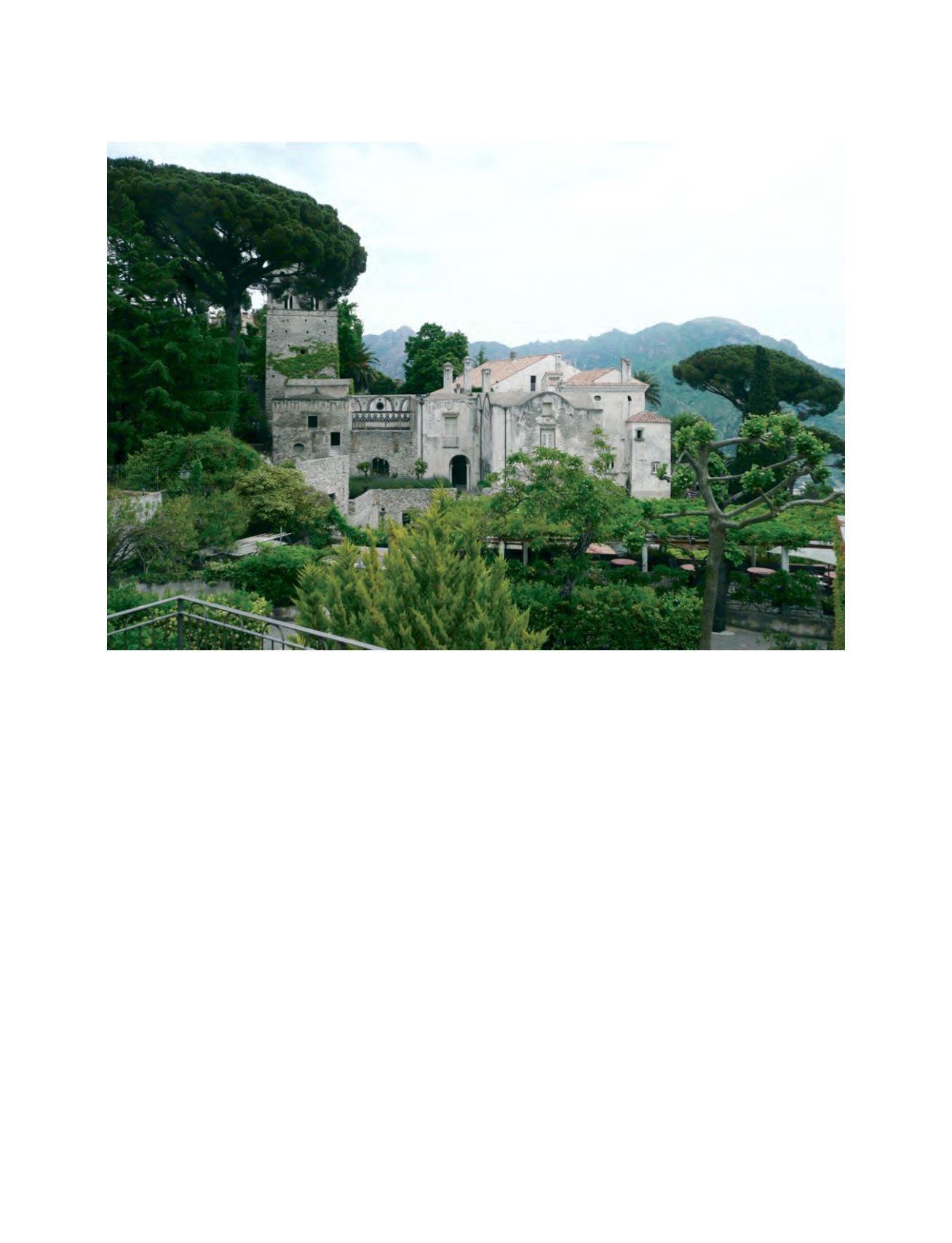
View of Ravello
Image: Francesc Pla