


 113 / 196

[
] 111
The South African Weather Service (SAWS) plays an integral role
in the region’s DRR activities. It is mandated to be the sole provider
of weather-related warnings over South Africa in order to ensure a
single authoritative voice in this regard. It therefore has established
links for the dissemination of advisories and warnings to relevant
disaster management centres through its regional forecast offices. Its
officials participate in national and provincial disaster management
advisory forums, and in meetings and conferences related to disas-
ter management activities. The excellent collaboration between
forecasters and disaster managers was highlighted during the devas-
tating storms that affected the country in early August 2006.
The SAWS maintains a climatological database of weather data
over South Africa, which is used regularly in DRR and mitigation
activities. The South African Cabinet has tasked the NDMC and
SAWS to develop clear guidelines for the South African Integrated
National Early Warning System.
Building a culture of safety and resilience
HFA Priority 3 promotes the use of knowledge, innovation and
education to build a culture of safety and resilience at all levels. The
interplay between environmental change and socio-political and
economic issues operating at different scales is a critical area requir-
ing more research in South Africa. There is also a need to understand
what generates vulnerabilities and what improves resilience in
people’s livelihoods in both ‘normal’ and ‘stressed’ conditions.
Responding to human vulnerability in South Africa requires build-
ing on people’s own responses, providing a range of institutional
support, and promoting resilience and adaptive capacity among
vulnerable people.
South Africa’s Disaster Management Act provides for an integrated
and coordinated disaster management policy that focuses on prevent-
ing or reducing disaster risks, mitigating their severity, emergency
preparedness, rapid and effective responses to disasters, and post-
disaster recovery. Linked to such a policy, vulnerability assessment
can measure the severity of potential threats on the basis of known
hazards and the level of vulnerability of societies and
individuals. It can be used to translate early warning
information into preventive action, and is necessary for
early warning and emergency preparedness. Despite
growing political will to twin vulnerability and develop-
ment efforts and enhance resilience to stresses including
climate variability, the institutional design and architec-
ture that may be required are still in the formative stages.
Education
Over the years, various themes have been followed to
observe International Strategy for Disaster Reduction
(ISDR) Day. For ISDR 2006/07 and 2007/08 there was an
emphasis on schools as a starting point for DRR. The
Tshwane Disaster Management Centre, in collaboration
with the African Centre for Disaster Studies, introduced a
project in primary schools as part of the National
Curriculum – it comprised a guide pack to serve as a tool
for teachers to introduce disaster management principles
into the curriculum in an engaging way. The content forms
part of the social sciences and environmental management
sciences learning areas for grade five, six and seven learn-
ers with the theme, ‘Be Aware, Prepare and Share’.
In 2006, the NDMC participated in a joint venture with
Chris Hani District Municipality (CHDM) to celebrate
ISDR Week. The concept involved learners in primary,
secondary and high schools competing in art, music and
drama, portraying the impact of disasters on communi-
ties, how these can be prevented, and the role of
communities in increasing their own resilience to disasters.
The South African Qualifications Authority (SAQA) is
a statutory body responsible for overseeing the imple-
mentation of the National Qualifications Framework
(NQF). Part of SAQA’s responsibility is to generate and
register qualifications. The Directorate Standard Setting
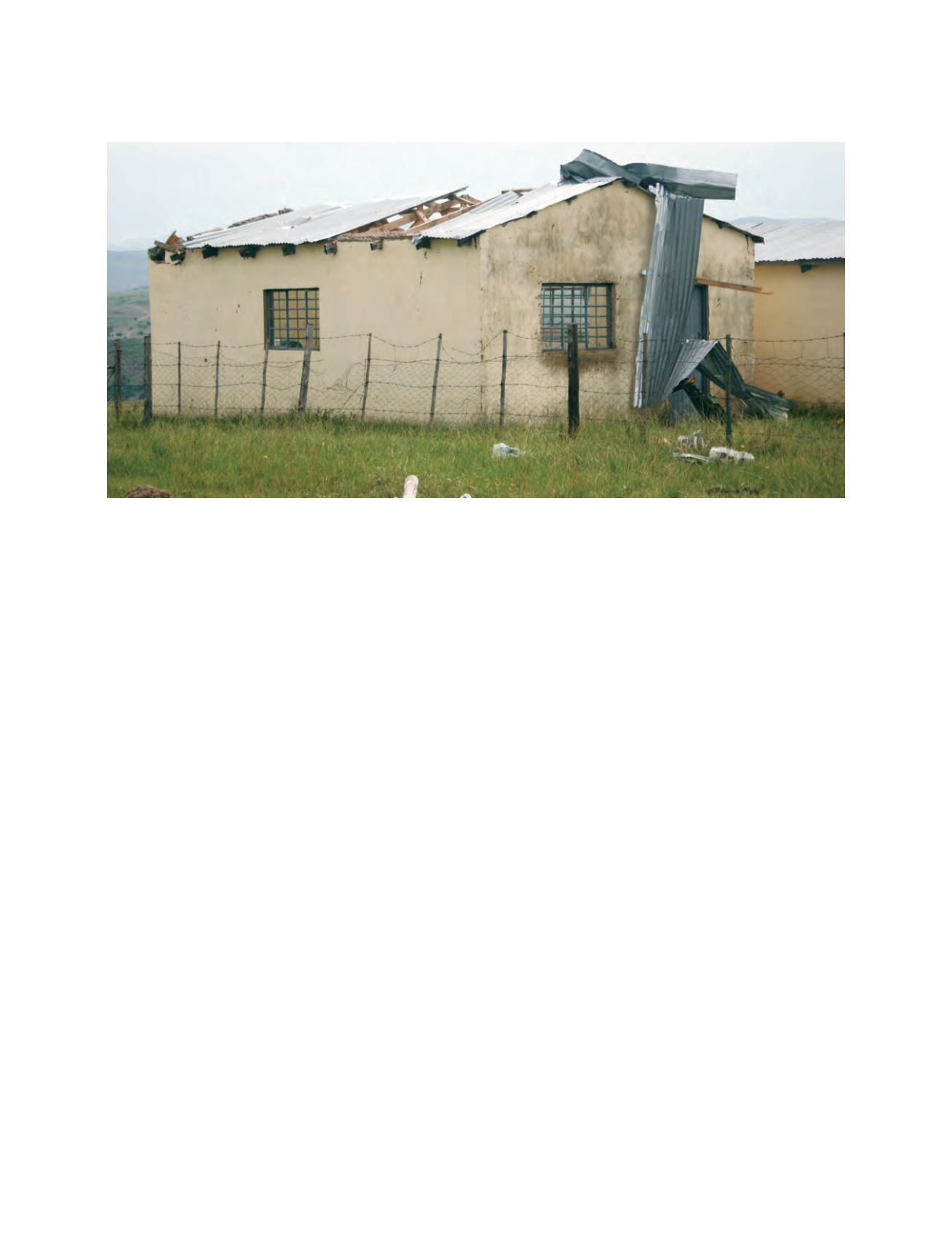
April 2008 hailstorm in Mpumalanga
Image: Mpumalanga Disaster Management