



 110 / 196

[
] 108
Community development
As a strategy for better effectiveness in implementation of its projects,
for more comprehensive development of community ties and sustain-
ability follow-up, IBC focused its interventions in selected areas,
instead of spreading them over too many districts of the earthquake-
affected area.
One of the villages targeted and addressed by IBC through all the
post-disaster phases is Sarbala village – known to locals as ‘the village
in the sky’ due to being situated on a mountaintop at a 7,500-foot
elevation, at the border between Muzaffarabad and Bagh districts in
AJK. The community of Sarbala, with a population of around 200
families, has been part of all IBC intervention stages.
Besides its share in the emergency phase, the rural housing recon-
struction project that IBC has implemented in the same UC, the
schools reconstruction and all other small initiatives in this partic-
ular village, IBC has built a community centre as a space for
interaction and learning for Sarbala and surrounding villages. The
multi-purpose building is providing a meeting space for the commu-
nity, for common decision making and also for hosting the
community’s most important events; a space for initiation of voca-
tional training and income generation for women (sewing and
embroidery classes); a space for day-care, leisure and learning for
pre-school children; modern skills learning for the youth (basic
computer use skills supported by a small computer lab), and a facil-
ity for school support and learning, with the establishment of a small
library (the first ever in the village or its surroundings).
In summary
Being impartial in its approach toward targeted beneficiaries and in
relations with its various international donors, being non-political
and non-religious but nevertheless coming from a major-
ity Muslim country, IBC definitely has an advantage in
working in parts of the world where these can be very
sensitive issues. In addition, given the general well-
received Turkish response by Pakistani society, IBC has
managed to do its work in very challenging locations
and conditions, encountering fewer difficulties than
those reported at times by other agencies.
Summarizing the efforts put into Pakistan earthquake
response, it can be said that IBC had a very interesting
opportunity to be involved in original approaches and
coordination (such as its participation in Clusters and
Humanitarian Hubs, and the strategic approach of
owner-driven reconstruction), to be working with both
civilian and military entities involved in the relief and to
act in extremely challenging environments. However,
when quantifying and comparing the resources used,
the timeframe of intervention and targets achieved, it
can be observed that much more effort has been put into
the Pakistan operation than in other emergencies, due
to factors such as the extreme working environment,
both geographically and climatically, lack of infrastruc-
ture and lack of qualified manpower.
From mountaintop village community meetings to
strategic meetings at Islamabad level, from reaching
earthquake victims by helicopter to providing aid on
footpaths, using porters and mules, from rubble to
building hope, the Pakistan response has been for IBC
an amazing adventure and continuous learning
process.
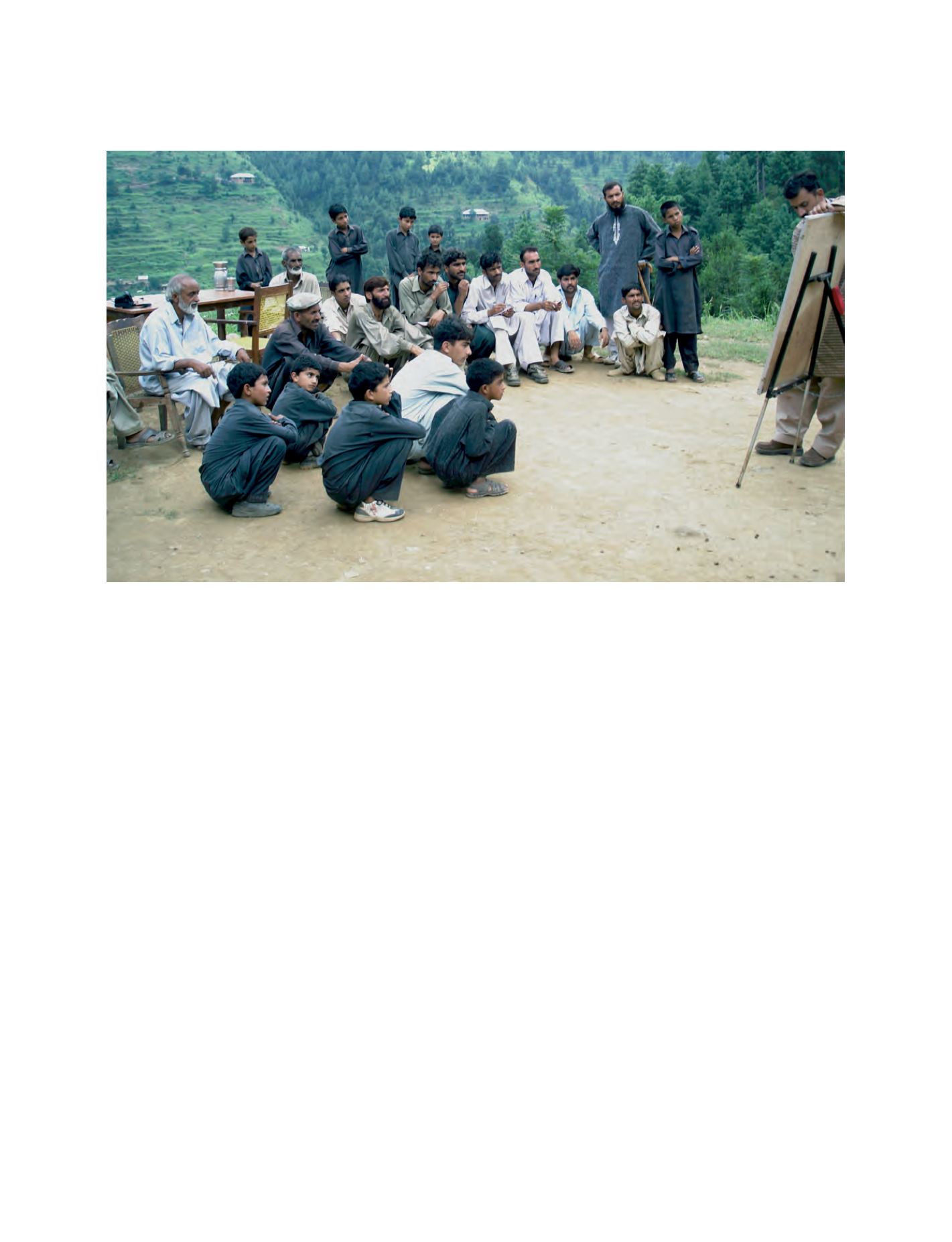
Theoretical training sessions were held at IBC Rawal Gali field camp and at different venues in the sub-villages
Image: IBC Archive