


 142 / 196


[
] 140
May 2009, WMO will be convening the 2nd International Experts’
Symposium on Multi-Hazard Early Warning Systems (MHEWS-II),
to be hosted by Météo-France in Toulouse, France. Through collec-
tive analysis of lessons learned from demonstration and pilot projects,
the goal of MHEWS-II is to develop the first set of comprehensive
guidelines on governance, organizational coordination and opera-
tional aspects of early warning systems leveraging cooperation at
regional, national and community levels.
Examples of good practices in early warning systems
French Vigilance System
– In December 1999, the severe winter storm
Lothar led to nearly 100 casualties and an estimated USD8 billion
economic losses in France. Following this disaster, the French
Vigilance System was established in close collaboration between the
Ministry of Transportation (responsible for provision of weather fore-
casts and warnings through Météo-France) and the Ministry of
Interior (responsible for emergency preparedness and response), and
was later complemented by a hydrological component, involving the
Ministry of Ecology, Environment and Sustainable Development
(responsible for flood forecasting). The French Vigilance System,
supported by an inter-ministerial steering committee, became oper-
ational in November 2001.
However, the 2003 heat wave led to nearly 20,000 casualties and
an estimated USD4 billion economic losses in France. Lessons
learned from this event were instrumental in setting up the
heat/health warning module within the Vigilance System, involving
close collaboration between Météo-France and the Ministry of Health
(through the National Institute for Health Surveillance).
Since 2003, new legislation has been enacted to enhance emer-
gency preparedness and response to the Vigilance System, including:
• The law for natural and technological risks (30 July 2003)
which is administrated by the Ministry of ecology and sustain-
able development, promoting adequate urban planning,
protection measures, and dissemination of precise information
about risks to the citizens
• The law for civil protection and crisis management (13 August
2004), which defines the roles and responsibilities of the differ-
ent agencies in the context of crisis management,
calls on the responsibility of citizens in ensuring
their security, and emphasizes the need for continu-
ous government watch on any risks that would
require operational response
• The Organic Law (1 January 2006) on finance,
which allows for the distribution of budgets among
different agencies, further strengthening inter-
agency collaborations for implementation of
specific programmes.
In the French Vigilance System, information about risks
of hydrometeorological and climate phenomena at sub-
regional and local levels is communicated on a map,
with four colour-coded levels of vigilance. This map is
updated at least twice a day and distributed to authori-
ties and the public. If needed, authorities also get
additional customized information for better planning
and response operations. The system is continually
improved through a feedback mechanism involving all
partners.
Bangladesh Comprehensive Disaster Management
Programme
– Bangladesh is one of the good practices
in demonstrating benefits of investments in emergency
preparedness and tropical cyclone early warning
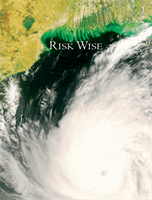
system. Cyclone Bhola, on 12 November 1970, has
been the deadliest tropical cyclone ever recorded in
modern times. Up to 300,000 people lost their lives,
primarily as a result of the associated storm surge that
flooded much of the low-lying islands of the Ganges
Delta. This cyclone was the sixth cyclonic storm and
the most powerful of the 1970 North Indian Ocean
cyclone season, reaching a strength equivalent to a
category three hurricane. The coastline of Bangladesh
was yet again devastated by Cyclone Gorky in 1991,
leading to an estimated 140,000 deaths. Following
Category One Hurricane:
Category Two Hurricane:
Category Three Hurricane:
Category Four Hurricane:
Category Five Hurricane:
Winds 74-95 mph (64-82 kt or 119-153 km/hr). Storm surge generally 4-5 feet above normal. Damage primarily
to unanchored mobile homes, shrubbery, and trees. Also, some coastal road flooding and minor pier damage.
Winds 96-110 mph (83-95 kt or 154-177 km/hr). Storm surge generally 6-8 feet above normal. Some roofing
material, door, and window damage of buildings. Considerable damage to shrubbery and trees with some trees
blown down. Considerable damage to mobile homes, poorly constructed signs, and piers.
Winds 111-130 mph (96-113 kt or 178-209 km/hr). Storm surge generally 9-12 feet above normal. Some
structural damage to small residences and utility buildings. Damage to shrubbery and trees with foliage blown
off trees and large trees blown down. Flooding near the coast destroys smaller structures with larger structures
damaged by battering from floating debris.
Winds 131-155 mph (114-135 kt or 210-249 km/hr). Storm surge generally 13-18 feet above normal. Some
complete roof structure failures on small residences. Shrubs, trees, and all signs are blown down. Extensive
damage to doors and windows.
Winds greater than 155 mph (135 kt or 249 km/hr). Storm surge generally greater than 18 feet above normal.
Complete roof failure on many residences and industrial buildings. Some complete building failures with small
utility buildings blown over or away. All shrubs, trees, and signs blown down.
The Saffir-Simpson Hurricane Scale
Source: National Hurricane Center Miami:
http://www.nhc.noaa.gov/aboutsshs