


 96 / 196

[
] 94
Education for Sustainable Development
as a platform for disaster preparedness
Sheldon Shaeffer and Derek Elias, UNESCO
T
he United Nations Educational, Scientific and Cultural
Organization (UNESCO), as the UN specialized agency for
education, has been designated as the lead agency for the
UN Decade of Education for Sustainable Development (DESD)
2005-2014, which includes education for natural disaster
preparedness as a thematic priority.
Sustainable development is undermined by the occurrence or threat
of disasters. The Director General of UNESCO, Mr Koïchiro
Matsuura, has highlighted the significant role of education in improv-
ing the capacity of individuals and communities to reduce the risk
of disasters, saying: “Anticipating, educating and informing are the
keys to reducing the deadly effect of such natural disasters.”
Furthermore, UNESCO has identified disaster preparedness as a
core environmental issue in the DESD. Education for Sustainable
Development (ESD) is an appropriate framework for disaster
preparedness in three important ways:
• It is interdisciplinary and holistic. Therefore, important
consideration is given to the impacts on, and relationship
between society, the environment, economy and
culture
• It promotes critical thinking and problem solving
that are essential to the empowerment of stake-
holder groups threatened or affected by disasters
• It seeks to be locally relevant, acknowledging that
languages and cultures say and understand things
differently, and addresses both local and global issues.
Phase 1: natural disaster preparedness and ESD
In the wake of the 2004 tsunami, numerous assessments
began gathering information on its impact on commu-
nities and the environment. The focus of activity in
Thailand and other countries directly after the disaster
was naturally on relief. However, the implementation of
many activities was undertaken only with short-term
needs in mind while problems of longer-term social,
environmental and economic unsustainability were
already becoming evident. The Hyogo Framework for
Action 2005-2015: Building the Resilience of Nations
and Communities to Disasters identifies education,
coupled with sustainable management and planning, as
the only effective long-term solution to prepare for, and
alleviate, future tsunamis and other natural disasters.
However, much of the existing educational material
is either too dry and academic, and/or targets a limited
audience. This project focuses on vulnerable popula-
tions and the key sectors that suffered as a result of
disasters. It includes, but is not limited to, education,
agriculture, tourism, environment, fisheries, communi-
cation and the private sector.
Significantly, the disaster has served to highlight the
importance of local and traditional knowledge in the
region. There are accounts in Thailand, for example, of
‘sea gypsy’ communities that escaped the tsunami based
on such knowledge. These and other traditional
approaches should be seriously considered and utilized
in future education initiatives for disaster preparedness.
Thailand country highlights
Towards sustainable development for the Moken-Andaman
Pilot Project
– The sea of South-East Asia is home to
unique groups of people, often euphemistically called
‘sea gypsies’. They have travelled the region for centuries,
living on boats and in temporary settlements along the
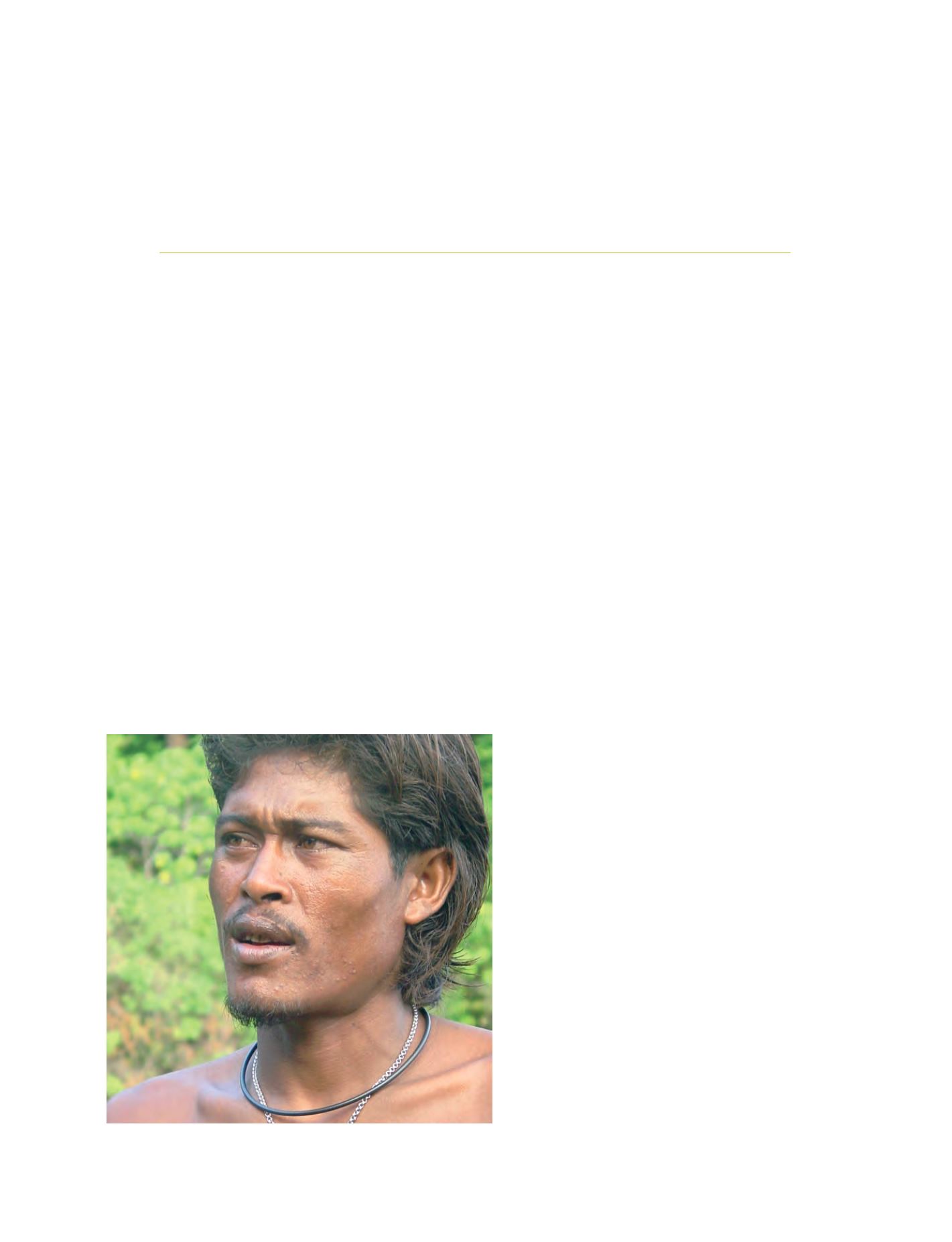
A Moken man from Mergui Archipelago, Myanmar, relating the story of the tsunami
Image: Derek Elias, January 2005, Ko Surin, Thailand