



 91 / 196

[
] 89
• Mobilization – to join in implementation and begin with your
own activities
• Education – to include measures in the education process in
schools, and pass on a standard tradition.
Capacity development programmes
– to be placed at the basic,
middle and advanced level for different subjects and different target
groups (with a certification system). Each programme should be
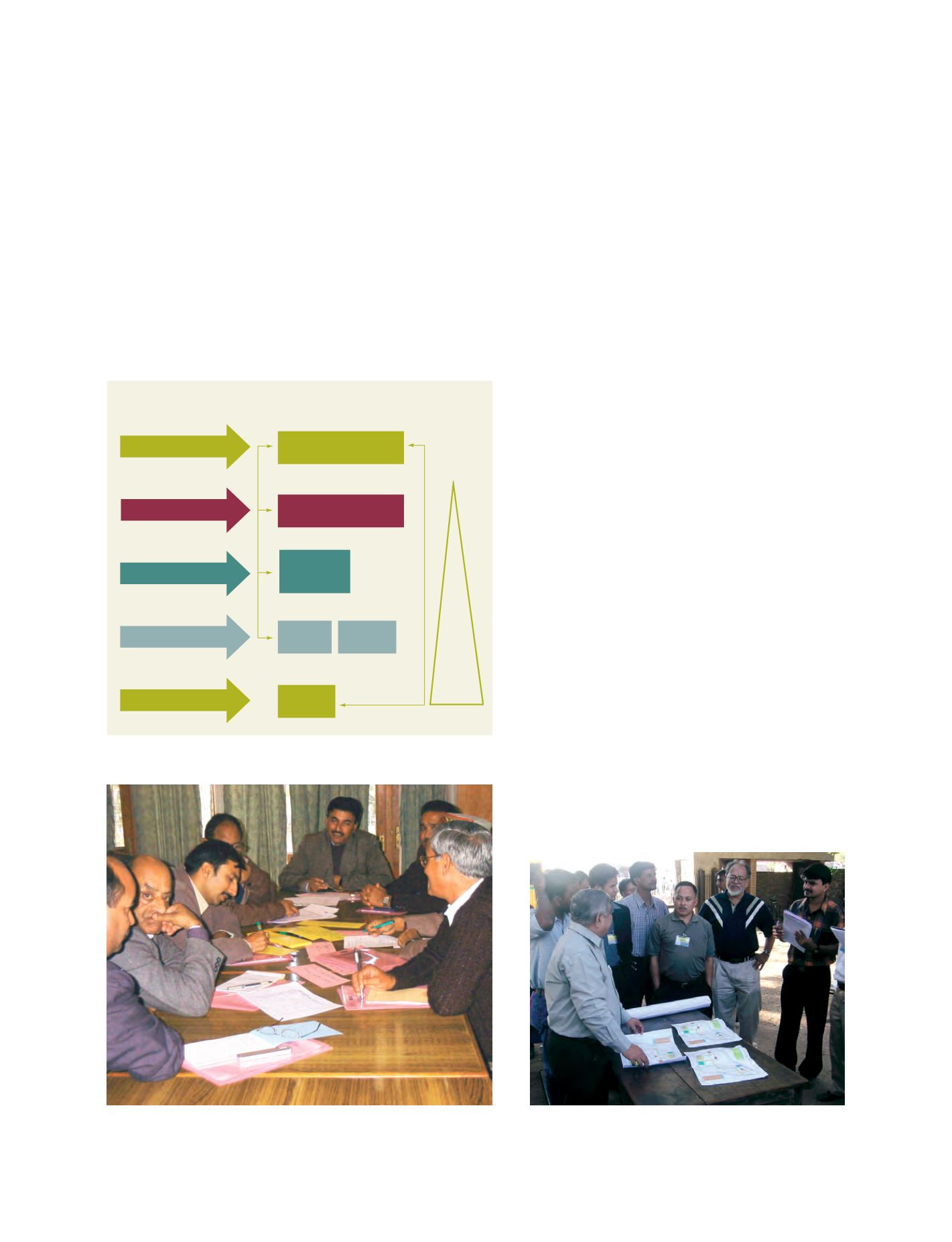
oriented along the series of steps shown in the included organiza-
tion chart.
Mechanisms and standards
– to guarantee recognition, adequate
qualifications and integrated quality assurance of training providers
and trainers with admission/acceptance and removal
criteria.
Mechanisms with commitments
– from the training
providers to spread the capacity development efforts
down the line (considering awareness building/teach-
ing/training methods adapted to the absorption capacity
of different target groups).
Discussion among key participants: an important
first step
The planning workshop in April 2008 brought together
the Indian National Disaster Management Authority,
industrial associations, officers in charge of disaster risk
management of Major Accident Hazard industries, district
collectors (the administrative heads of districts), chief
inspectors of factories and boilers (the responsible author-
ity for industrial Disaster Risk Management in each State),
the responsible authority for industrial Disaster Risk
Management in each State, State Industrial Development
Corporations, State Pollution Control Boards, Central
Labour Institute, emergency response centres, training
providers for industrial managers, and the National Civil
Defence College.
The phenomenon of intense, energetic discussions and
long hours spent in a planning workshop – a process that
can easily get bogged down in technicalities – can be
summarized in the words of one participant: “All of us are
at different points in the line of potential disasters. We are
not contributing to the direct productivity of our indus-
tries, we are not increasing agricultural productivity, and
we are not building nice houses – we are like Cassandra,
and it is not the most pleasant thing to communicate with
her. We had the chance here in Bhopal to talk to each other
– and we talk about making changes in our system and
industry more likely, in order to be better prepared. But
we also talked about ourselves, to be taken more seriously.”
These programmes are supported under Indo-German
cooperation by InWEnt –Capacity Building International,
and GTZ-ASEM – Advisory Service in Environmental
Management.
2
Development of strategies for disaster risk management for an
industrial estate – planners at work
Image: F. Bemmerlein-Lux
Understanding: orientation and motivation of planners of an
industrial estate
Image: F. Bemmerlein-Lux
Development
Development of concepts
and operational plans
Awareness &
Sensitization
Knowledge
orientation &
motivation
Technical
skills
Managerial
skills
Field test
mock drill
Acceptance
Understanding
Practice
Test & Implementation
Organizational development
Capacity development programmes – an organizational chart
Source: F. Bemmerlein-Lux