


 94 / 196

[
] 92
identified a small group of farmers at risk of losing a significant
proportion of their crops every second or third year because of local-
ized, low intensity floods caused by rain water runoff from sloping
land. These farmers were participating in an agricultural diversity
programme but, because of the regular eroding of their asset base,
were not benefiting from the programme in a sustainable fashion that
could lead to the establishment of more livelihood options. The
vulnerability analysis identified that they could not manage this risk
because they lacked appropriate tools to construct an earth bund to
protect their fields – something which was easily addressed by the
programme – an intervention that had an immediate impact.
In essence, risk management is very simple – it requires that we
address the scale, frequency, intensity or impact of a hazard, or
people’s vulnerability to a hazard, or both. In practice, it requires a
careful contextual understanding of the nature, cause and interac-
tions of the many types of hazards, and identifying why communities
are unable – or only partially able – to manage the risks that face
them as a result of these.
The complexity and nature of hazards facing poor communities
are such that it may not always be possible to introduce measures to
reduce their frequency, magnitude or scale, particularly in the short
term. For example, when looking at the risks facing those in
displaced camps in northern Uganda, the underlying hazard facing
the community was conflict. While it was not realistic for Concern
or our partners to resolve this, risk analysis suggested areas where we
could help the displaced reduce their vulnerabilities to some of the
consequential risks associated with the conflict. These included
issues around firewood collection, the siting of water points, the
location of latrines, and protecting particularly vulnerable groups
such as households headed by children.
Risk analysis – an approach to holistic contextual
analysis and quality programming
In addition to responding to humanitarian crises,
Concern focuses on four programme sectors through
which we seek to realize our mission of contributing to
the elimination of poverty: health, HIV/Aids, education
and livelihoods. These areas of activity are informed by
a number of cross cutting issues including gender and
equality. One of the challenges that we have is to ensure
that these activities are complementary and collectively
contributing to the elimination of poverty.
Contextual analysis and understanding are funda-
mental to quality programming and risk and
vulnerability analysis must be at the heart of the highest
level of analysis that we make when seeking to deter-
mine where and how we should work.
The starting point for risk management should not
be post-disaster, but rather the consistent early applica-
tion of risk analysis to further our contextual
understanding. Risk analysis aims to identify the nature,
characteristics, interaction and causes of existing and
expected future hazards that threaten poor people’s lives
and livelihoods, the impact of these hazards, and to
establish who is vulnerable to these and why.
Risk analysis should include an analysis of micro and
macro issues, and the linkages between them, as this will
highlight the underlying causes of poverty such as inap-
propriate policies, poor governance and the denial of
rights. Responding to risks of this nature requires long-
term advocacy programmes that are necessarily
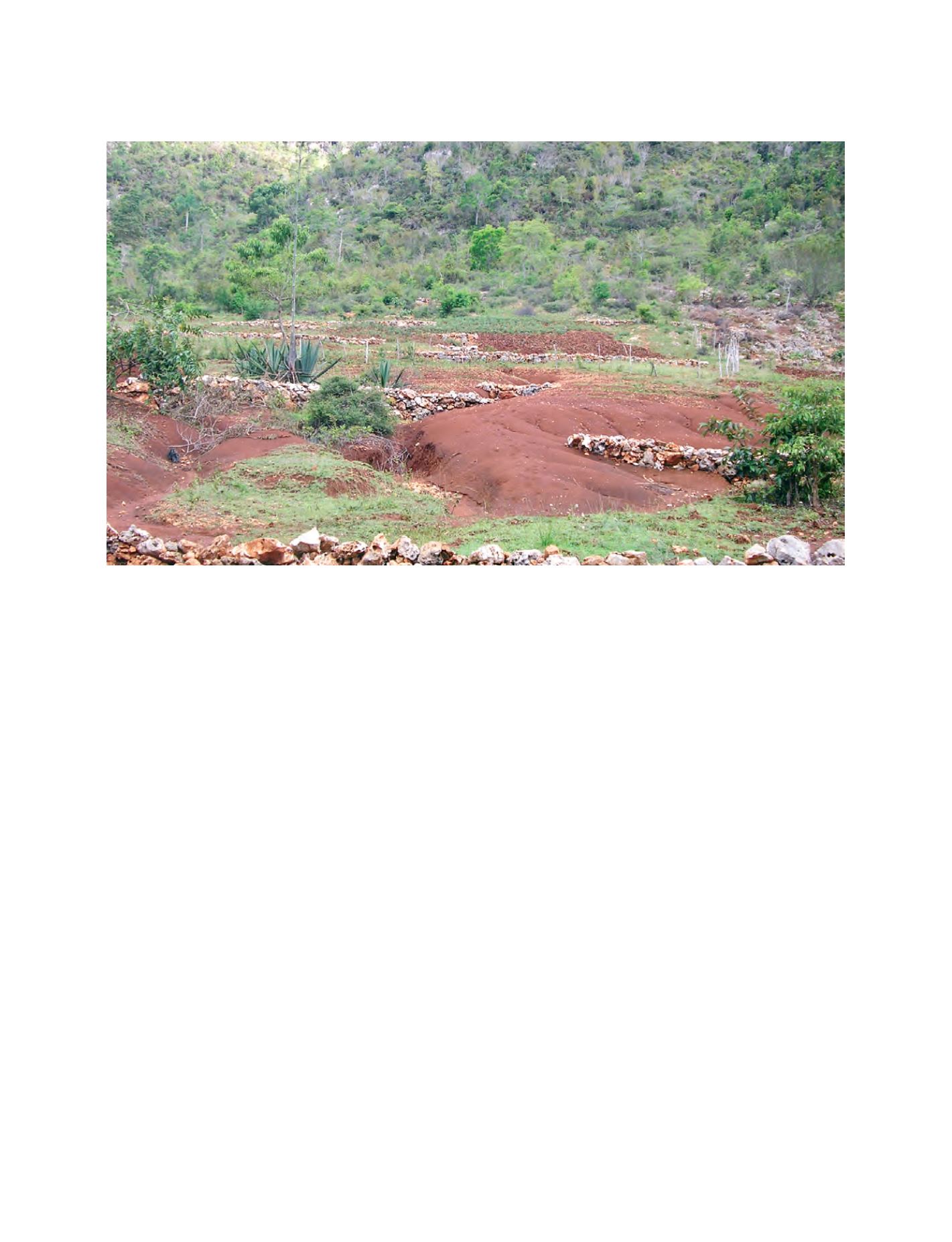
Plaine Mapou, La Gonave, Haiti. A risk analysis recently completed on the island of La Gonave, Haiti showed that addressing environmental degradation is a priority
for the community
Image: William Devas