


 100 / 196

[
] 98
Peacetime Strategies for
Disaster Risk Mitigation
Hassan Ahmad, Alicia Wong and S.R. Shiever, Mercy Relief, Singapore
N
atural disasters are inevitable, and they often occur with
little or no notice and require an immediate and effec-
tive response in order to prevent further damage or loss
of life. Cyclones, earthquakes, tsunamis and typhoons are all
forces of nature. Environment abuse has led to the increase of
natural disasters. The process of environmental degradation and
damage can only be delayed. With the decline in global climate
due to environmental and human factors, disaster and risk miti-
gation has taken on an unprecedented importance.
Environmentally focused solutions have limitations and require total
global cooperation. There must be resources, education and train-
ing before they can be put into place. More importantly, the
community and the affected peoples must be able to see the rele-
vance of the proposed solutions. Why should fishermen plant
mangroves that will stop them from accessing the sea for the daily
catch that would feed their families? International
experts are brought in with scientific and technical
knowledge that has little relevance and connection to
the local community. Very often, the proposed solutions
are too narrowly focused on the single problem at hand
and do not take into consideration the challenges faced
by the affected peoples in their daily lives; or offer any
alternatives when an environmental solution takes away
the only means of livelihood the community has.
In the introduction chapter of the
World Disasters
Report 2005
, Markku Niskala, the Secretary-General of
the International Federation of Red Cross and Red
Crescent Societies (IFRC) said:
“Three things need to happen. First, we must under-
stand what enables people to cope with, recover from
and adapt to the risks they face. Second, we must build
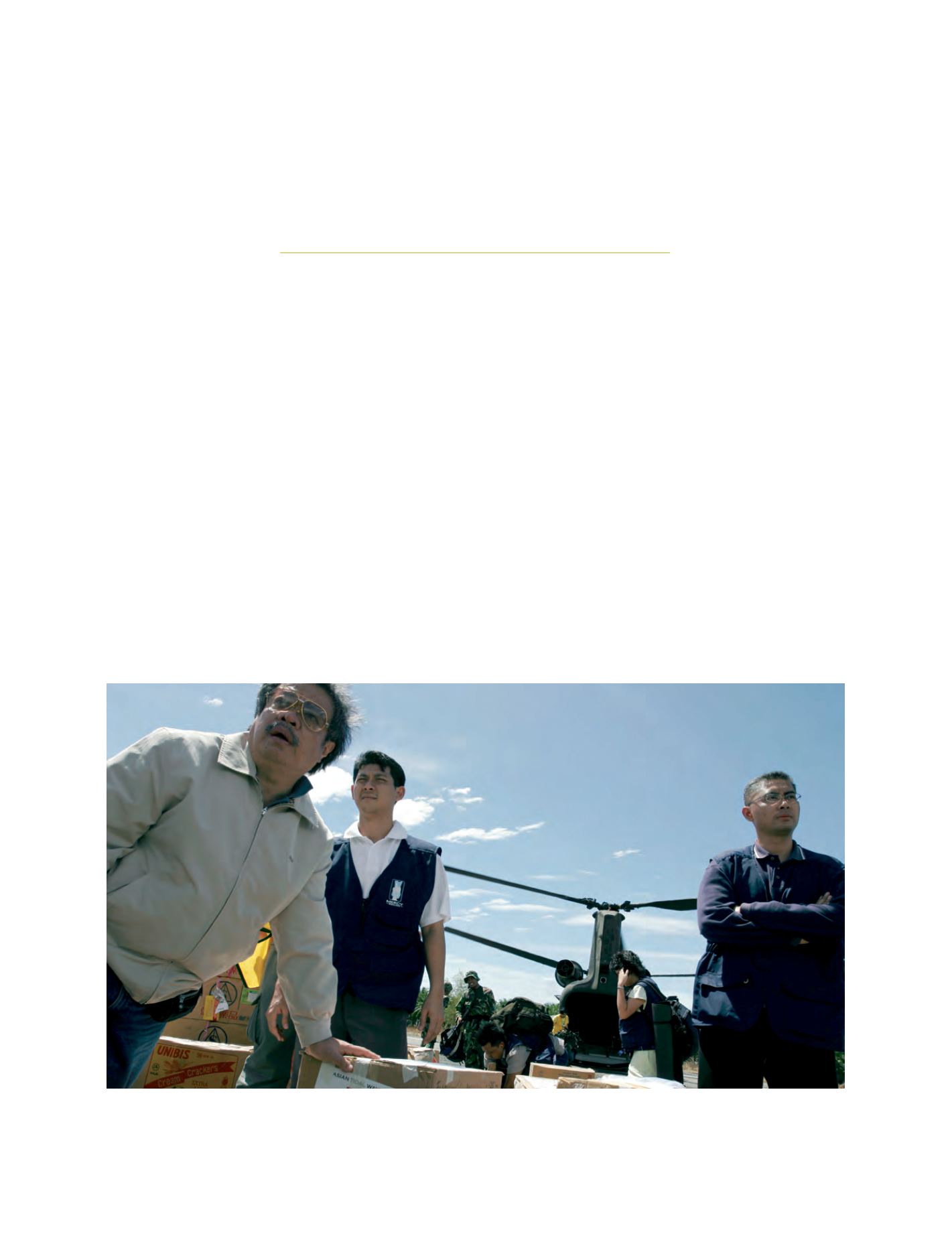
Meulaboh: history helps – Personnel from Mercy Relief (MR) and the Tentera Negara Indonesia (TNI) delivering supplies to Meulaboh in a Singapore Armed Forces’
(SAF) Chinook just days after the tsunami. From left: Iwan Subrata (MR’s Medanese partner); Hassan Ahmad (MR’s Chief Executive) and Dr Iskandar Idris, (MR’s
medical volunteer) with other volunteers in the background
Image: Ernest Goh