


 98 / 196

[
] 96
indigenous children from their own culture and affect the transmis-
sion of indigenous knowledge and cultural heritage from one
generation to the other,” says Sheldon Shaeffer, director of UNESCO’s
Regional Bureau for Education in Bangkok. “Many strategies have
been developed to address this. Gaining initial literacy in one’s
mother tongue, then moving to literacy in the national language, is
one such strategy. Most research shows that minority children in
primary schools taught in their own language acquire knowledge
and skills faster.” Another strategy is the inclusion of ancestral stories
in learning material – such as that about La-Boon. In northern
Thailand, minorities have established their own educational
programmes using ancient tribal stories as content for reading mate-
rials. UNESCO and Chulalongkorn University developed something
similar for the Moken. A working system to preserve indigenous
heritage, however, is generally hard to develop, especially for small
groups like the Moken.
“The fact that the sea gypsies survived, while many others did not,
points to certain lessons to be learned from traditional, indigenous
knowledge,” says Richard Engelhardt, UNESCO’s regional advisor for
culture in Asia and the Pacific. “Twenty years ago, beachfront construc-
tion was light and made of bamboo and thatch that, if it collapsed,
would not kill the occupants. The use of such traditional construc-
tion ‘rules’ should be part and parcel of village rehabilitation work.”
Unlike other Thai fishing villages affected by the tsunami, the sea
gypsies prefer to remain in their traditional homes by the sea. On
Ko Surin, where they also escaped without loss of life thanks to their
knowledge of the sea, some 170 people had returned by mid-January
to rebuild their homes from traditional bamboo and woven leaves.
Aid agencies have thrown themselves into the task of reconstruc-
tion. However, UNESCO’s Bangkok Bureau observes with regret that,
in the Surin Islands and elsewhere in Thailand, “a multitude of aid
bodies are bringing in project money and ‘staking their claim’ to
certain areas for providing reconstruction assistance that often does
not consider practical matters of sustainability.” In a
newly reconstructed Moken coastal village in Thailand’s
Ko Surin National Park, new houses have been built in
the forest too far from the water’s edge, lined up on a
grid, and both too low to the ground and too close
together. The result is poor ventilation and sanitation, as
well as obstructed views to the sea, even though clear
visibility is essential both for monitoring sea conditions
and for daily activities along the coast. The Moken
would like to rebuild their village in the traditional
sustainable manner at the earliest opportunity, if the
park authorities will allow it.
UNESCO Bangkok developed a proposal in February
2005 to produce educational materials in health, disas-
ter preparedness and tsunami education for different
target groups, including schools, governments, munic-
ipalities and the private sector. Once finalized, these
materials will be disseminated as part of the DESD.
A problem has arisen from a lack of consultation by
local authorities. Another community saved from the
tsunami by its knowledge of the sea, the Urak Lawoi, was
unwilling to move from its village on Ko Sileh beach near
Phuket, where only ten houses had been destroyed and a
further 200 damaged. The villagers cited the importance
of remaining close to their boats and equipment and the
loss of income from fishing if they moved inland. Yet, the
governor indicated in mid-January 2005 that 200 new
houses would be allocated to the Urak Lawoi community,
which was to be relocated to a nearby degraded mangrove
forest some 300 metres back from the sea.
In 1995, Uluru-Kata Tjuta National Park and its
management board won UNESCO’s highest award, the
Picasso Gold Medal. They were commended for distinc-
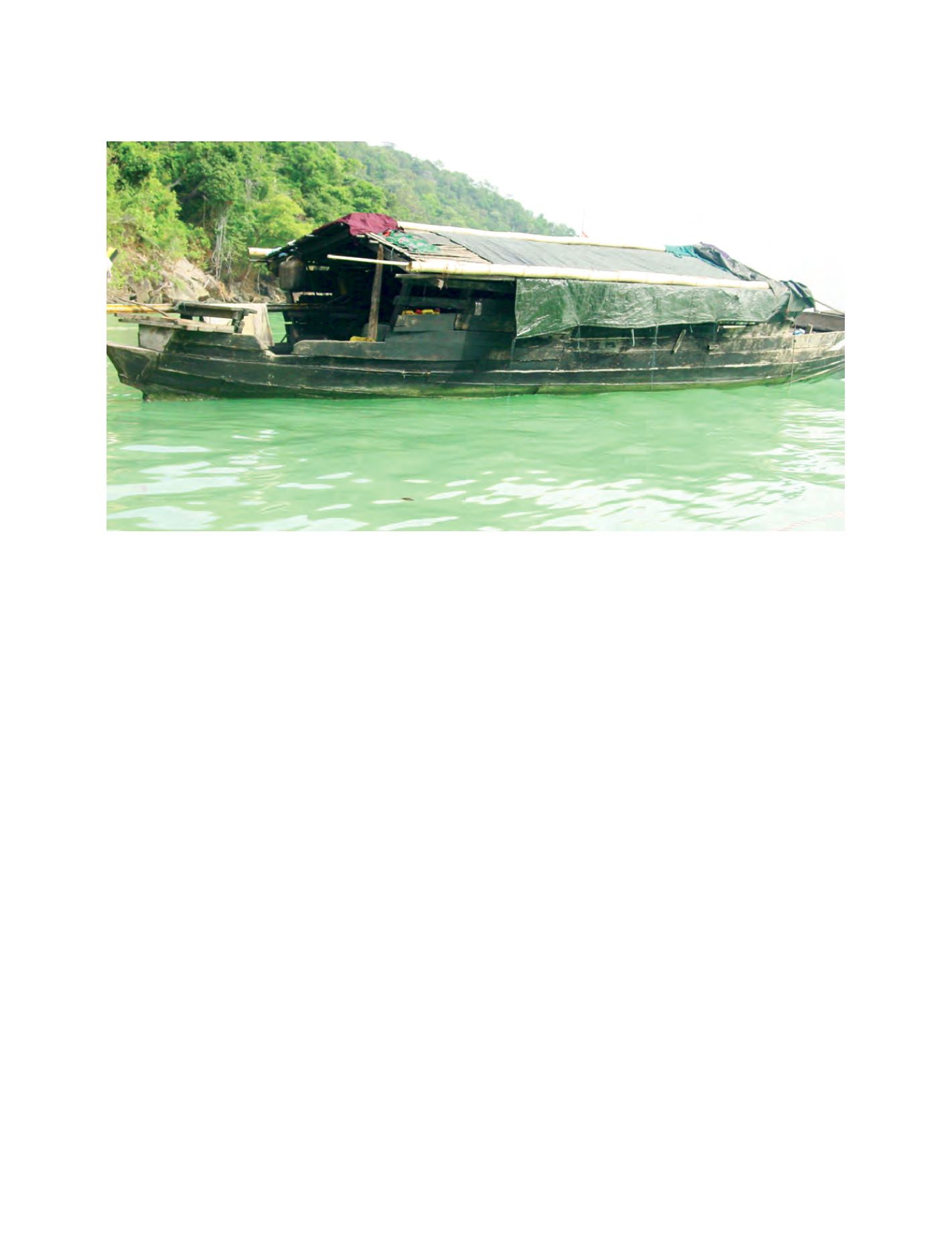
A Moken house boat from Myanmar at anchor in Ko Surin, Thailand
Image: Derek Elias, January 2005, Ko Surin, Thailand