



 77 / 196

[
] 75
that community-based organizations normally exhibit a
‘life cycle’ – arising in response to a particular problem or
interest and fading into inactivity once the problem is
solved or, as often happens, no solution is found. Third,
the stereotype that community-based initiatives are only
locally effective and lacking wider impact must be over-
come.
Systematic capacity-building
– Capacity, as noted, is
the inverse of vulnerability, and in this sense, capacity
building is the central task of an NDV programme.
Capacity building is understood here as processes
whereby individuals and organizations acquire the
ability to perform certain functions, solve problems, and
set and achieve objectives. Training is evidently an
important component of the process. However, beyond
the transfer of information and skills, capacity building
implies the creation of a fertile environment within
which the ‘seeds’ of training can grow and become effec-
tive. Organizational development and the provision of
appropriate instruments are essential aspects of the
process.
The main challenge of an NDV programme is to
mount a capacity building programme that is feasible in
terms of the required time and resources, while being
effective in its long-term impact on disaster manage-
ment capacity.
Bottom-up organizational development
– The NDV
programme aims to establish a network of neighbour-
hood-based volunteer groups throughout the area of a
prevailing hazard. The effort would not be justifiable or
sustainable for a few groups in a limited area.
Furthermore, the existence of a large number of local
groups creates a potential for exchange, cooperation and
joint activities which contributes simultaneously to the
strength of each member group.
However, an extensive network requires an appropri-
ate organizational structure. The challenge, in this
regard, is to establish an appropriate organizational hier-
archy which respects and reinforces the local ‘ownership’
Principles and challenges of the NDV approach
The NDV approach is based on several working principles, in partic-
ular: volunteerism; neighbourhood-based organization; systematic
capacity building; bottom-up organizational development; and part-
nership between government and civil society. Each presents specific
challenges, which need to be addressed to establish an effective and
sustainable network of disaster volunteers.
Volunteerism
– An NDV network depends upon volunteerism: the
willingness of people to contribute their time, energy and resources
to training, organizational activities and community service. This
willingness is motivated, mainly, by people’s concern to protect them-
selves, their family and their neighbours from the impact of a natural
hazard. Other private and/or social interests may also be involved, of
course, but the basic motivation stems from people’s conviction that,
by joining together with their neighbours and acquiring appropri-
ate skills, they can do something to reduce disaster risks.
Neighbourhood-based organization
– The essential unit of the NDV
network is the neighbourhood-based group, whereby ‘neighbour-
hood’ refers to a specific portion of a city, town or village with a
recognized administrative and social identity. In general, it is an entity
with which the residents readily identify. The basic reason for orga-
nizing NDV into neighbourhood-based groups relates to their greater
effectiveness in disaster response, preparedness and recovery as
compared with individual volunteer systems. Furthermore, neigh-
bourhood-based organizations have distinct advantages regarding
the recruitment of volunteers. As demonstrated by the Turkish NDV
experience, the best way to mobilize new volunteers is through direct
contacts with local leaders and their networks. Most volunteers
confirm that their initial interest was awakened by participating
friends or neighbours. Finally, the shared perspective of neighbours
facilitates the evolution of NDV groups into broadly based and
sustainable civil society organizations.
At the same time, implementation of the neighbourhood-based
approach poses three important challenges. First, the approach must
generate effective disaster response capacity in different neighbour-
hoods with a wide variety of physical characteristics, socioeconomic
conditions, education levels, and past disaster experiences. Second,
the groups need to be self-sustaining over a long period with a minimal
amount of external support. This is not self-evident in view of the fact
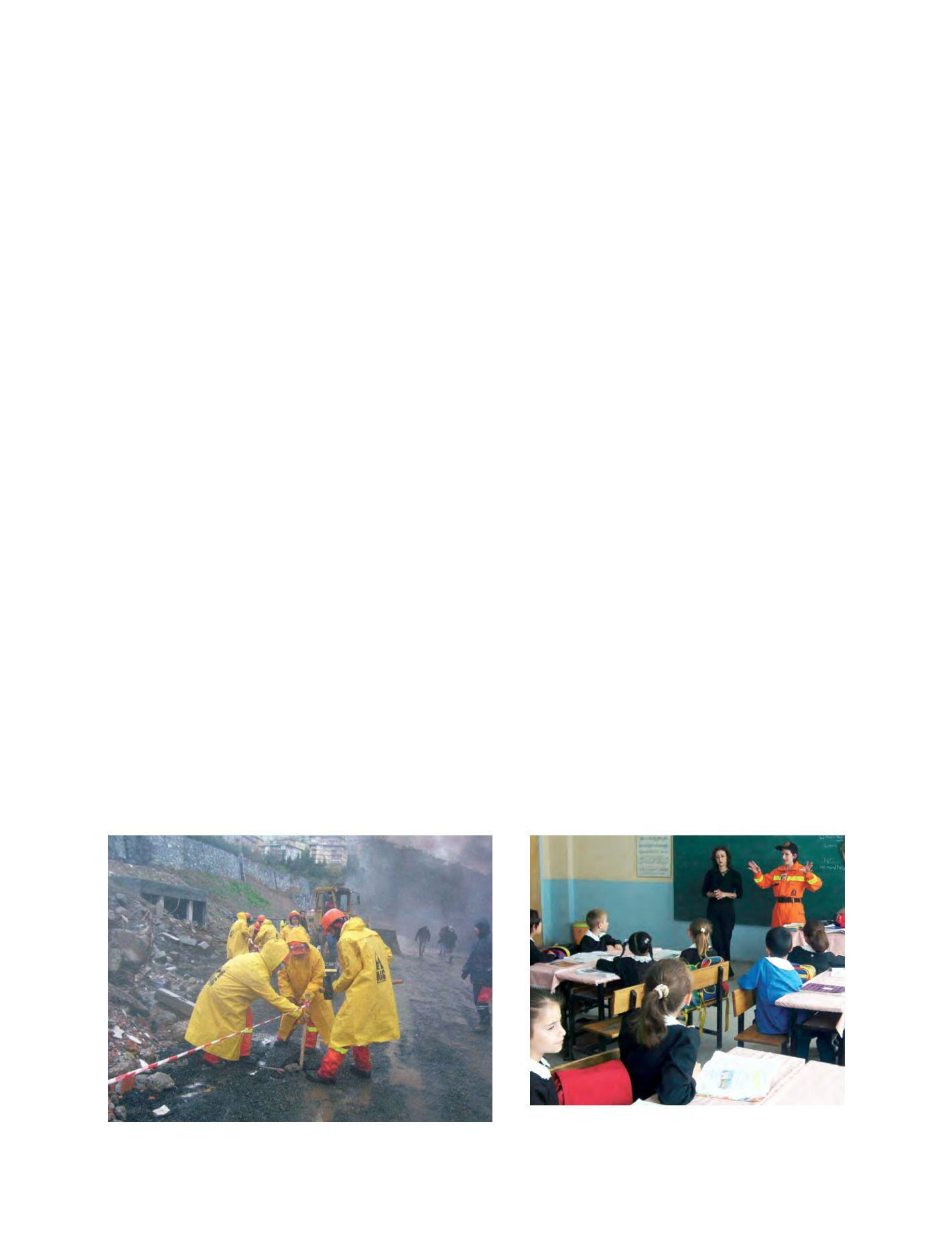
A Neighbourhood Disaster Volunteer helps raise awareness and
preparedness through a school programme
Image: Neighbourhood Disaster Volunteer Foundation MAG
Local residents play a crucial role in the first 72 hours after an earthquake
Image: Neighbourhood Disaster Volunteer Foundation MAG