



 78 / 196

[
] 76
and relative independence of the member groups while bundling
their strength to accomplish essential support and expansion func-
tions.
Partnership between civil society and government
– Although it is a
relatively independent civil society organization, the NDV network
depends for its practical effectiveness and legitimacy on linkage to
the official disaster management system. The approach thus aims to
build a strong working partnership between the NDV network, local
authorities and the official disaster management agencies.
The main challenge regarding civil society-government partner-
ship is to ensure that disaster authorities achieve adequate control of
the volunteers’ disaster related procedures and performance stan-
dards, and operational authority over the volunteers during disaster
response, while, at the same time, respecting the independence and
self-management needs of the NDV network.
The NDV approach to this challenge is based on well-defined train-
ing standards and regulations and a system of bylaws and agreements
defining each level of the organizational structure. The central orga-
nization – which includes official participation – remains the final
guarantor of the NDV principles and quality standards, ensuring
their compatibility with official requirements.
How effective is the NDV approach?
Origins and development
– The NDV programme began in late 2000
as a pilot project in two neighbourhoods of Kocaeli, Turkey. The
initial focus was on the elaboration and testing of a training
programme for disaster volunteers. In the following two years the
NDV model was progressively developed, tested, improved and stan-
dardized as the programme expanded. The model defines four main
stages of the NDV implementation process:
Mobilization
– Neighbourhood selection and volunteer recruit-
ment. The main activities are: establishing cooperation with officials,
selection of the neighbourhoods and potential volunteers. Men and
women between the ages of 18 and 55 who are residents of the neigh-
bourhood and intending to remain so for some time can take part in
the next stage. Women are particulary welcome to participate.
Basic training
– Activities include setting up training facilities and
equipment, organization of trainers and conducting training sessions.
The Standard Basic Training Program is 36 hours and comprises
disaster awareness, disaster psychology, basic fire fight-
ing, basic first aid, basic search and rescue, with many
practical exercises as well as theory.
Organization and equipment
– Formation of neigh-
bourhood groups and their local committees;
distribution and management of equipment and facili-
ties; internal communication procedures; official
recognition and operational linkage to the civil defence
system. After the basic training and formation of the
teams, neighbourhoods receive both personal and team
equipment which will help them to apply the first
response. The equipment is meticulously maintained by
the volunteers according to a carefully prepared peri-
odic maintenance programme.
Follow-up support
– Ongoing support activities
include: conducting refresher, replacement and
advanced training; social events, drills and exercises,
maintaining equipment, organizing community activi-
ties, disaster awareness training and other events to keep
motivation high and build team spirit. All these activi-
ties are conducted in close cooperation and coordination
with local officials and other volunteer organizations.
NDV has evolved into an extensive taskforce for disas-
ter preparedness and response numbering 68
neighbourhood groups and over 3,000 active volunteers,
with standardized training, locally maintained equip-
ment, clear organization and close working relationships
with the official emergency response centres in three
provinces: Kocaeli, Yalova and Istanbul, in the Marmara
region. The network is presently growing at the rate of
over 500 volunteers per year and expanding to other
regions in Turkey.
Organizational structure
The NDV network is structured at three organizational
levels: neighbourhood, provincial and central.
At the neighbourhood level, each group of 35-50
volunteers is headed by a Neighbourhood Disaster
Committee (NDC), consisting of the official neigh-
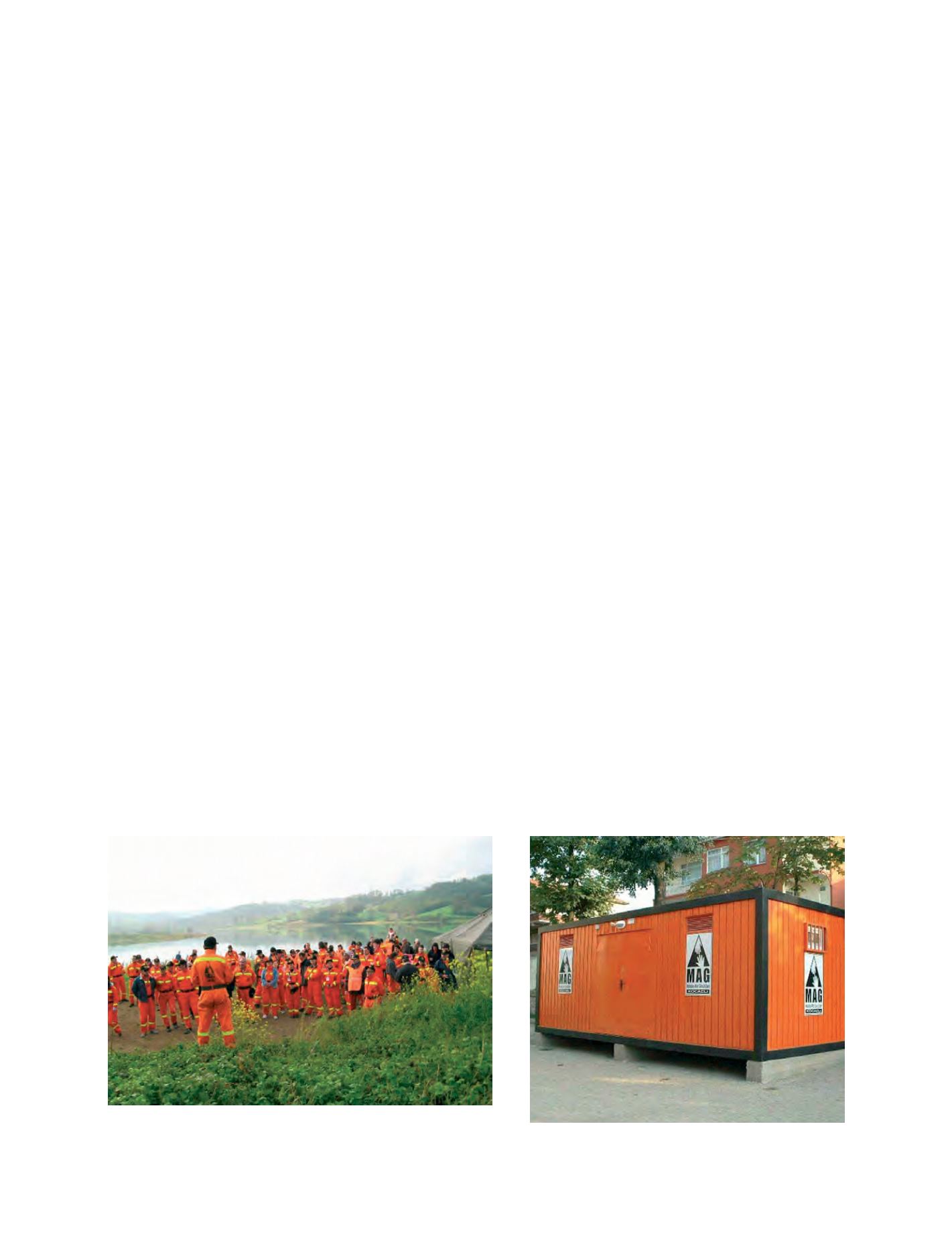
A Neighbourhood Disaster Volunteer response centre
Image: Neighbourhood Disaster Volunteer Foundation MAG
Neighbourhood Disaster Volunteers receive basic training, including setting up
training facilities and equipment
Image: Neighbourhood Disaster Volunteer Foundation MAG