


 71 / 196

[
] 69
• Disaster mitigation and preparedness must form
part of the wider context of disaster risk reduction
– relevant to all those working in hazardous
regions, whether in relief, development, business,
civil society or government
• Long-term partnerships based on good governance
across many sectors and disciplines provide the best
basis for tackling the threats posed by disasters
• Setting targets for risk reduction could provide a
way to focus political will and adequate resources
on the problem.
The proof of the pudding
There is no better way of demonstrating the impor-
tance of these policy and strategy statements than to
look at the work of the National Red Cross and Red
Crescent Societies on the ground. It is highly likely that
in the global family that makes up the membership of
the International Federation, there is activity being
undertaken that relates to all five priorities of the
Hyogo Framework for Action. Many of the member
societies function in countries that have established
Millennium Development Goals and are implementing
substantial poverty reduction strategies. Success in
Federation of the Future
sets out the International Federation’s Global
Agenda. Among the four goals it identifies are Goal 1: ‘Reduce the
number of deaths, injuries and impact from disasters’ and Goal 3:
‘Increase local community, civil society and Red Cross Red Crescent
capacity to address the most urgent situations of vulnerability’. The
priorities identified to meet the goals include ‘Scaling up our actions
with vulnerable communities in health promotion, disease preven-
tion and disaster risk reduction’.
At the 28th International Conference of the Red Cross and Red
Crescent held in December 2003, the theme was ‘Protecting Human
Dignity’. Among the resolutions adopted by the conference was the
‘Agenda for Humanitarian Action’, one of the final goals of which
acknowledged ‘the importance of disaster risk reduction’ and agreed
to ‘undertake measures to minimize the impact of disasters on vulner-
able populations’. The last International Conference held in November
2007 reinforced this need, associating disaster risk reduction very
closely with meeting the requirements of climate change adaptation.
The support for disaster risk reduction has been echoed through
the goals of regional conferences, while more than 160 of the
International Federation’s 186 members have identified disaster risk
reduction activities in their plans and budgets for 2008/9. In 2002,
the International Federation even devoted one entire edition of its
annual flagship publication
World Disasters Report
to disaster risk
reduction, concluding that:
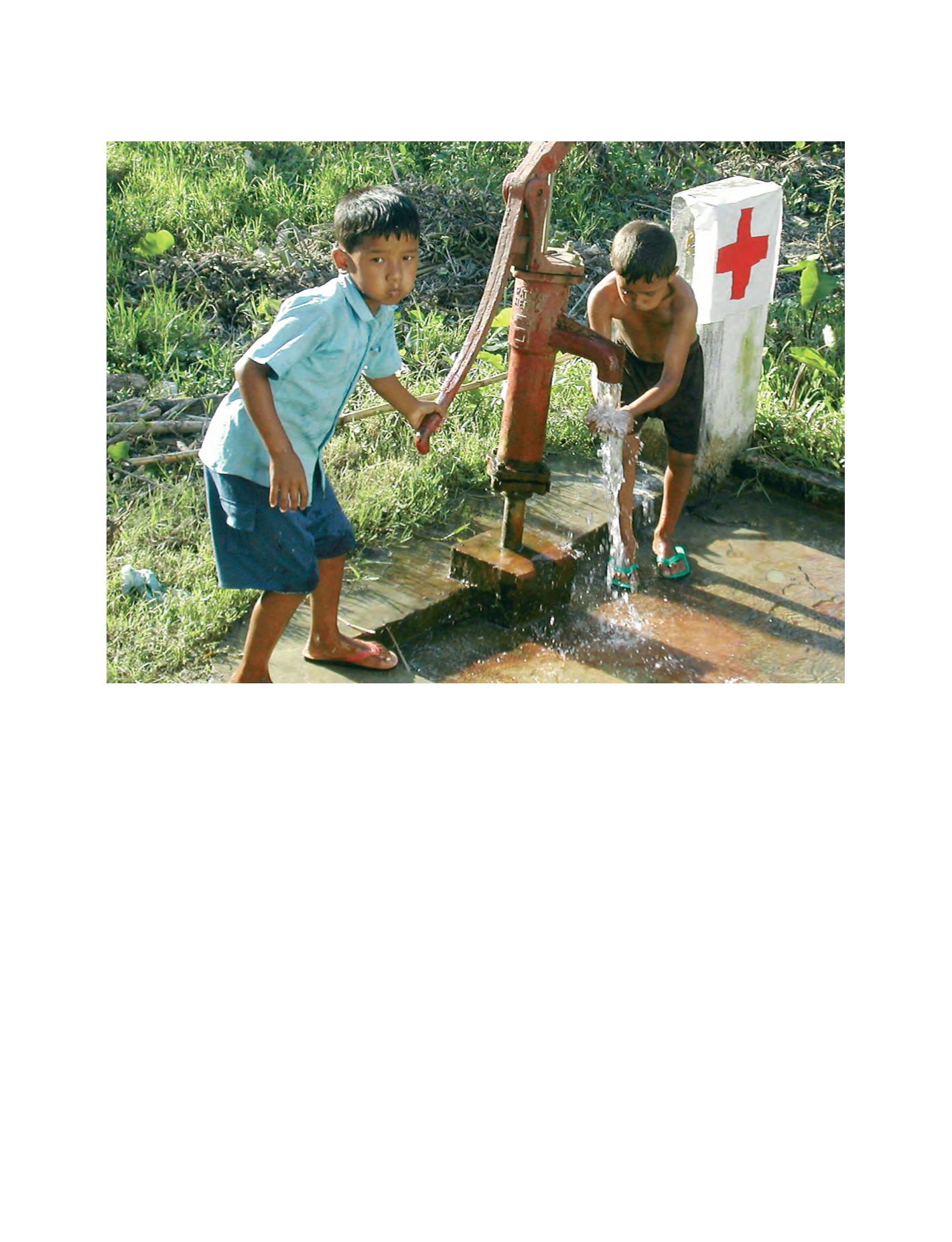
Children at a tube well constructed by the Nepal Red Cross Society
Image: © Nepal Red Cross Society