


 63 / 196

[
] 61
Lessons learned
Following the floods of 2006, SEEDS intervened by restoring the shel-
ters of the affected community. The challenge was deciding whether
to go for an adaptation of their traditional shelter practices (which has
limitations), or to apply contemporary approaches (which provided
many external benefits, but allowed stresses to build up). SEEDS chose
the former and the results have been very well received.
The results have revealed that:
• Communities have inherent resilience developed through
adaptation to natural environments
• This resilience is put to the test in their day-to-day activities,
and practices that promote resilience are often understood in
their cultural and spiritual context
• The capacity of communities to absorb sudden catastrophic
disasters is dependent on the level of their resilience to
small-scale, recurrent disasters
• Failure of communities to correctly understand and respond to
gradual stress build-up in their natural environments increases
their vulnerability
• External post-disaster interventions that fail to recognize and
strengthen the propensity to absorb small-scale disasters create
new levels of vulnerability
• Post-disaster external interventions that seek to strengthen existing
coping practices promote resilience
• Current interventions and related research activities
to find ways to promote resilience by examining
communities’ coping practices are inadequate
• Coping practices do not become integrated by
external intervention. Rather, problems are imposed
on communities from outside
• A form of education is needed that restores communi-
ties’ traditional bonds with their natural
environments. This would imply revisiting traditional
knowledge on coping practices and finding ways in
which they can be applied in current scenarios
• The model of resilience in vulnerable communities
needs to put education and awareness of commu-
nity knowledge and practice ahead of any other.
Allow small shocks, prevent stress build-up, build
resilience
The emerging model approach may be summarized as
follows:
We should recognize communities’ coping practices.
In a sense, allow small shocks to take place that can help
build their capacity.
New solutions should strengthen resilience, through
research and development. These solutions, if aimed at
long-term development, would prevent stress build up
and allow communities to be able to rely on their locally
available resources for lowering their risks.
We should promote education that allows communi-
ties to mirror their own past, their interconnectedness to
all things living and not living, discovering their own
infinite potential and thus enable them to practice
measures, strengthened through external intervention,
which will promote their own resilience.
The alternative approach to CBDM practice proposed
herein needs further debate and testing. Its true value
would lie in its efficacy in varying social and natural
environments.
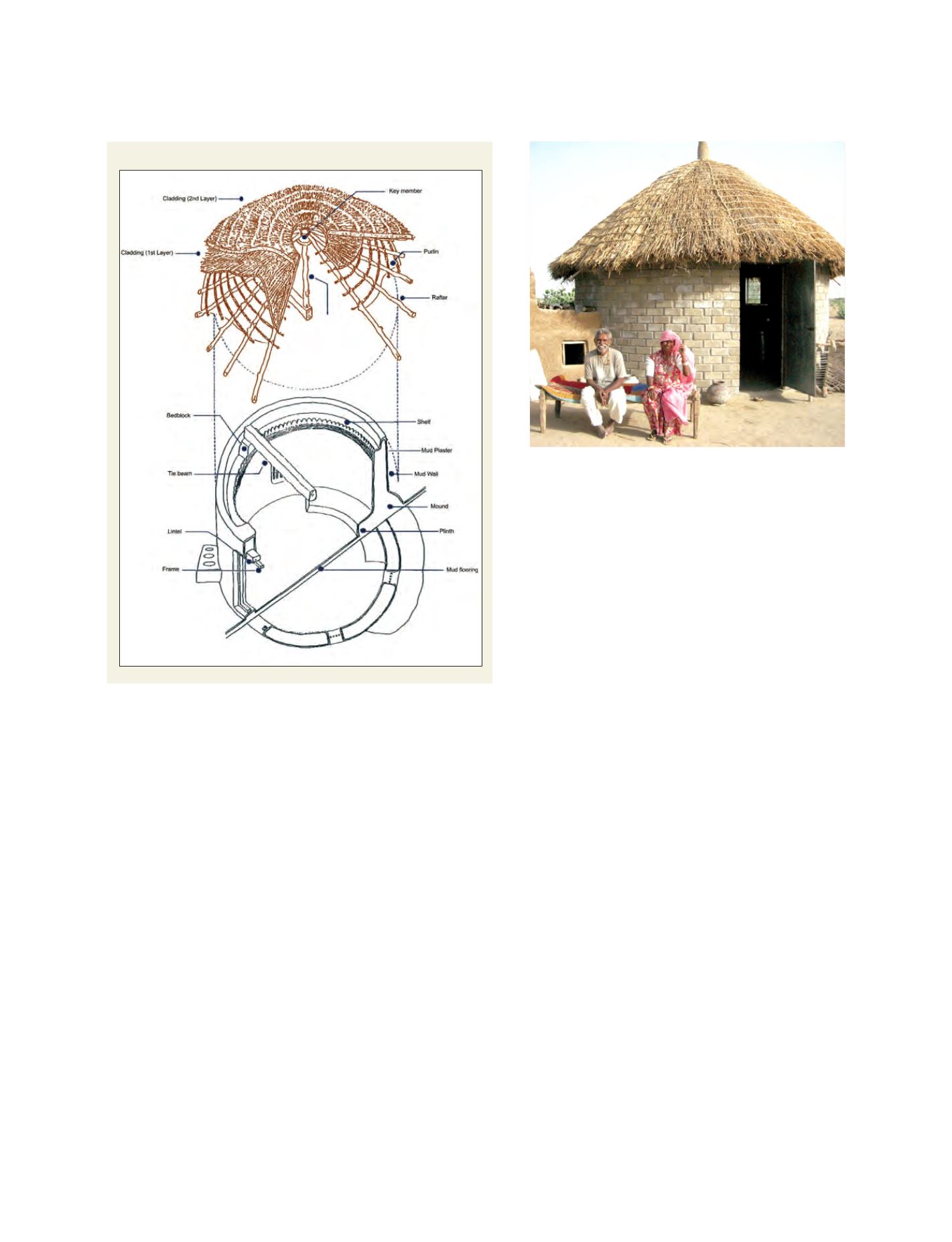
The design of an emergency shelter
Source: Safer World Communications
New houses were built on a similar model to traditional Dhanis,
and made of earthen blocks
Image: SEEDS