


 61 / 196

[
] 59
minimum of nine degrees centigrade in the chill of
winter. The 2006 floods in the region were an unprece-
dented phenomenon, putting the community’s own
knowledge and traditional practices to the test. In one
day alone, the district received 577mm of rainfall,
300mm more than the annual average rainfall of
277mm.
Shocks and stresses in Barmer
– The region is marked
by dire poverty. Arid land with extremes of temperature
does not provide the right ingredients for a good agri-
cultural yield.
Under the unfriendly and unfavourable conditions,
life is a struggle. Though the land is unyielding, agri-
culture is the mainstay of the district and the state. Close
to 80 per cent of the workforce depends on the land for
income and livelihood. Following close on the heels of
agriculture is animal husbandry. Incomes from livestock
account for up to 50 per cent of a rural household’s
revenue. In the aftermath of the 2006 floods, it would
seem that the people lost more than they possessed.
Over 800,000 of Barmer’s population of two million
were affected by the floods with hundreds of people still
missing. It was officially reported that 103 people died,
while 95 per cent of the villagers were made homeless
and had to move to higher ground with no clothes, food,
utensils or bedding. Forty seven thousand cattle died in
the floods and 5,200 houses were damaged. Houses in
the affected villages of Barmer district were primarily
made of a mixture of soil, cow dung and some wooden
constituents that are locally available in the area. These
are circular structures called ‘Dhanis’. The damage in
these villages was widespread as most of the houses
made up of such material were washed away.
In Bandhada village, the local people had not experi-
enced such rain in their lifetime. There were 85 such
damaged houses in Bandhada village, which has a popu-
lation of about 1,200. Apart from ‘kuccha’ houses, the
school building was also damaged due to incessant rain.
Even 15 days after the flood, the water did not recede in
some areas, as the soil strata are made up of gypsum and
bentonite. Thus, seepage of water was much reduced.
Furthermore, as there are no natural drainage channels
like rivers or ‘Nala’ in this area, water was present in
many places. Evaporation is the only natural way by
which this level of water can be reduced.
Shelter recovery programme
– The shelter recovery
programme was taken up by the Sustainable Environment
and Ecological Development Society (SEEDS) India with
support from Christian Aid, a UK-based charity, and the
European Commission’s Humanitarian Office. As part of
the programme, 300 houses were reconstructed within
eight months of the disaster.
Three hundred beneficiaries were chosen from over
400 potential recipients across a group of 24 villages,
which was then downsized to 15 villages. The main
targets were families that were socially marginalized and
ostracized, persons who were physically handicapped
and/or remotely located. Community participation was
at the core of the shelter recovery programme. Villages
able to absorb stresses at a smaller scale or in recurrent forms, they
may not be in a position to absorb larger shocks. Here lies a paradox.
While communities are able to deal with stresses, they cannot deal
with sudden large shocks. At the same time, if they are not allowed
to deal with small-scale or recurrent stresses, their vulnerability to
large shocks increases. In spite of experiences proving so, CBDM
strategies continue to increase/make no difference to vulnerability
rather than increase resilience.
The community’s own capacity being central to building resilience,
the critical challenges are:
• How to recognize and build upon traditional knowledge?
• How can communities overcome their helplessness to face
sudden catastrophic disasters?
• How can communities build resilience incorporating the needs
of both present and future generations?
• What is the role of external agencies in helping communities
become resilient?
An analysis of ongoing approaches for disaster reduction either as
part of development programming or as disaster response, presents
the following conclusions:
• The key to successful CBDM is strengthening resilience by way
of recognizing and strengthening communities’ traditional
coping mechanisms, rooted in their culture and environments
• The role of external agencies is to create enabling environments
that strengthen communities’ understanding and application of
their natural environments and find technological solutions that
help remove impedance to understanding and application.
Recognizing communities’ traditional coping capacities
The most recent experience for the author was a post-flood shelter
recovery programme in Rajasthan State, located in western India.
The community in the Barmer District of Rajasthan experienced
unprecedented floods in 2006. These people reside in an arid area of
the continent. Almost entirely a desert district, Barmer is one of the
sparsest regions of the country with regard to density of population.
It has only 853 inhabited villages with barely 70 people spread over
every square kilometre.
2
People in Barmer face sweltering heat of up
to 45 degrees centigrade in the height of summer, dropping to a
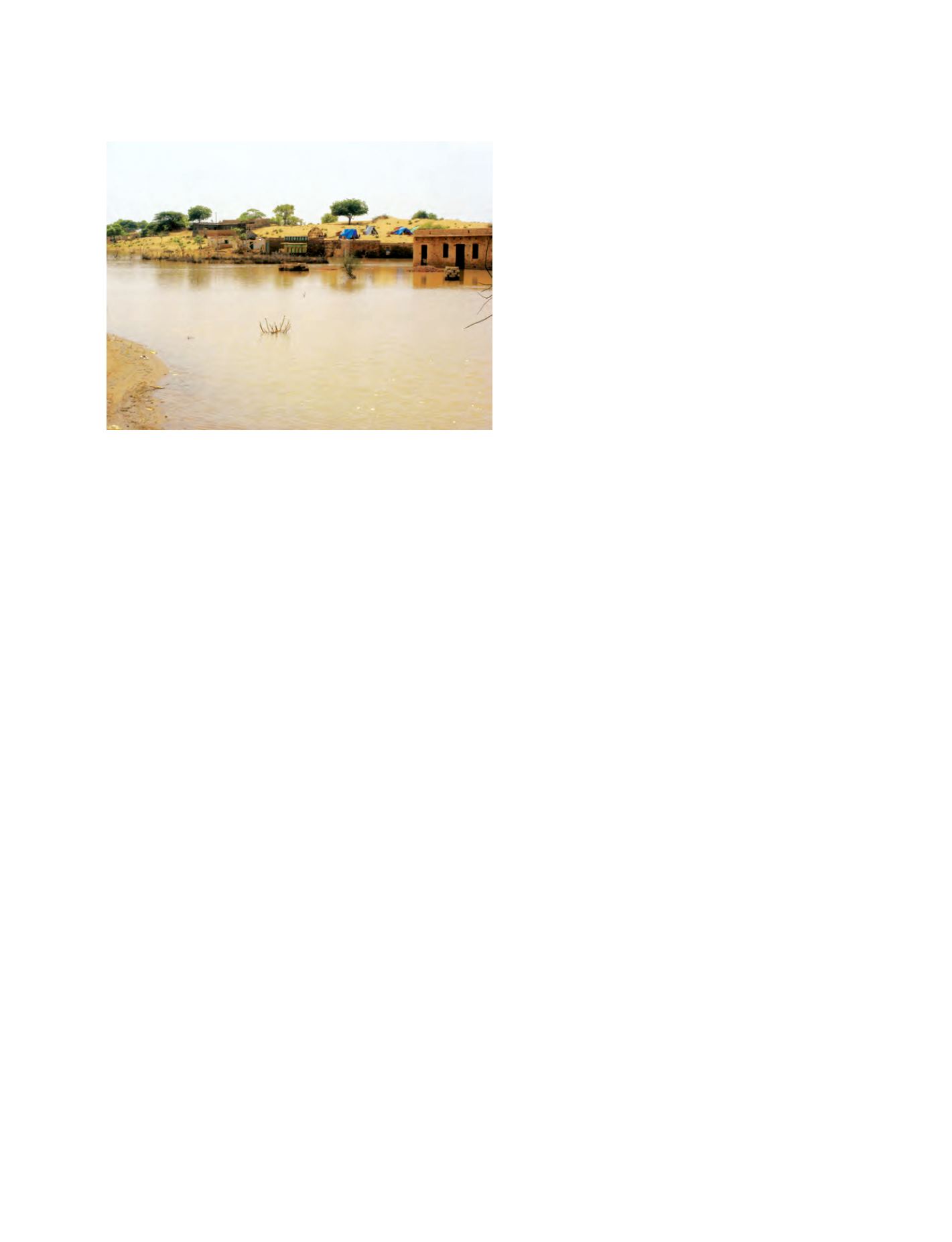
Over 800,000 of Barmer’s population were affected by the floods
Image: SEEDS